
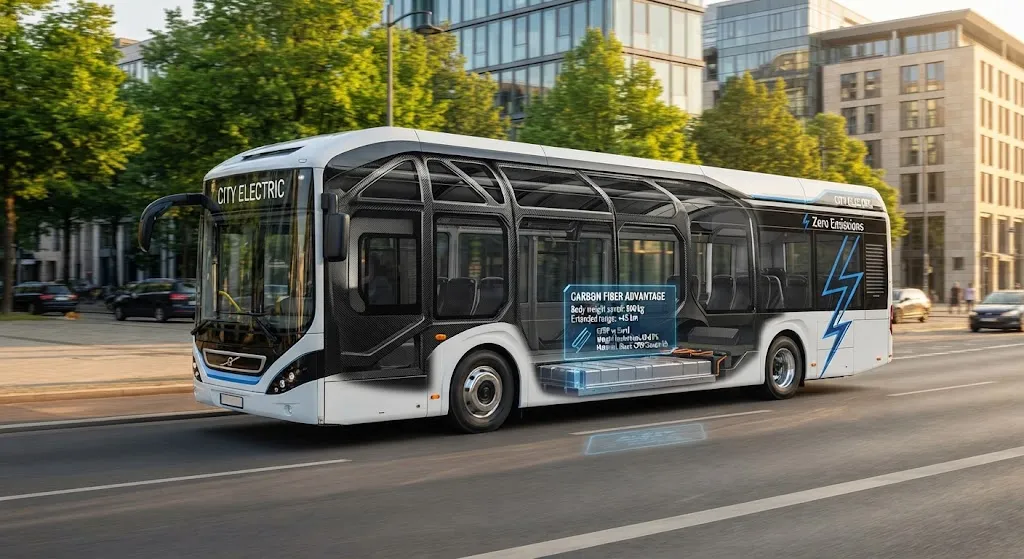
Electric bus manufacturers are adopting carbon fiber composite bodywork to reduce vehicle weight and extend driving range. This article examines CFRP structural panels, design approaches, and fleet economics for urban electric bus applications.
Introduction
The electric bus market is growing rapidly as cities worldwide transition to zero-emission public transportation. However, electric buses face a fundamental challenge: battery weight significantly reduces payload capacity and driving range compared to diesel equivalents. Carbon fiber composite bodywork offers a solution by reducing structural weight by 30-50% compared to steel or aluminum, directly translating to extended range or increased battery/payload capacity.
A typical 12-meter electric bus weighs 12,000-16,000 kg, with batteries accounting for 3,000-5,000 kg. CFRP bodywork can reduce the structural body weight by 500-1,000 kg, enabling either extended driving range (additional 30-60 km) or increased passenger capacity. This weight reduction is particularly valuable for urban buses that operate on fixed routes with limited charging opportunities.
Structural Applications
CFRP components in electric bus bodywork include:
Side wall panels: CFRP sandwich panels with foam or honeycomb cores replace steel or aluminum side walls, providing structural integrity while reducing weight by 40-60%. These panels incorporate window openings, door frames, and mounting points for interior fixtures.
Roof structures: CFRP roof panels reduce top-heavy weight distribution, improving vehicle stability and handling. Roof-mounted equipment — air conditioning, pantographs for overhead charging — benefits from the high strength-to-weight ratio of CFRP mounting structures.
Rear and front panels: CFRP rear and front panels provide impact resistance and design flexibility for bus styling. These panels integrate lighting, ventilation, and structural connections to the chassis frame.
Floor structures: CFRP floor panels with anti-slip surfaces and integrated structural reinforcements reduce weight while providing the stiffness needed for passenger loading and unloading.
Design Approaches
Electric bus CFRP bodywork uses several design approaches:
Sandwich construction: CFRP face sheets bonded to lightweight core materials (PMI foam, aluminum honeycomb) provide high stiffness-to-weight ratio for panel applications. This approach is standard for side walls, roof, and floor panels.
Pultruded profiles: Pultruded CFRP structural profiles — I-beams, channels, tubes — provide framing and structural support elements. Pultrusion offers cost-effective production of constant-cross-section structural members.
Hybrid construction: Combining CFRP with aluminum or steel in high-stress areas optimizes cost and performance. CFRP panels with metallic edge reinforcements and connection details balance weight savings with manufacturing practicality.
Fleet Economics
The economics of CFRP electric bus bodywork depend on fleet size and operating conditions:
Weight reduction value: At $10-15 per kg of weight saved (based on battery cost and range extension), CFRP bodywork savings of 500-1,000 kg represent $5,000-$15,000 in battery cost offset or range extension value per bus.
Production volume: CFRP bodywork costs decrease significantly at production volumes above 100-200 buses per year, where automated manufacturing processes become economic.
Operating savings: Reduced energy consumption from lower vehicle weight translates to lower electricity costs over the bus lifetime, typically $1,000-$3,000 per year depending on operating conditions.
Conclusion
Carbon fiber composite bodywork offers significant weight reduction benefits for electric buses, directly translating to extended range, increased payload capacity, or reduced battery requirements. As electric bus production scales up and CFRP manufacturing costs decrease, composite bodywork will become increasingly competitive for urban transit applications.
Related Articles
- Carbon Fiber Mooring for Floating Offshore Wind: Fatigue and Corrosion in Deep Water
- Carbon Fiber Bicycle Frame Optimization: Layup Design and Manufacturing for Competitive Racing
- Carbon Fiber CFRP Retrofit for Infrastructure: Bridge and Building Seismic Strengthening
- Carbon Fiber Medical Imaging Equipment: Lightweight Gantry and Couch Structures for MRI/CT
- Carbon Fiber EV Battery Enclosures: Crash Safety and Electromagnetic Shielding Design
- Carbon Fiber Structures for Low-Altitude Economy: UAV Airframes and eVTOL Components
Interested in Our Products?
Contact our team for competitive pricing and technical specifications.
Get a QuoteRelated Products

Carbon Fiber Plate — 3K Twill T700 1.5mm
Thin 1.5mm carbon fiber plate with 3K twill weave surface. Lightweight and stiff, commonly used for covers, panels, drone bodies, and applications requiring a premium aesthetic appearance.

Carbon Fiber Plate — 3K Twill T700 3.0mm
Medium-thickness 3.0mm carbon fiber plate offering significantly higher load capacity while maintaining attractive 3K twill finish. Suitable for structural brackets, reinforcement plates, and load-bearing panels.

Square Carbon Fiber Tube — 3K Twill T700
Square cross-section carbon fiber tube manufactured with 3K twill weave for torsional strength. Preferred for structural frames, trusses, and support columns where rectangular geometry offers design flexibility.
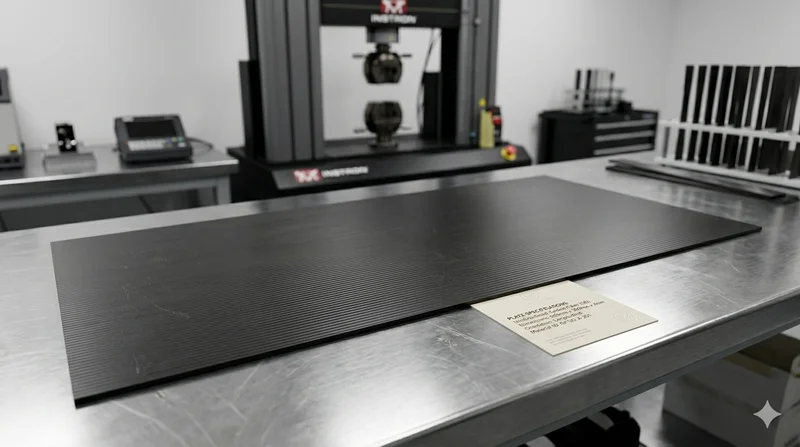
Carbon Fiber Plate — UD Unidirectional T700
Unidirectional carbon fiber plate with all fibers oriented in a single direction for maximum strength along the fiber axis. Essential for structural reinforcements, splints, and applications where load direction is predictable.
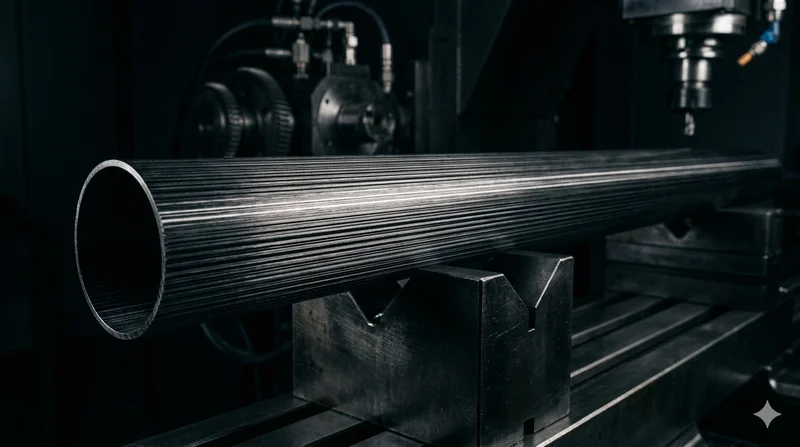
Round Carbon Fiber Tube — UD Unidirectional T700
Unidirectional (UD) round tube with all fibers aligned axially for maximum longitudinal stiffness. Ideal for applications requiring high bending rigidity with minimal weight, such as shafts, struts, and structural reinforcements.