
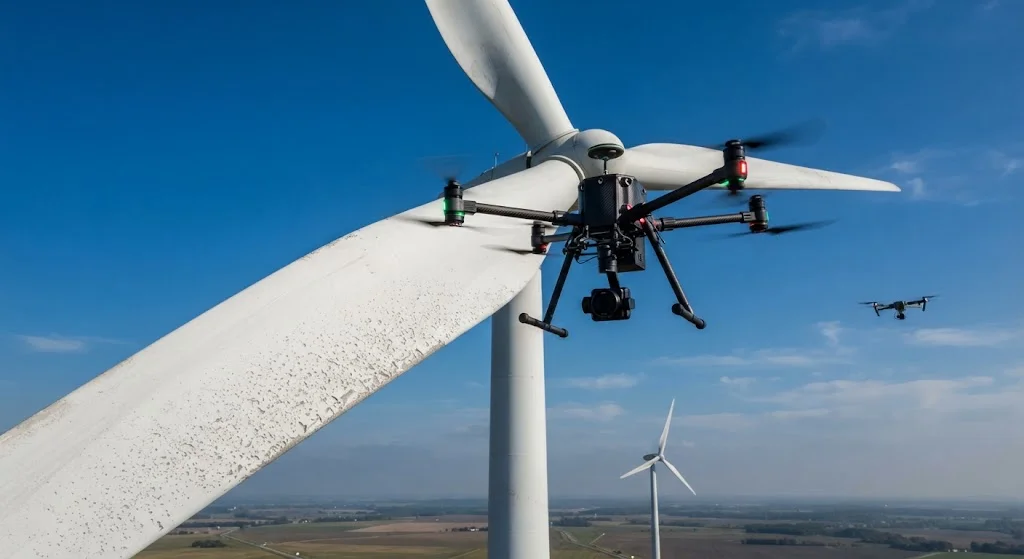
Carbon fiber drones are transforming wind turbine blade inspection, offering faster, safer, and more detailed condition assessment than rope-access methods. This article examines drone technology, data processing, and the business case for inspection services.
Introduction
Wind turbine blade inspection has traditionally relied on rope-access technicians who visually inspect blades and document damage with handheld cameras. This approach is slow (4-8 hours per turbine), dangerous (working at heights of 80-150 meters), and limited in the detail it can capture. Carbon fiber drones are revolutionizing this process by enabling faster, safer, and more comprehensive blade inspections.
Carbon fiber drone frames provide the ideal combination of light weight and structural stiffness needed for precise aerial positioning near turbine blades. The high specific stiffness of carbon fiber enables stable flight characteristics even in the turbulent airflows around operating turbines, allowing detailed image capture from distances of 1-5 meters from blade surfaces.
Drone Platform Technology
Specialized inspection drones incorporate several key technologies:
Carbon fiber frame construction: Quadcopter and hexacopter frames constructed from carbon fiber tubes and plates provide the strength-to-weight ratio needed for extended flight times (30-45 minutes) while carrying high-resolution camera payloads of 2-5 kg.
Precision positioning: RTK-GPS and visual-inertial odometry systems enable centimeter-level positioning accuracy relative to the turbine structure. This precision is essential for systematic blade coverage and repeatable inspection routes.
Obstacle avoidance: Multi-directional sensing systems — radar, LiDAR, and ultrasonic — prevent collisions with turbine blades, towers, and other structures. These systems must operate reliably in the electromagnetic environment near operating turbines.
Wind resistance: High-thrust propulsion systems and advanced flight control algorithms enable stable operation in wind speeds up to 10-12 m/s, allowing inspections to proceed in conditions that would ground less capable platforms.
Data Capture and Processing
Modern blade inspection generates massive datasets that require sophisticated processing:
Image capture: High-resolution cameras (40-60 megapixels) capture blade surfaces at resolutions of 0.1-0.5 mm per pixel, enabling detection of defects as small as 0.5 mm. Thermal cameras detect subsurface damage and moisture ingress through differential thermal response.
Photogrammetric processing: Structure-from-motion algorithms reconstruct 3D models of blade surfaces from overlapping images, enabling precise measurement of erosion depth, crack length, and surface deformation.
AI-powered defect detection: Machine learning algorithms trained on thousands of labeled defect images automatically identify and classify damage types — leading edge erosion, surface cracks, delamination, lightning damage — with accuracy approaching that of experienced human inspectors.
Business Case
The economics of drone-based blade inspection strongly favor adoption over traditional methods:
Speed: A drone can inspect a single turbine in 30-60 minutes, compared to 4-8 hours for rope-access inspection. A two-person drone team can inspect 10-15 turbines per day, compared to 1-2 turbines for a rope-access team.
Safety: Drone inspection eliminates the fall risk associated with rope-access work at heights of 80-150 meters. This reduces insurance costs and regulatory burden while improving worker safety.
Data quality: High-resolution digital records provide permanent documentation of blade condition, enabling trend analysis and predictive maintenance. Rope-access inspections rely on subjective human judgment and limited photographic documentation.
Cost: At $500-$1,500 per turbine for drone inspection versus $2,000-$5,000 for rope-access inspection, the cost savings are significant, particularly for large wind farms with hundreds of turbines.
Regulatory Considerations
Drone blade inspection operations must comply with aviation regulations that vary by jurisdiction:
Beyond visual line of sight (BVLOS): Many jurisdictions now permit BVLOS operations for industrial inspection applications, enabling more efficient inspection of large wind farms without requiring visual observers for each turbine.
Airspace authorization: Operations near airports, military installations, and other controlled airspace require coordination with aviation authorities. Wind farm locations are often in areas with minimal airspace restrictions.
Conclusion
Carbon fiber drone technology is transforming wind turbine blade inspection from a slow, dangerous manual process to a fast, safe, and data-rich digital service. As the wind energy industry continues to grow, drone-based inspection services will become the standard for blade condition monitoring, enabling more effective maintenance planning and extending blade service life.
Part of topic
Related Articles
- Carbon Fiber Mooring for Floating Offshore Wind: Fatigue and Corrosion in Deep Water
- Carbon Fiber Bicycle Frame Optimization: Layup Design and Manufacturing for Competitive Racing
- Carbon Fiber CFRP Retrofit for Infrastructure: Bridge and Building Seismic Strengthening
- Carbon Fiber Medical Imaging Equipment: Lightweight Gantry and Couch Structures for MRI/CT
- Carbon Fiber EV Battery Enclosures: Crash Safety and Electromagnetic Shielding Design
- Carbon Fiber Structures for Low-Altitude Economy: UAV Airframes and eVTOL Components
Interested in Our Products?
Contact our team for competitive pricing and technical specifications.
Get a QuoteRelated Products

Carbon Fiber Plate — 3K Twill T700 3.0mm
Medium-thickness 3.0mm carbon fiber plate offering significantly higher load capacity while maintaining attractive 3K twill finish. Suitable for structural brackets, reinforcement plates, and load-bearing panels.

Carbon Fiber Plate — 3K Twill T700 1.5mm
Thin 1.5mm carbon fiber plate with 3K twill weave surface. Lightweight and stiff, commonly used for covers, panels, drone bodies, and applications requiring a premium aesthetic appearance.

Square Carbon Fiber Tube — 3K Twill T700
Square cross-section carbon fiber tube manufactured with 3K twill weave for torsional strength. Preferred for structural frames, trusses, and support columns where rectangular geometry offers design flexibility.
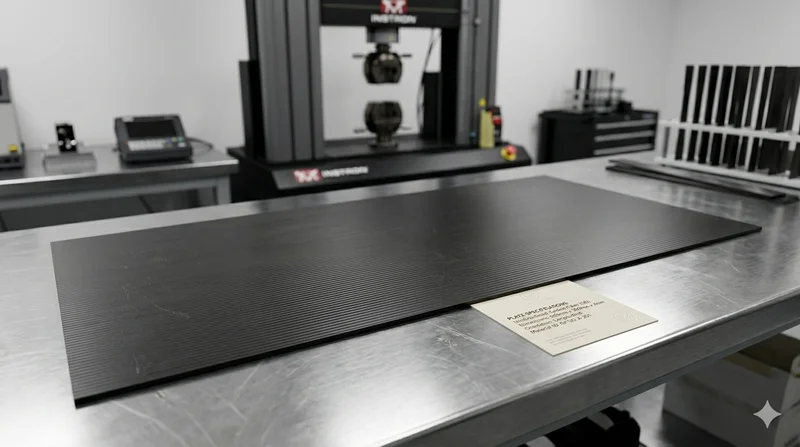
Carbon Fiber Plate — UD Unidirectional T700
Unidirectional carbon fiber plate with all fibers oriented in a single direction for maximum strength along the fiber axis. Essential for structural reinforcements, splints, and applications where load direction is predictable.
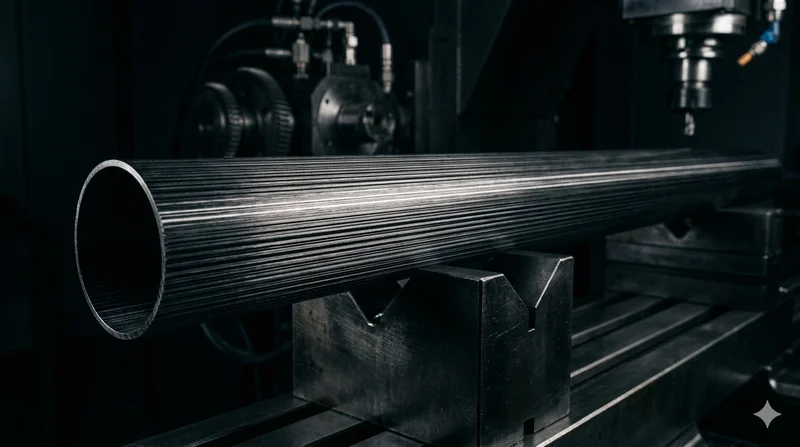
Round Carbon Fiber Tube — UD Unidirectional T700
Unidirectional (UD) round tube with all fibers aligned axially for maximum longitudinal stiffness. Ideal for applications requiring high bending rigidity with minimal weight, such as shafts, struts, and structural reinforcements.