
A crane boom is a paradox: the structure that lifts the load must also be lifted itself. Every tonne of boom dead weight consumes capacity that could otherwise carry paying cargo, and every meter of boom length amplifies the leverage that a tip weight exerts on the whole machine. This i
Introduction
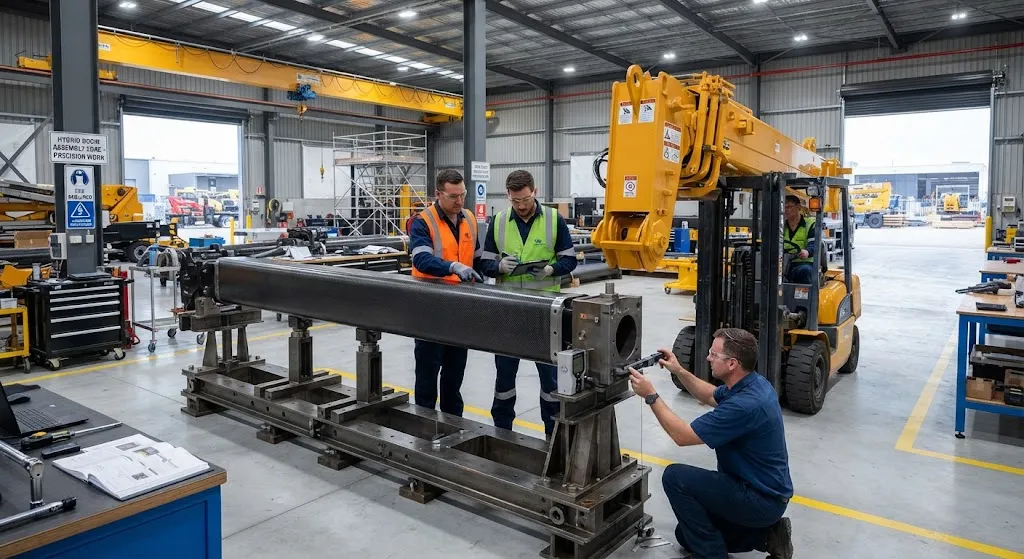
A crane boom is a paradox: the structure that lifts the load must also be lifted itself. Every tonne of boom dead weight consumes capacity that could otherwise carry paying cargo, and every meter of boom length amplifies the leverage that a tip weight exerts on the whole machine. This is why boom weight reduction is one of the highest-value exercises in construction equipment engineering, and why carbon fiber has moved from racing yachts and aircraft to the booms of mobile cranes, turntable ladders and aerial work platforms.
Three mechanisms reward a lighter boom. First, payload gain: with the same tipping moment, a lighter boom carries more net load. Second, deflection control: stiffer, lighter sections reduce tip sag at full extension, improving precision for placement work. Third, life extension: composites tolerate load cycling and local damage differently from welded steel, changing the fatigue and inspection equations that dominate crane operating costs. This article examines each mechanism and the engineering trade-offs that determine whether a carbon fiber boom makes economic sense.
The Weight-to-Payload Leverage
The economics of boom weight begin with a simple relationship: the overturning moment on a crane is the product of load and radius. A telescopic boom extended to maximum reach carries its own weight at the end of a long lever, so a kilogram of boom tip weight can consume several kilograms of payload capacity at the widest working radius. Conversely, the same kilogram removed at the tip can be converted into additional payload, longer reach, or both. The table below compares the material options for boom construction:
| Property | High-Strength Steel | Carbon Fiber Composite | Effect on Crane Performance |
|---|---|---|---|
| Density | 7.85 g/cm³ | 1.55-1.60 g/cm³ | Section mass reduced by 50% or more |
| Tensile strength | 690-960 MPa | 2,400-3,500 MPa (fiber) | Higher design stress in controlled layups |
| Specific stiffness | Baseline | 3-4x steel | Lower tip deflection at equal stiffness design |
| Fatigue endurance | Welding-class limited | Very high, high-cycle tolerant | Longer service intervals, lower inspection cost |
| Corrosion behavior | Requires protection | Inherently resistant | Reduced maintenance in outdoor service |
The practical consequence of the material comparison is a 40-60 percent reduction in the weight of the uppermost boom sections when steel is replaced by carbon fiber composite. Because the tip sections experience the largest flexural moment amplification, concentrating the weight saving there delivers the majority of the payload benefit. This is why most carbon fiber crane applications are hybrid: steel lower sections retain robustness and cost efficiency, while the top sections that dominate the leverage equation are built from composite.
Deflection Control and Precision at Height
Deflection, not strength, frequently governs the design of long booms. A boom that is strong enough to hold a load may still sag visibly at full extension, and sag translates directly into positioning error. For crane operators placing heavy components in tight spaces — precast panels, turbines, process equipment — tip position accuracy matters as much as capacity. Carbon fiber's specific stiffness, roughly three to four times that of steel, allows a boom of equal weight to be significantly stiffer, or a boom of equal stiffness to be significantly lighter.
Field experience with hybrid and full-composite booms shows tip deflection reductions in the range of 15-30 percent compared with steel designs of similar class. The benefits accumulate in real operations:
- Faster positioning: Less sag and overshoot means the operator spends fewer cycles fine-adjusting the load, shortening each lift and improving daily productivity.
- Higher usable reach: A lighter tip section allows an additional extension stage or a taller luffing geometry without exceeding the tipping-moment budget.
- Better dynamic behavior: Lower boom mass changes the natural frequencies of the system, reducing pendulation of the load and improving control feel for the operator.
These gains matter most in the applications that already pay the highest premiums for precision: city-center tower crane support, fire and rescue turntable ladders, and heavy-lift work where schedule delays are priced in penalties.
Fatigue Life and Actuarial Considerations
Crane fleets are costed actuarially. Ownership models, lease rates and residual values all depend on predicted service life, inspection intervals and major repair events, and welded steel booms have a well-understood — and limiting — fatigue envelope. The welded joints that connect boom sections are classified fatigue details: under cyclic loading, small geometric notches grow cracks over years of service, and classification societies and crane standards such as EN 13000 and ISO 4301 define the allowable stress ranges accordingly.
Carbon fiber composites change that equation. Unidirectional and fabric-reinforced laminates tolerate high-cycle loading with very flat S-N characteristics, and damage tends to grow slowly and visibly rather than catastrophically. For crane operators the consequences are favorable: longer intervals between major inspections, reduced crack-repair welding in the field, and more predictable life extension programs. Composite sections are also easier to repair locally — a damaged laminate region can be bonded or patched with structural adhesive, avoiding the hot work and distortion that come with welding on a boom in service. These actuarial advantages are a significant part of why fleet owners accept the higher first cost of composite booms.
Hybrid Design and Manufacturing Routes
Realistic carbon fiber crane booms are rarely all-composite. The dominant engineering pattern is a hybrid construction: steel lower and mid sections providing proven load transfer, durability and low cost, with composite top sections capturing the weight and stiffness benefits where the leverage is largest. The interface between steel and composite is the critical design problem. Bonded and adhesively bonded joints distribute load over large areas but require rigorous surface preparation and controlled cure; bolted hybrid joints allow disassembly but concentrate load at fastener holes. Thermal expansion mismatch between steel and carbon fiber must also be managed, typically through compliant adhesive layers and careful joint geometry.
Manufacturing routes for composite boom sections have matured around the industry's available processes. Pultrusion produces constant-cross-section profiles efficiently for the mid-sections of long booms. Resin transfer molding and vacuum infusion handle the tapered and node geometries at section ends. Tailored fiber placement, where fibers are aligned to local load paths rather than laid in a uniform pattern, delivers the highest performance per kilogram for the most demanding sections. Each route has its own cost profile, and the choice is driven by production volume, section length and the performance target of the specific crane model.
Cost and Adoption Considerations
The barrier to wider adoption of carbon fiber crane booms is first cost, and it remains substantial. Composite sections cost several times more than equivalent steel per kilogram, and the tooling investment for each new boom geometry is significant. The adoption decision therefore rests on a rate-of-return calculation specific to each fleet:
- Payload and revenue gains: In heavy-lift markets where lift rates are fixed by capacity class, a crane that carries more due to weight savings earns more per shift with no added fuel or crew cost.
- Fuel and transport savings: A lighter boom reduces axle loads, allowing the same crane to travel legally with more counterweight or under a lighter transport permit class.
- Service life agreements: Where operators sell machine-hours rather than machines, the composite boom's fatigue behavior supports longer, more predictable service contracts.
As carbon fiber pricing continues to fall and hybrid designs concentrate material only where it pays, the business case strengthens. For manufacturers, the competitive question is no longer whether carbon fiber booms work — demonstrators and production turntable ladders have proven that — but how quickly their next-generation models can capture the weight-to-payload leverage before competitors do.
Frequently Asked Questions
How much lighter is a carbon fiber crane boom than a steel boom?
Replacing steel with carbon fiber composite in the uppermost boom sections reduces their weight by 40-60 percent. Because tip sections dominate the tipping-moment equation, concentrating the weight saving there delivers most of the payload benefit, even in hybrid cranes that retain steel in the lower sections.
Does a carbon fiber boom increase a crane's payload capacity?
Yes. Every kilogram removed from the boom consumes less of the crane's tipping-moment budget, which converts into additional payload at radius or additional reach. A kilogram saved at the boom tip can add several kilograms of capacity at the widest working radius because of leverage amplification.
Why do carbon fiber booms reduce tip deflection?
Carbon fiber composites have a specific stiffness roughly three to four times that of steel, so a boom of equal weight is significantly stiffer. Reported tip deflection reductions are in the range of 15-30 percent versus steel designs of similar class, improving positioning accuracy for precision placement work.
How do carbon fiber booms affect service life and inspection?
Composite laminates tolerate high-cycle loading better than welded steel details and damage tends to grow slowly and visibly. This supports longer intervals between major inspections, fewer field repairs, and easier local bonded patch repairs compared with welding on steel booms, improving the actuarial economics of fleet ownership.
Conclusion
Carbon fiber crane booms convert engineering physics into commercial advantage. Weight savings at the tip multiply into payload and reach, specific stiffness shrinks deflection at height, and fatigue-tolerant composites change the service-life and inspection equations that rule fleet economics. Hybrid steel-composite designs concentrate the material where the leverage is largest, and manufacturing routes from pultrusion to tailored fiber placement are mature enough to produce them reliably. For fleets that price lifts by capacity class, the lighter boom is not a premium feature — it is the difference between carrying the load and carrying the boom.
YongXian supplies carbon fiber fabrics, prepregs and unidirectional tapes to construction equipment manufacturers building lightweight composite structures. Explore our carbon fiber material range or contact our engineering team to discuss boom section design and material selection.
Related Articles
- Carbon Fiber Mooring for Floating Offshore Wind: Fatigue and Corrosion in Deep Water
- Carbon Fiber Bicycle Frame Optimization: Layup Design and Manufacturing for Competitive Racing
- Carbon Fiber CFRP Retrofit for Infrastructure: Bridge and Building Seismic Strengthening
- Carbon Fiber Medical Imaging Equipment: Lightweight Gantry and Couch Structures for MRI/CT
- Carbon Fiber EV Battery Enclosures: Crash Safety and Electromagnetic Shielding Design
- Carbon Fiber Structures for Low-Altitude Economy: UAV Airframes and eVTOL Components
Interested in Our Products?
Contact our team for competitive pricing and technical specifications.
Get a QuoteRelated Products
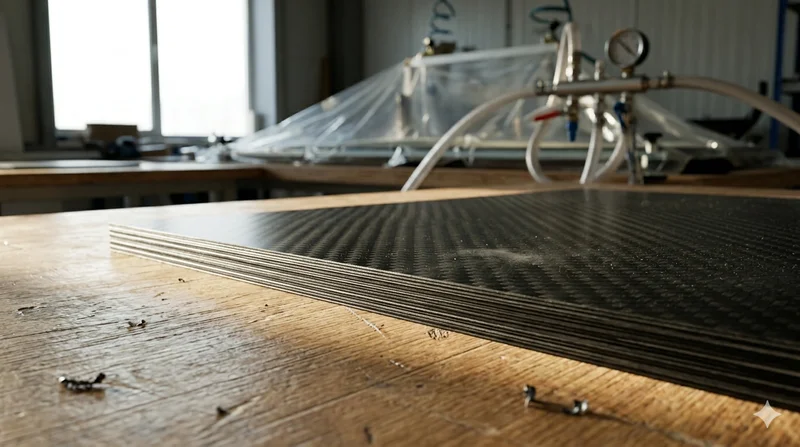
Carbon Fiber Plate — 3K Twill T700 3.0mm
Medium-thickness 3.0mm carbon fiber plate offering significantly higher load capacity while maintaining attractive 3K twill finish. Suitable for structural brackets, reinforcement plates, and load-bearing panels.

Carbon Fiber Plate — 3K Twill T700 1.5mm
Thin 1.5mm carbon fiber plate with 3K twill weave surface. Lightweight and stiff, commonly used for covers, panels, drone bodies, and applications requiring a premium aesthetic appearance.

Square Carbon Fiber Tube — 3K Twill T700
Square cross-section carbon fiber tube manufactured with 3K twill weave for torsional strength. Preferred for structural frames, trusses, and support columns where rectangular geometry offers design flexibility.
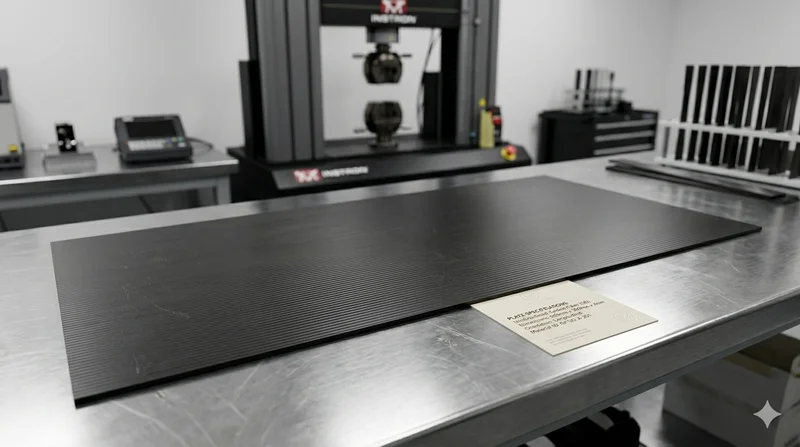
Carbon Fiber Plate — UD Unidirectional T700
Unidirectional carbon fiber plate with all fibers oriented in a single direction for maximum strength along the fiber axis. Essential for structural reinforcements, splints, and applications where load direction is predictable.
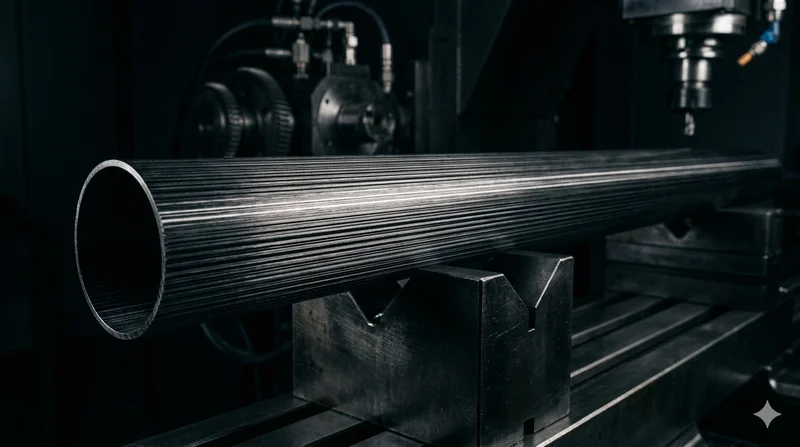
Round Carbon Fiber Tube — UD Unidirectional T700
Unidirectional (UD) round tube with all fibers aligned axially for maximum longitudinal stiffness. Ideal for applications requiring high bending rigidity with minimal weight, such as shafts, struts, and structural reinforcements.