
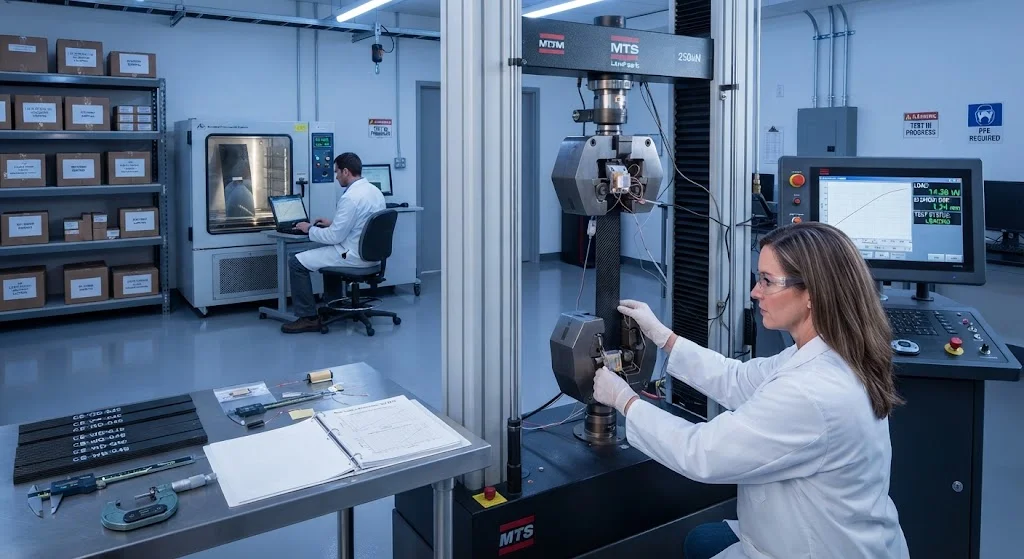
Certifying a wind turbine blade built with a new material or a new manufacturing process hinges on evidence that certification bodies can trust — and most of that evidence starts with coupons. A coupon is a small, standardized test specimen cut or manufactured from the same material and
Introduction
Certifying a wind turbine blade built with a new material or a new manufacturing process hinges on evidence that certification bodies can trust — and most of that evidence starts with coupons. A coupon is a small, standardized test specimen cut or manufactured from the same material and by the same process as the production part. The systematic testing of coupons generates material allowables, validates that a process produces repeatable properties, and underpins the design margins that survive the certification review. The Thermo-Blade-Spine approach to blade technology is a current example: instead of relying on full-scale prototypes alone, the program builds its certification case on a matrix of coupon-level data before any blade ever leaves the plant.
This article walks through why coupon testing is the backbone of blade certification, how material allowables are computed from coupon data, and how a technology validation matrix turns a new process from a laboratory curiosity into a certifiable production method. The focus is the workflow and the statistics — the "how certification actually gets done" — rather than the properties of any single fiber grade.
What Coupon Testing Covers
Coupons exist to answer three questions for any new blade technology: does the material meet specification, does the process produce consistent parts, and do the design values used in structural analysis hold up under real loading? Each question maps to a test family:
- Material qualification: Coupons taken from panels manufactured under defined conditions verify fiber, resin, and laminate properties against the material specification.
- Process qualification: Coupons cut from plaques produced across multiple manufacturing runs, tools, and shifts confirm that the process delivers statistically equivalent properties.
- Design data generation: Coupon tests of tension, compression, shear, and damage-tolerance properties supply the allowables that feed finite element models and certification margin checks.
The same specimen geometry serves all three purposes — the difference is in the test matrix, the number of batches, and the statistical treatment of the results. A thin flat laminate coupon costs a fraction of a structural subcomponent test and a small fraction of a full-scale blade test, which is why certification programs lean on coupons so heavily.
Material Allowables and the A/B-Basis Statistics
Material allowables are statistically derived property values that a designer can use with a defined level of confidence. In aerospace and increasingly in wind blade certification, they follow the basis-value approach codified in CMH-17 (formerly MIL-HDBK-17): the B-basis value is the threshold below which 90 percent of the population falls with 95 percent confidence, and the A-basis value is the corresponding threshold at 99 percent reliability with 95 percent confidence. Wind blade practice commonly works with characteristic values derived from coupon testing under the framework of standards such as IEC 61400-5 and DNV-ST-0376.
The statistics matter because they convert scattered coupon data into an engineering guarantee. A typical qualification produces allowables from a minimum number of batches and specimens per batch: often three to five batches with at least eight to twelve valid coupons per test condition. The variability between batches — driven by fiber batch, resin lot, cure cycle, and ambient conditions — is captured by the analysis, so the allowable reflects the real production envelope rather than an idealized laboratory sample. When a new blade process promises higher performance, it is the coupon-derived allowables, not brochure data, that determine whether the promised margins actually exist.
Standard Coupon Tests for Blade Laminates
| Test | Standard Method | Property Generated | Use in Certification |
|---|---|---|---|
| In-plane tension | ISO 527-4 / ASTM D3039 | Young's modulus, tensile strength | Design allowables for blade skins and spar caps |
| In-plane compression | ASTM D6641 / D3410 | Compressive strength and modulus | Buckling and compression-dominated load cases |
| In-plane shear | ISO 14129 / ASTM D3518 | Shear modulus and strength | Web shear and torsional load paths |
| Open-hole tension / compression | ASTM D5766 / D6484 | Notched allowables | Bolt-hole stress concentrations in blade joints |
| Compression after impact | ASTM D7136 / D7137 | Residual strength after damage | Damage tolerance and inspection interval setting |
| Interlaminar shear | ASTM D2344 | Apparent ILSS | Laminate quality control and screening |
The table is the core of a coupon test matrix for blade materials. Not every blade certification exercises every test on every material system; the matrix is tailored to the loads, the failure modes, and the novelty of the process being qualified. What matters is that the selected matrix covers every load-bearing property claimed in the design, at every environmental condition — dry, wet, hot, and cold — because allowables drop substantially with moisture uptake and elevated temperature.
The Technology Validation Matrix for New Processes
A technology validation matrix structures coupon testing so that a new process earns its way stage by stage. The Thermo-Blade-Spine program is representative: a new blade architecture proceeds from material screening coupons, through a process development phase where coupon panels are made with production-representative tooling, to a design data phase where full allowables and environmental knockdowns are generated, and finally to a limited full-scale validation that confirms the coupon-derived margins hold on a real blade. Each stage is a gate: no design data is released from a stage until its coupons meet the acceptance criteria.
This staged structure closes the loop between materials and geometry. Coupon data proves the process can build the material; full-scale tests then prove the geometry uses the material correctly. If a full-scale blade test reveals a shortfall, the validation matrix identifies precisely which coupon property and which process step caused it, instead of forcing an expensive blind re-test. That traceability is the practical reason certification authorities accept coupon-heavy programs: every number in the structural model can be traced back to a documented test.
Building a Certification-Ready Coupon Program
- Anchor to a recognized standard: Choose IEC 61400-5, DNV-ST-0376, or the relevant GL guideline as the framework before generating any data.
- Define batches and sampling early: Minimum batch counts and per-batch specimen numbers must be fixed up front, so the statistics are valid at the end.
- Cover environmental conditions: Test dry, saturated, and thermal extremes; environmental knockdowns often control the final design margins.
- Use production-representative panels: Coupons cut from prototype-quality plaques mislead; panels must come from the actual production process and tooling.
- Document every process parameter: Cure cycle, vacuum bag, resin batch, and fiber batch must be recorded for each panel so allowables carry lineage.
- Stage the gates: Release design data only after each validation stage meets its acceptance criteria, and trace every full-scale result to its coupon roots.
Frequently Asked Questions
Why are coupons considered trustworthy evidence for certification instead of full-scale tests?
Because coupons isolate variables. A full-scale blade test mixes material behavior, geometry, manufacturing defects, and loading environment into one outcome; when it fails, the cause is ambiguous. A coupon test controls every variable except the one being measured, so a failure can be traced to a specific property and process step. Coupons also allow statistical depth: dozens of specimens across multiple batches quantify variability that a handful of full-scale tests cannot. Certification bodies therefore view a strong coupon matrix as the foundation and full-scale tests as the confirmation that the coupon-derived margins are real at production scale.
What is the difference between A-basis and B-basis allowables, and which one should a blade program use?
The basis value defines the reliability level of the allowable. A B-basis value is the threshold below which 90 percent of the material population is expected to fall, with 95 percent confidence; an A-basis value is the equivalent threshold at 99 percent reliability with the same confidence. A-basis allowables are therefore lower and more conservative, and they are typically required for non-redundant, single-load-path structures where failure is catastrophic. Wind blade practice generally uses characteristic values derived under IEC 61400-5 and DNV-ST-0376 rather than the aerospace A/B framework, but the statistical logic is the same — and for critical single-load-path components in blade architecture, conservative basis values are the safe choice.
How many coupons does a new blade material or process need for certification?
There is no single number; the requirement scales with the novelty of the technology and the criticality of the properties. A common material-qualification structure uses at least three to five production batches with eight to twelve valid coupons per batch per test condition, covering tension, compression, shear, and damage-tolerance tests under multiple environmental conditions. A full matrix for a new process can run into hundreds of coupons before design data is released. The guiding principle is statistical validity: enough batches and specimens to demonstrate that batch-to-batch variability is understood and that the recommended margins genuinely exist.
Conclusion
Systematic coupon testing is what turns a promising blade technology into a certifiable one. Coupon data generates the allowables that structural models depend on, validates that new processes produce repeatable parts, and provides the traceability that certification authorities require. Staged through a technology validation matrix, coupon testing lets a program prove its margins incrementally and cheaply, reserving full-scale tests for the final confirmation. For blade manufacturers and material buyers, the strength of the coupon program — not the marketing data — is the real predictor of whether a new technology will reach certification.
For teams developing new blade structures and processes, explore our carbon fiber products for blade spar caps and structural laminates, or contact our engineering team to discuss coupon testing programs, material qualification, and supply of documented, traceable carbon fiber for your certification effort.
Related Articles
- Bio-Based Carbon Fiber Precursors: Lignin and Polyethylene for Low-Cost Production
- Large-Tow Carbon Fiber Cost Analysis: 48K vs 60K Price-Performance Comparison
- Carbon Fiber-Resin Interface Bonding: Surface Treatment and Coupling Agent Optimization
- Digital Twin for Carbon Fiber Manufacturing: Real-Time Process Monitoring and Defect Prevention
- Thermoplastic Carbon Fiber Welding for Automotive: Ultrasonic and Induction Welding Process Windows
- Large-Tow Carbon Fiber Wet Spinning: Process Optimization for 48K/60K Production Efficiency
Interested in Our Products?
Contact our team for competitive pricing and technical specifications.
Get a QuoteRelated Products
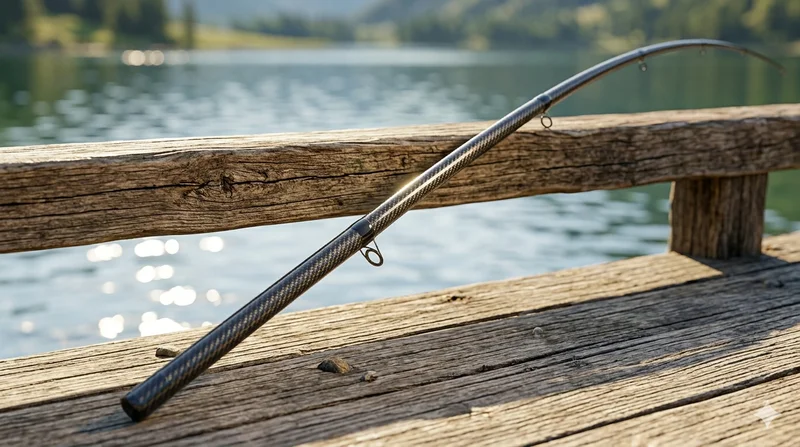
Carbon Fiber Fishing Rod Blank
High-quality carbon fiber fishing rod blank manufactured from multiple grades of Toray carbon fiber cloth. Available in a wide range of lengths, powers, and actions for freshwater and saltwater applications. Suitable for OEM rod building.

Carbon Fiber Plate — 3K Twill T700 1.5mm
Thin 1.5mm carbon fiber plate with 3K twill weave surface. Lightweight and stiff, commonly used for covers, panels, drone bodies, and applications requiring a premium aesthetic appearance.

Square Carbon Fiber Tube — 3K Twill T700
Square cross-section carbon fiber tube manufactured with 3K twill weave for torsional strength. Preferred for structural frames, trusses, and support columns where rectangular geometry offers design flexibility.
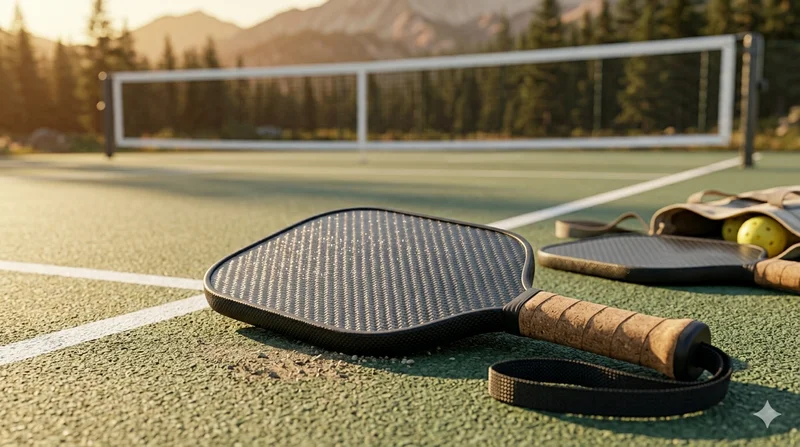
Carbon Fiber Pickleball Paddle
High-performance pickleball paddle with Toray T700 carbon fiber face and polypropylene honeycomb core. Delivers excellent power-to-weight ratio, spin generation, and vibration dampening for competitive play.
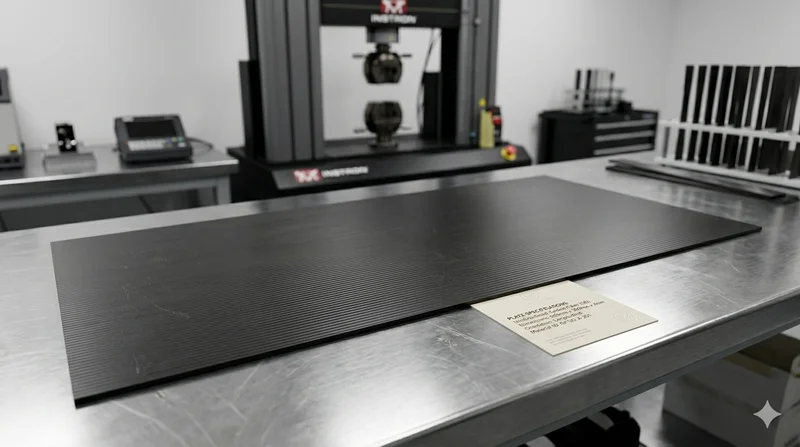
Carbon Fiber Plate — UD Unidirectional T700
Unidirectional carbon fiber plate with all fibers oriented in a single direction for maximum strength along the fiber axis. Essential for structural reinforcements, splints, and applications where load direction is predictable.