
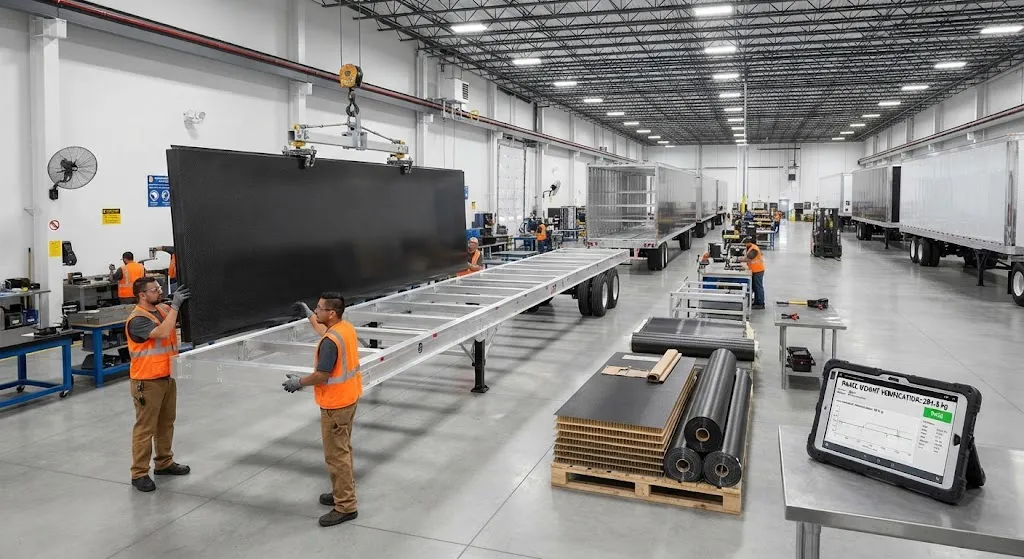
A commercial trailer is a negative-margin box: it earns nothing on its own, and every kilogram it carries as structure is a kilogram that cannot be carried as freight. This is why trailer lightweighting has become one of the most commercially rational applications of carbon fiber compos
Introduction
A commercial trailer is a negative-margin box: it earns nothing on its own, and every kilogram it carries as structure is a kilogram that cannot be carried as freight. This is why trailer lightweighting has become one of the most commercially rational applications of carbon fiber composites — and why carbon fiber trailer panels, not exotic supercar bodies, may be the largest-volume vehicle composite market of the next decade. A standard 53-foot dry van weighs roughly 6,800-7,200 kg empty; a refrigerated trailer (reefer) can exceed 8,000 kg once the cooling unit and insulation are added. Carbon fiber side panels and floors attack exactly this deadweight.
Three forces are pushing carbon fiber trailer panels from pilot programs into serial production. Curb weight regulations are tightening in several jurisdictions, effectively penalizing empty weight. Electric and fuel-cell trucks are entering fleet service, where every kilogram of trailer structure directly reduces the payload an electric chassis can haul on a single charge. And freight economics reward weight saved — over a million-mile trailer life, a 500 kg weight reduction can allow hundreds of additional revenue loads. This article examines the panel technology, the weight and fuel arithmetic, and the state of adoption across North American and European fleets.
The Panel Technology: Honeycomb Sandwich Construction
Carbon fiber trailer panels are almost universally honeycomb sandwich structures. The architecture is the same concept used in aircraft floor panels — thin, high-stiffness skins bonded to a lightweight core — scaled to the dimensions and cost targets of road transport. A typical panel comprises three elements:
- Outer skins: Carbon fiber reinforced polymer laminates, typically 0.5-1.0 mm thick, providing bending stiffness, impact resistance, and the visible surface. Both woven fabric and unidirectional laminate skins are used, with woven skins preferred for impact tolerance.
- Core: Honeycomb core, usually aluminum or aramid, 8-20 mm thick, providing shear stiffness and buckling resistance at very low density.
- Edge and insert systems: Reinforced edges with integrated aluminum extrusions for attachment to the trailer frame, floor, and roof, plus bonded inserts at load points such as tie-down rails and reefer wall brackets.
The panel is produced by bonding the skins to the core in a heated press or vacuum-assisted process, then trimming and edge-sealing. Areal weight is the controlling specification: a good carbon fiber sandwich panel for trailer applications weighs 1.2-1.8 kg per square meter of panel face, against roughly 4.5-6.5 kg per square meter for a conventional aluminum-skinned foam or plywood panel with equivalent mechanical properties.
| Panel Type | Areal Weight | Bending Stiffness | Impact Resistance | Relative Cost |
|---|---|---|---|---|
| Plywood / hardwood | 8-12 kg/m² | Good | Moderate | 1.0x |
| Aluminum-skinned foam | 4.5-6.5 kg/m² | Good | Good | 1.5-2x |
| Glass fiber sandwich | 3.5-5.0 kg/m² | Moderate | Good | 2-2.5x |
| Carbon fiber sandwich | 1.2-1.8 kg/m² | High | Good | 3-4.5x |
The weight delta is concentrated where it matters: side walls of a 53-foot trailer account for roughly 1,500-2,000 kg of structural mass in conventional construction, and switching them to carbon fiber sandwich panels can remove 700-1,000 kg from a single trailer before the floor is even considered. The floor itself, traditionally hardwood over steel crossmembers, is a further 1,000-1,400 kg target.
The Weight Arithmetic: What a Lighter Trailer Is Worth
The value of trailer weight reduction is best expressed in freight terms. Under gross vehicle weight limits, every kilogram removed from the trailer is a kilogram of additional payload capacity. For a fleet running a million miles over a trailer's 10-15 year life, the payload increment compounds into revenue that quickly dwarfs the material premium of carbon fiber.
The fuel side matters too, though the arithmetic is more subtle. Trailer weight affects rolling resistance and, to a lesser degree, aerodynamic losses; industry estimates place the fuel saving from a 1,000 kg trailer weight reduction at roughly 1.5-2.5% of total fuel consumption on a mixed cycle. At diesel prices above 1.2 USD per liter, a heavy-linehaul truck covering 120,000 km per year burns 40,000-50,000 liters annually, so a 2% saving is worth 800-1,000 liters — approximately 1,000-1,200 USD per truck per year. The payload benefit is usually larger still: an extra 500 kg of allowed freight on even part of the fleet's loads adds revenue per trip that exceeds the fuel saving on many routes.
Electric truck deployment sharpens the case. Battery-electric tractors carry 2-4 tonnes of batteries that displace payload; an e-truck pulling a carbon fiber trailer recovers part of that penalty. Several operators report that combining a lightweight electric tractor with a lightweight composite trailer restores 60-75% of the payload lost to battery weight, which is the difference between an electric linehaul operation being viable or not. This payload-recovery argument, more than fuel savings, is driving early electric-fleet adoption of composite trailers.
Adoption in North America and Europe
North American adoption is advancing fastest where the economics are clearest. Dry van fleets with high annual mileage and dense freight are the first movers; several large US fleets have run composite-panel trailer evaluations for five or more years, and carbon fiber sandwich panels are now specified on some premium equipment lines. Reefer operators follow close behind, because the insulated structure of a refrigerated trailer makes its empty weight especially burdensome — insulation adds mass that carries no freight, making every kilogram saved proportionally more valuable.
European adoption is more regulatory-driven. Curb weight rules and CO2-based tolling schemes effectively tax empty weight, and several European trailer manufacturers have launched carbon-fiber-panel models targeting the segment. The European approach tends to pair carbon fiber side walls with aluminum or composite floors, optimizing the total weight envelope against the region's lower per-trip payload limits. Both regions share the same bottleneck: panel cost and repair economics. A damaged carbon fiber panel must be replaceable as a module, and the repair and warranty structure around composite trailer panels is still maturing — the single strongest argument for modular panel designs that can be swapped in the field.
Panel Cost, Service Life, and Repair Economics
Carbon fiber trailer panels cost three to four and a half times more than conventional panels on a per-square-meter basis, but the relevant comparison is life-cycle cost, not purchase price. A premium trailer is operated for 10-15 years and a million or more miles, and the panels must survive road debris, dock impacts, temperature cycling, and moisture ingress over that entire life. The total-cost comparison must include the fuel and payload value of weight saved, the reduced corrosion and damage maintenance of composite skins, and the residual value at trade-in.
Impact damage is the main repair concern. Honeycomb sandwich panels dent and delaminate under concentrated loads, but the damage is typically localized and field-repairable: a damaged skin area can be patched, or a modular panel can be unbolted and replaced. The key design decision is modularity — panels mounted as discrete, replaceable units rather than a monolithic skin bonded across the whole trailer side. Trailer OEMs are converging on modular architectures for exactly this reason, and the modular format also simplifies recycling and end-of-life material recovery, which is becoming a procurement requirement for sustainability-focused fleets.
Frequently Asked Questions
How much weight does a carbon fiber trailer panel save?
A carbon fiber honeycomb sandwich panel weighs 1.2-1.8 kg per square meter against 4.5-6.5 kg per square meter for a conventional aluminum-skinned panel. Switching the side walls of a 53-foot trailer to carbon fiber sandwich panels can remove 700-1,000 kg, and replacing the hardwood floor with a composite floor removes a further 500-700 kg, for a total of roughly 1,200-1,700 kg per trailer.
Does a lighter trailer actually save fuel?
Yes, but the fuel effect is secondary to the payload effect. A 1,000 kg trailer weight reduction saves roughly 1.5-2.5% of fuel on a mixed cycle — about 800-1,000 liters per year for a heavy linehaul truck. The payload benefit is usually larger: an extra 500 kg of allowed freight adds revenue per trip that exceeds the fuel saving on many routes, and for electric trucks it restores 60-75% of the payload lost to battery weight.
Why are carbon fiber trailer panels so much more expensive than aluminum panels?
Carbon fiber itself is expensive, and sandwich panel production involves bonded assembly and quality inspection rather than simple roll-forming. On a per-square-meter basis, panels cost three to four and a half times more. The life-cycle case rests on weight-driven fuel and payload value, reduced corrosion and damage maintenance, and residual value — the purchase premium amortizes over a million-mile service life.
Can a damaged carbon fiber trailer panel be repaired?
Yes. Honeycomb sandwich panels sustain localized denting and delamination under concentrated impact, which is typically field-repairable — a damaged skin area can be patched, or a modular panel can be unbolted and replaced. Trailer OEMs are converging on modular panel architectures so that damaged units are swapped rather than repaired in place, simplifying both maintenance and end-of-life recycling.
Conclusion
Carbon fiber trailer panels are the most commercially rational large-volume application of carbon fiber in road transport. Honeycomb sandwich construction removes 1,200-1,700 kg from a trailer, converting empty weight into payload capacity and fuel savings that pay back the material premium over a million-mile service life. Curb weight regulation, electric truck payload recovery, and life-cycle freight economics are all aligning in the same direction, and North American and European fleets are moving from evaluations to serial specification. The technology that remains to be perfected is repair and modular replacement economics — and that is a design problem, not a material problem.
YongXian supplies carbon fiber fabrics and sandwich panel materials for commercial vehicle applications. Explore our product range or contact our engineering team to discuss panel design and material selection for your trailer program.
Part of topic
Related Articles
- Carbon Fiber Mooring for Floating Offshore Wind: Fatigue and Corrosion in Deep Water
- Carbon Fiber Bicycle Frame Optimization: Layup Design and Manufacturing for Competitive Racing
- Carbon Fiber CFRP Retrofit for Infrastructure: Bridge and Building Seismic Strengthening
- Carbon Fiber Medical Imaging Equipment: Lightweight Gantry and Couch Structures for MRI/CT
- Carbon Fiber EV Battery Enclosures: Crash Safety and Electromagnetic Shielding Design
- Carbon Fiber Structures for Low-Altitude Economy: UAV Airframes and eVTOL Components
Interested in Our Products?
Contact our team for competitive pricing and technical specifications.
Get a QuoteRelated Products

Carbon Fiber Plate — 3K Twill T700 3.0mm
Medium-thickness 3.0mm carbon fiber plate offering significantly higher load capacity while maintaining attractive 3K twill finish. Suitable for structural brackets, reinforcement plates, and load-bearing panels.

Carbon Fiber Plate — 3K Twill T700 1.5mm
Thin 1.5mm carbon fiber plate with 3K twill weave surface. Lightweight and stiff, commonly used for covers, panels, drone bodies, and applications requiring a premium aesthetic appearance.

Square Carbon Fiber Tube — 3K Twill T700
Square cross-section carbon fiber tube manufactured with 3K twill weave for torsional strength. Preferred for structural frames, trusses, and support columns where rectangular geometry offers design flexibility.
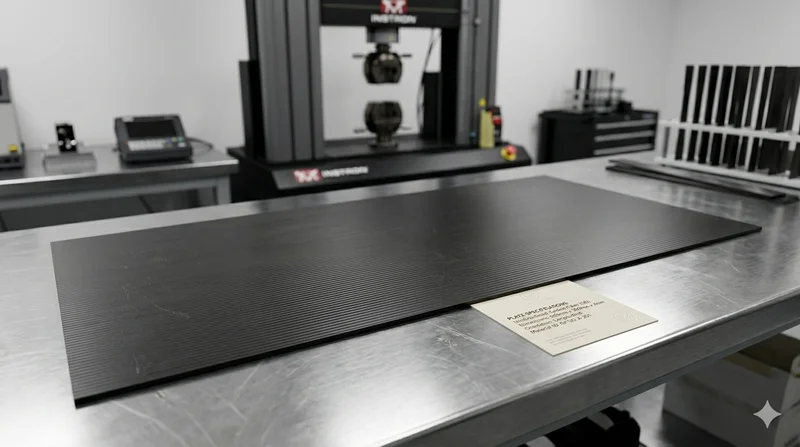
Carbon Fiber Plate — UD Unidirectional T700
Unidirectional carbon fiber plate with all fibers oriented in a single direction for maximum strength along the fiber axis. Essential for structural reinforcements, splints, and applications where load direction is predictable.
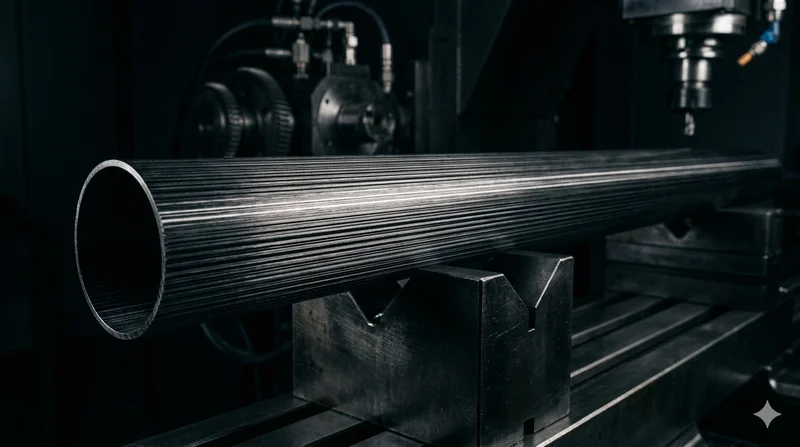
Round Carbon Fiber Tube — UD Unidirectional T700
Unidirectional (UD) round tube with all fibers aligned axially for maximum longitudinal stiffness. Ideal for applications requiring high bending rigidity with minimal weight, such as shafts, struts, and structural reinforcements.