
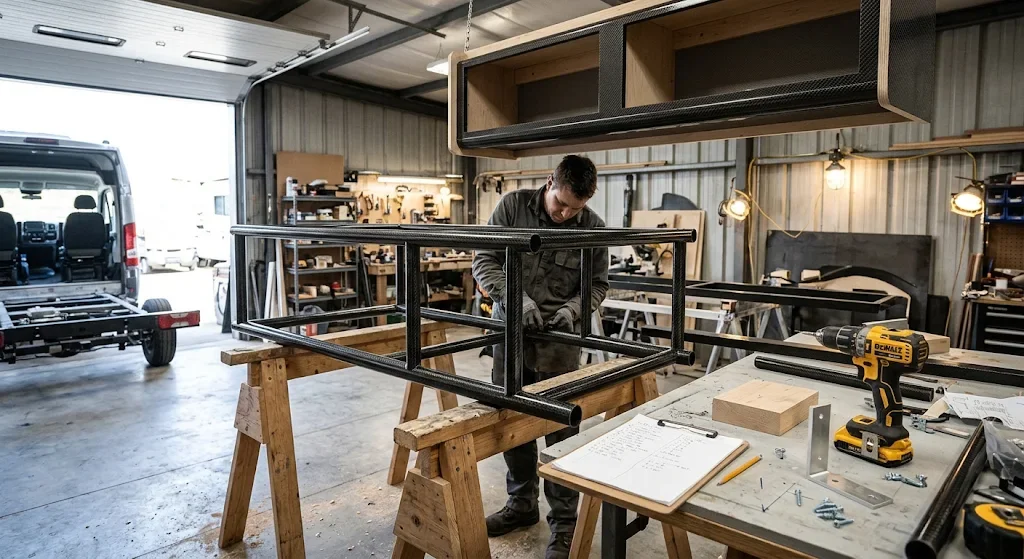
Every kilogram removed from a recreational vehicle is paid back twice: once in tow rating and once in fuel burn, which is why carbon fiber tube for rv construction has moved from racing trailers into mainstream coachbuilding. A hollow carbon tube weighs roughly one-fifth of the steel equivalent and
Introduction
Every kilogram removed from a recreational vehicle is paid back twice: once in tow rating and once in fuel burn, which is why carbon fiber tube for rv construction has moved from racing trailers into mainstream coachbuilding. A hollow carbon tube weighs roughly one-fifth of the steel equivalent and about half of aluminum at comparable bending stiffness — but the material only returns its cost when placed where the loads actually are, not spread evenly across the coach for a marketing claim.
This guide covers where tube sections earn their keep in an RV, the diameters and grades that fit each job, how to order custom length carbon fiber tube so scrap stays low, and the joining details that separate a quiet coach from one that rattles apart after two seasons.
Where Carbon Fiber Tube for RV Construction Saves the Most Weight
Weight removed high and far from the axle matters most: it reduces sprung mass and the rollover moment the suspension must control. On a typical travel trailer the best returns come from four zones. Upper cabinets: 25 millimetre round tube replaces steel angle carrying only the cabinet's own load, and the saving sits above the axle where it hurts handling least. Ladder and roof racks: long cantilevered runs are pure bending members, the exact duty cycle carbon tube handles well. Slide-out box frames: every kilogram inside the slide loads the roller mechanism each move. Wardrobe and bed-base frames carry only dead load.
What does not pay is replacing chassis rails, axle hangers, or hitch structure. Those parts see impact and fatigue loads that demand metal's ductility; a cracked carbon tube does not bend, it sheds fibers. Spend the budget on the superstructure and leave the running gear alone.
| Member | Steel tube | Aluminum tube | Carbon tube | Typical saving |
|---|---|---|---|---|
| Cabinet frame, 25 mm round | 1.2 kg/m | 0.55 kg/m | 0.28 kg/m | 77% vs steel |
| Roof rack rail, 30 x 20 mm | 1.6 kg/m | 0.72 kg/m | 0.36 kg/m | 78% vs steel |
| Slide-out box rail | 1.4 kg/m | 0.63 kg/m | 0.32 kg/m | 77% vs steel |
| Full cabinet run, 12 m | 14.4 kg | 6.6 kg | 3.4 kg | 11 kg removed |
The cumulative effect is realistic: a mid-size trailer can shed 15 to 25 kilograms from cabinetry and racks alone without touching a single structural chassis member, and that mass comes out above the axle line where it improves tow behavior rather than degrading it.
Carbon Fiber Tube Specs: Diameters, Walls, and Grades for RV Work
RV duty cycles are gentler than aerospace, so the grade conversation is about stiffness and finish rather than absolute tensile strength. For furniture and rack work, T300-class carbon in a quasi-isotropic lay-up is the sensible default; step up to T700 only where a long unsupported span must stay straight under load. Wall thickness of 1.5 to 2 millimetres covers most cabinet and rack tubes, with 2.5 to 3 millimetres reserved for roof racks carrying bikes and kayaks.
- Round tubes, 20-40 mm: general framing, wardrobe uprights, grab handles — the cheapest profiles to source and join.
- Square and rectangular sections: cabinet base frames where a flat mounting face saves brackets.
- Flattened or airfoil profiles: roof rack crossbars, where drag and wind noise matter as much as stiffness.
- Finish: sanded matte for painted interiors, gloss twill only where the tube will be seen.
Order wall thickness by load path, not habit: a tube in bending fails by buckling the compression wall long before the fibers run out of strength, so a slightly heavier wall on a long span is often lighter overall than a doubled frame of thinner tube.
Custom Length Carbon Fiber Tube Cutting for RV Builders
Length discipline is where a tube order turns into savings or into scrap. An RV cabinet run is a cut list, not a catalogue: forty pieces of mixed length nested from six-metre stock waste far less than forty pre-cut lengths that each leave an offcut. Ask the mill to cut to your drawing with a one-millimetre tolerance, face the ends square, and deburr before shipping — square ends let a frame joint close without a shim. For Canadian workshops building through long winters, the same custom length carbon fiber tube program ships as one consolidated parcel, keeping freight per piece down and avoiding the partial-order surcharges that push small shops back to aluminium.
Mark fiber direction on any piece carrying a bending load: on unidirectional or bias-heavy stock a tube mounted with its stiffness axis across the load will flex like a fishing rod, and ten seconds of labelling at the factory prevents a teardown at the workshop.
Joining Carbon Fiber Tubes to the Chassis Without Cracks
Road vibration is unforgiving of bad joints, and most carbon tube failures in RV service start at a fastener, not mid-span. Three rules cover nearly every case. First, never clamp a tube with a metal saddle over a sharp edge: use a bonded insert inside the tube end or an external sleeve with a rubber isolator, so crushing load spreads over an area instead of a line. Second, drill with sharp bits at low speed and support the exit face; a tear-out at the hole is a delamination crack waiting to grow. Third, use flexible polyurethane adhesive between tube and bracket rather than rigid epoxy, so thermal cycling does not load the joint with shear.
For tube-to-tube frames, internal sleeves with epoxy and two through-pins outload any external bracket. Where the joint must be serviceable, write a torque value into the build sheet: over-tightened clamps crush the wall, under-tightened ones fret until the isolator wears through.
Cost Reality: When the Weight Savings Pay Back
Carbon tube costs several times more per metre than steel and two to three times more than aluminum, so payback must come from somewhere other than material price. On a towed trailer the honest arithmetic is payload and tow rating: if the coach sits at the edge of the tow vehicle's limit, removing 20 kilograms of upper structure moves you back inside the rating without downgrading the vehicle, and that upgrade dwarfs the tube premium. For motorhomes the fuel argument is weaker per kilogram; the better case is cumulative — racks, cabinets, and interior frames together move the gross weight needle, and taking mass out of overhead lockers raises the rollover margin too.
Sequence the rollout: prototype one upper cabinet, live with it through a season, then commit the rest of the cut list — and ask for interlaminar data on the actual batch.
Frequently Asked Questions
Is carbon fiber tube strong enough for RV roof racks carrying bikes?
Yes, for the rack itself. A 30 x 20 millimetre rectangular carbon tube in quasi-isotropic lay-up carries two bikes through static and cornering loads with margin, because the duty is bending, not impact. It will not survive being a jacking point — keep impact loads out of the design.
How much weight can a typical trailer save with carbon fiber tube cabinetry?
Between 15 and 25 kilograms on a mid-size travel trailer is realistic when overhead cabinets, wardrobe frames, and a ladder rack convert from steel angle to 25 millimetre tube. The saving is worth more than the number suggests: it sits above the axle, reducing the lever arm the suspension sees in cornering.
Can carbon fiber tubes be cut and drilled with ordinary workshop tools?
They can, with care: sharp bits, low drill speed, a backing block under the exit face, and a vacuum on the dust. Carbide or diamond blades cut cleaner than abrasive discs, which burn the resin and leave an edge that later delaminates. Deburr by hand — a rounded edge accepts adhesive better than a sharp one.
Conclusion
Carbon fiber tube for rv construction earns its place one assembly at a time: overhead cabinets, roof racks, slide-out rails, and bed frames first, chassis and hitch components never. Stiffness per kilogram beats steel and aluminium in bending duty, and a cut list ordered to drawing keeps scrap — and therefore cost — under control. Start with one cabinet, live with it through a season, then scale the pattern across the coach.
YongXian supplies T300 and T700-class carbon fiber tube in standard and custom lengths for RV and marine builders: round, square, and rectangular profiles from 10 to 60 millimetres, cut to your drawing with square faces and batch traceability. Review tube specifications or send your cut list for a quote.
Part of topic
Related Articles
- Carbon Fiber Rods for Fishing: Blank Selection for Builders
- Carbon Fiber Toe Plates: Rocker Design in Footwear
- Carbon Fiber Drones (carbon fiber drones): Airframes, Payloads, and Cost Impact
- Best Carbon Fiber Rod: Application-Based Picks
- The Crust Carbon Fiber: What the Term Means in Searches
- Carbon Fiber Rod for Drone: Spars, Arms, and Sizing
Interested in Our Products?
Contact our team for competitive pricing and technical specifications.
Get a QuoteRelated Products

Round Carbon Fiber Tube — 3K Plain Weave T700
Standard round carbon fiber tube manufactured from Toray T700 grade fiber with 3K plain weave. Offers balanced strength and stiffness for general industrial applications including robotics, automation, sports equipment, and aerospace structures.

Square Carbon Fiber Tube — 3K Twill T700
Square cross-section carbon fiber tube manufactured with 3K twill weave for torsional strength. Preferred for structural frames, trusses, and support columns where rectangular geometry offers design flexibility.

Round Carbon Fiber Tube — 3K Twill
Lightweight and ultra-stiff round tubes ideal for drone frames, robotics, and structural applications.

Round Carbon Fiber Tube — UD Unidirectional T700
Unidirectional (UD) round tube with all fibers aligned axially for maximum longitudinal stiffness. Ideal for applications requiring high bending rigidity with minimal weight, such as shafts, struts, and structural reinforcements.

Carbon Fiber Plate — 3K Twill T700 3.0mm
Medium-thickness 3.0mm carbon fiber plate offering significantly higher load capacity while maintaining attractive 3K twill finish. Suitable for structural brackets, reinforcement plates, and load-bearing panels.