
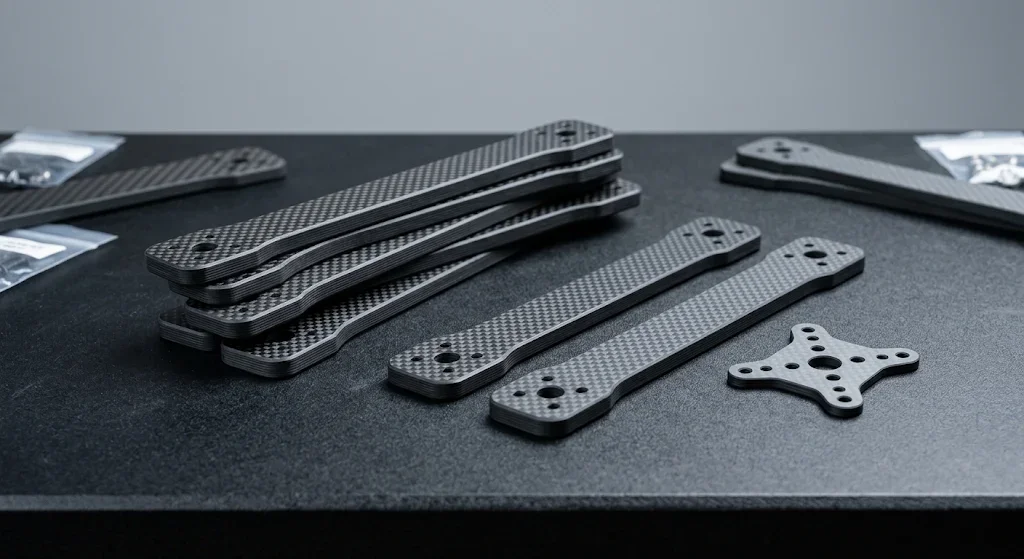
Carbon fiber sheet for drone frames is not a single commodity: the same nominal 2 millimetre plate can be a stiff, grain-aligned racing arm or a soft, randomly oriented decorative panel, and the difference shows up in flight vibration and crash survival rather than on the spec sheet. Frame builders
Introduction
Carbon fiber sheet for drone frames is not a single commodity: the same nominal 2 millimetre plate can be a stiff, grain-aligned racing arm or a soft, randomly oriented decorative panel, and the difference shows up in flight vibration and crash survival rather than on the spec sheet. Frame builders who pick sheet by thickness alone end up with arms that buzz at hover, plates that delaminate around blind inserts, or arms that weigh more than the motors can justify. The variables that actually matter are ply orientation, thickness matched to frame geometry, and a resin system that does not soften inside a sun-baked canopy.
This guide covers how loads flow from motor mounts through a plate arm, which thickness bands suit racing versus camera platforms, what to ask a mill about flatness and edge finish, and when best carbon fiber drone frame stock earns its premium over generic plate.
Carbon Fiber for Drone Frames: How Loads Flow Through a Plate
A multicopter arm is a cantilever beam loaded in bending and torsion at every motor mount. Unidirectional plies aligned along the arm carry bending efficiently; a twill or plain weave on the outer plies resists the torsional twist that yaw motors induce and takes fastener bearing around M3 inserts. Orientation mistakes are the most common failure mode: a sheet with fibres running across the arm rather than along it will pass a bench flex check and still crack at the root after a handful of hard landings.
- Bending stiffness: scale with thickness cubed, so 2 millimetre plate is roughly four times stiffer in bending than 1 millimetre at the same modulus.
- Torsional stiffness: improved by balanced quasi-isotropic lay-up, not by simply adding more unidirectional plies.
- Insert bearing: the lay-up around M3 blind inserts needs off-axis plies or an aluminium collar, or the insert pulls through in a crash.
- Root fatigue: the motor-end fillet is where delamination starts; sealed edges and a generous radius matter more than an extra ply.
Ask the supplier whether the sheet is quasi-isotropic, 0/90 bias, or unidirectional, and orient the cutting layout so the primary fibre direction follows each arm's long axis.
Thickness Bands for Carbon Fiber Sheet for Drone Builds
Thickness choice is a trade between arm stiffness, weight, and crash energy absorption. Racing frames run thin, stiff plates that flex predictably and stay light for punch-outs; camera and cinema platforms accept heavier plates for vibration damping and mount stability; long-range builds sit in the middle, favouring stiffness for efficiency over maximum lightness.
| Platform | Typical thickness | Lay-up | Design priority |
|---|---|---|---|
| Racing quad | 1.5 - 2.0 mm | Quasi-isotropic | Weight, predictable flex |
| Freestyle | 2.0 - 3.0 mm | 0/90 or quasi-iso | Crash survival, stiffness |
| Camera / cinema | 2.5 - 4.0 mm | Quasi-isotropic | Vibration damping, mount stability |
| Long-range | 2.0 - 3.0 mm | Quasi-isotropic | Efficiency, stiffness-to-weight |
| Top / bottom plate | 1.0 - 2.0 mm | Balanced weave | Flatness, low mass |
Going thicker is not free: every extra half-millimetre adds mass at the worst possible radius from the centre of mass, shortening flight time and dulling response. Build the lightest frame that survives your worst normal crash, not the heaviest plate that survives a laboratory drop test.
Resin, Heat, and the Sun-Baked Canopy Problem
A frame sitting on a landing pad in summer sun can see canopy air temperatures that soften a standard epoxy laminate. The practical consequences arecreep under motor preload and a loss of stiffness that shows up as mid-throttle vibration. Toughened or high-temperature epoxy systems hold modulus to roughly 80 to 100 degrees Celsius; standard systems start to give way nearer 60. For outdoor and commercial platforms, specify the resin grade on the purchase order rather than assuming every black sheet is equal.
Edge sealing deserves the same attention. A raw waterjet edge wicks moisture and starts micro-delamination at the first thermal cycle; a sealed, sanded edge with a small radius extends service life measurably, especially on arms that see frequent prop-wash and rain.
Qualifying a Sheet Supplier for Drone Work
Flatness is the check most often skipped. A plate out of flat by more than about 1 millimetre per metre forces every CNC fixture to fight the material and produces arms with inconsistent stiffness. Ask for a stated flatness tolerance and verify a sample with a straightedge before committing to a production run. Thickness tolerance matters for press-fit inserts: a sheet delivered at 1.8 millimetres against a 2.0 millimetre specification will not hold the same bearing load around an M3 boss.
Batch traceability separates a drone-grade mill from a generic panel factory. Request the fabric roll identifier and cure batch with each order, so a field failure can be traced to a specific production run rather than argued about from photographs. A supplier who can also provide interlaminar shear data for the actual lay-up is quoting a process, not just a price.
Frequently Asked Questions
What thickness of carbon fiber sheet for drone frames should a beginner use?
Start with 2 millimetre quasi-isotropic plate for a five-inch freestyle or camera build: it is stiff enough for normal crashes, light enough for reasonable flight time, and forgiving of minor cutting errors. Move to 1.5 millimetre only when building a dedicated racer, and to 3 millimetres only for heavy cinema platforms that need the damping.
Is unidirectional sheet better than woven sheet for drone arms?
Unidirectional plate maximises bending stiffness along one axis, which suits long, narrow arms cut with the grain along the span. Woven twill or quasi-isotropic plate handles torsion and multi-directional loading better, which suits shorter arms and frames with complex geometries. Most modern arms use a quasi-isotropic core with woven outer plies for the best compromise.
How do I know a supplier's best carbon fiber drone frame stock is actually drone grade?
Ask for three things in writing: fabric grade (T300 or T700 equivalent), lay-up schedule, and flatness tolerance. A drone-grade supplier answers all three without hesitation and can attach a batch code to your order. A generic panel factory quotes thickness and price only, and that gap in information usually predicts a gap in performance once the frame is flying.
Conclusion
Choosing carbon fiber sheet for drone frames comes down to orienting fibres along the load path, matching thickness to platform rather than to habit, and specifying a resin that survives the canopy temperatures your aircraft will actually see. Flatness, edge sealing, and batch traceability are the quiet differentiators between a frame that holds calibration through a season of crashes and one that creeps after a month of hovering.
YongXian supplies T300 and T700-class carbon fiber plate for drone builders: quasi-isotropic and unidirectional lay-ups from 0.5 to 10 millimetres, flatness held to 1 millimetre per metre, sealed edges, and batch codes on every order. Review plate specifications or send your frame drawing for a quote.
Part of topic
Related Articles
- Carbon Fiber Rods for Fishing: Blank Selection for Builders
- Carbon Fiber Toe Plates: Rocker Design in Footwear
- Carbon Fiber Drones (carbon fiber drones): Airframes, Payloads, and Cost Impact
- Best Carbon Fiber Rod: Application-Based Picks
- The Crust Carbon Fiber: What the Term Means in Searches
- Carbon Fiber Rod for Drone: Spars, Arms, and Sizing
Interested in Our Products?
Contact our team for competitive pricing and technical specifications.
Get a QuoteRelated Products

Round Carbon Fiber Tube — 3K Plain Weave T700
Standard round carbon fiber tube manufactured from Toray T700 grade fiber with 3K plain weave. Offers balanced strength and stiffness for general industrial applications including robotics, automation, sports equipment, and aerospace structures.

Square Carbon Fiber Tube — 3K Twill T700
Square cross-section carbon fiber tube manufactured with 3K twill weave for torsional strength. Preferred for structural frames, trusses, and support columns where rectangular geometry offers design flexibility.

Round Carbon Fiber Tube — 3K Twill
Lightweight and ultra-stiff round tubes ideal for drone frames, robotics, and structural applications.

Round Carbon Fiber Tube — UD Unidirectional T700
Unidirectional (UD) round tube with all fibers aligned axially for maximum longitudinal stiffness. Ideal for applications requiring high bending rigidity with minimal weight, such as shafts, struts, and structural reinforcements.

Carbon Fiber Plate — 3K Twill T700 3.0mm
Medium-thickness 3.0mm carbon fiber plate offering significantly higher load capacity while maintaining attractive 3K twill finish. Suitable for structural brackets, reinforcement plates, and load-bearing panels.