
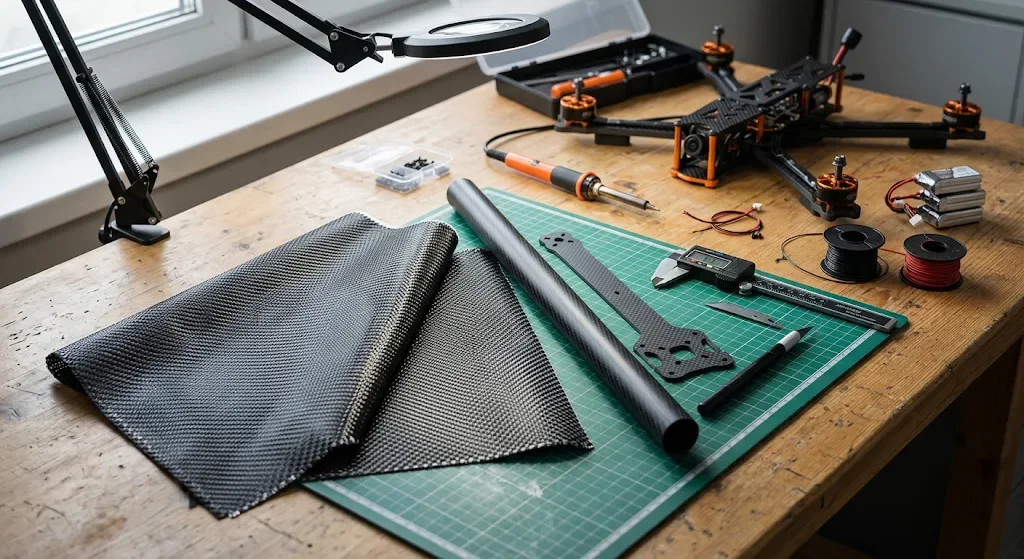
Choosing carbon fiber for drone frame builds starts with a form-factor decision, not a fibre grade decision. Cloth, tube, and plate each solve a different structural problem, and picking the wrong one costs weight, stiffness, or crash survival before the first flight. A frame designed around woven c
Introduction
Choosing carbon fiber for drone frame builds starts with a form-factor decision, not a fibre grade decision. Cloth, tube, and plate each solve a different structural problem, and picking the wrong one costs weight, stiffness, or crash survival before the first flight. A frame designed around woven cloth behaves differently under impact than a frame cut from solid plate, even when both use the same T700-class fibre.
This guide compares the three common forms of carbon fiber for drone frame work and shows when each is the right answer. Whether you are building a custom carbon fiber drone frame from scratch or buying a replacement arm, the decision tree below maps load case to form factor before any cutting begins.
Woven Cloth Laminate for Drone Frames
Woven carbon cloth, typically 3K twill or plain weave at 200 gsm, is laid up over a mould and cured under vacuum bag. The weave gives quasi-isotropic behaviour in the plane, which suits irregularly shaped frame plates, camera mounts, and gussets where loads arrive from multiple directions. Vacuum-infused or prepreg layups in the 1.5-3 mm range deliver stiffness values comparable to aluminium at roughly half the mass, and the closed mould surface is clean enough for exterior-facing parts.
The weakness is edge delamination. Woven cloth holds in-plane loads well, but a cut edge without a sealed gel coat or edge resin will start to fray under repeated vibration. Frame builders who cut their own plates from flat stock should budget for edge sealing, especially on arms that see prop-wash vibration for hours at a time.
| Form factor | Typical thickness | Stiffness (flexural) | Mass (100×100 mm plate) | Best use on a frame |
|---|---|---|---|---|
| 3K twill cloth laminate | 1.5-3 mm | 45-60 GPa | ~45-90 g | Frame plates, camera mounts, gussets |
| Pultruded tube (round) | 1-3 mm wall | 120-150 GPa axial | ~12-35 g per 300 mm | Arms, landing gear, spars |
| Plate stock (solid) | 2-6 mm | 50-70 GPa | ~60-180 g | Motor mounts, hard-points, jigs |
| Aluminium 6061 reference | 2 mm | 69 GPa | ~110 g | Legacy frames, conductive paths |
The table shows why a hybrid frame is common: cloth laminate for the central plate, pultruded tube for the arms, and plate stock at the motor hard-points. Each form factor plays to its strength rather than forcing one material shape to do every job. Carbon fiber drone frame price varies most with the custom carbon fiber drone frame layup schedule, not with the fibre grade alone.
- Cloth: best for complex 2D shapes, multi-directional loads, and clean exterior surfaces.
- Tube: best for arms and booms where bending stiffness per gram is the governing metric.
- Plate: best for hard-points, motor mounts, and jigs that need flat, thick stock.
- Hybrid frames: combine all three so each part sees the load case it was designed for.
Carbon Fiber Drone Frame Price Across Form Factors
Carbon fiber drone frame price depends on three variables: the form factor, the layup complexity, and the order volume. Woven cloth plates cut from flat stock are the cheapest per part because the material arrives in a ready-to-cut sheet and the labour is just cutting and sealing. Tube arms cost more per part because each one must be cut, faced, and often bonded to a CNC-machined joint. Custom moulded parts, such as a monocoque frame shell, carry tooling cost that only makes sense above a few dozen units.
For a one-off build, expect plate and tube stock to dominate the bill of materials. For a small production run, amortising a simple mould across twenty frames usually beats hand layup on both cost and consistency. When comparing quotes, ask whether the price includes edge sealing, countersink finishing, and inspection — these line items separate a flyable frame kit from a bag of cut squares.
Choosing Carbon Fiber for Drone Frame Repairs
Repair strategy follows the same form-factor logic. A cracked cloth plate can be patched with a wet layup and clamped flat, restoring most of its in-plane stiffness with minimal weight penalty. A delaminated tube arm is harder: a wrap repair around the full circumference recovers bending stiffness, but a longitudinal split along the fibre line usually means scrap. That asymmetry is worth designing for — put replaceable tube arms on sacrificial mounts so a crash costs one arm, not the whole frame.
Custom carbon fiber drone frame buyers should also confirm the fibre orientation schedule before ordering replacements. A frame whose arms were laid up at ±45° will not behave the same as one with straight 0° pultruded arms, even if the outer diameter matches. Keep the layup drawing with the airframe log; it is the single most useful document for any future repair or re-order.
Frequently Asked Questions
Is cloth or tube better for carbon fiber for drone frame arms?
Tube wins for arms because bending stiffness per gram is higher and the round section resists impact from any direction. Cloth laminate is better suited to the central frame plate, where loads are distributed in the plane.
What drives carbon fiber drone frame price the most?
Layup complexity and order volume dominate. Simple plate and tube parts cut from stock are cheap per unit; custom moulded shells carry tooling cost that only amortises at higher volumes.
Can I repair a custom carbon fiber drone frame at home?
Small plate cracks can be wet-laid and clamped flat with good results. Tube arms with longitudinal splits are usually scrap; budget for replaceable arms on sacrificial mounts instead.
Conclusion
Carbon fiber for drone frame builds is a form-factor decision first: cloth for plates, tube for arms, plate stock for hard-points, and hybrids where the load case demands it. Match the form to the load, keep the layup drawing, and design replaceable arms so a crash costs one part, not the frame. YongXian supplies cloth, tube, and plate stock for custom carbon fiber drone frame builds, so send your drawing and target mass before ordering. browse drone frame materials or request a frame material quote.
Part of topic
Related Articles
- Carbon Fiber Rods for Fishing: Blank Selection for Builders
- Carbon Fiber Toe Plates: Rocker Design in Footwear
- Carbon Fiber Drones (carbon fiber drones): Airframes, Payloads, and Cost Impact
- Best Carbon Fiber Rod: Application-Based Picks
- The Crust Carbon Fiber: What the Term Means in Searches
- Carbon Fiber Rod for Drone: Spars, Arms, and Sizing
Interested in Our Products?
Contact our team for competitive pricing and technical specifications.
Get a QuoteRelated Products

Round Carbon Fiber Tube — 3K Plain Weave T700
Standard round carbon fiber tube manufactured from Toray T700 grade fiber with 3K plain weave. Offers balanced strength and stiffness for general industrial applications including robotics, automation, sports equipment, and aerospace structures.

Square Carbon Fiber Tube — 3K Twill T700
Square cross-section carbon fiber tube manufactured with 3K twill weave for torsional strength. Preferred for structural frames, trusses, and support columns where rectangular geometry offers design flexibility.

Round Carbon Fiber Tube — 3K Twill
Lightweight and ultra-stiff round tubes ideal for drone frames, robotics, and structural applications.

Round Carbon Fiber Tube — UD Unidirectional T700
Unidirectional (UD) round tube with all fibers aligned axially for maximum longitudinal stiffness. Ideal for applications requiring high bending rigidity with minimal weight, such as shafts, struts, and structural reinforcements.

Carbon Fiber Plate — 3K Twill T700 3.0mm
Medium-thickness 3.0mm carbon fiber plate offering significantly higher load capacity while maintaining attractive 3K twill finish. Suitable for structural brackets, reinforcement plates, and load-bearing panels.