
Carbon fiber for drone airframes has become the default in professional builds, but the material earns its place component by component, not as a blanket upgrade. A frame plate, a motor arm, a camera mount, and a landing leg each face a different load case, and carbon solves some of them better than
Introduction
Carbon fiber for drone airframes has become the default in professional builds, but the material earns its place component by component, not as a blanket upgrade. A frame plate, a motor arm, a camera mount, and a landing leg each face a different load case, and carbon solves some of them better than aluminium or glass-filled nylon while losing on others. Knowing which is which matters more than knowing the fibre grade printed on the datasheet.
This guide maps the main structures on a modern multirotor, shows where carbon fiber drones deliver measurable gains, and states the limits plainly: conductivity near antennas, brittle impact response, anisotropic repair, and cost on small parts. Use it as a specification checklist before cutting a custom carbon fiber for drone frame or ordering replacement arms for a fleet.
Carbon Fiber Drones: Component Map
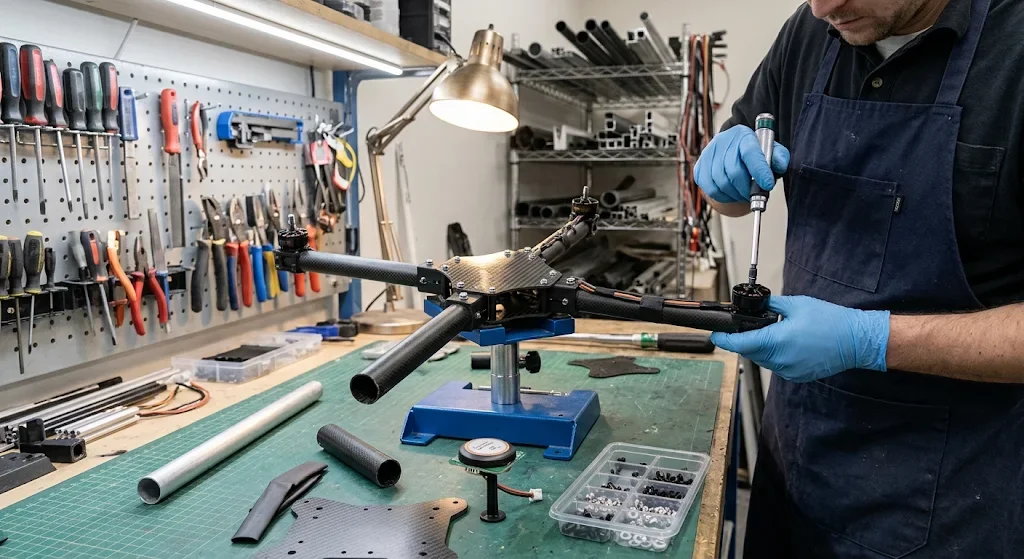
Most multirotor frames mix forms on purpose. The central plate is a woven laminate for flat stiffness and clean routing; the arms are pultruded tube for axial modulus; motor hard-points use thicker plate stock so fasteners have bite; landing gear stays tubular to absorb vertical shock. Camera mounts sit between these extremes, machined from plate to damp gimbal vibration without adding span.
| Component | Typical carbon form | What carbon buys | Watch-out |
|---|---|---|---|
| Frame plate | 3K twill laminate, 1.5-2.5 mm | Flat stiffness, low mass, clean layout | Seal cut edges against delamination |
| Arms | Pultruded tube, 1-3 mm wall | High axial modulus per gram | Bond or bolt joints; press-fit loosens |
| Motor mounts | Plate stock, 3-5 mm | Hard-point for screws and inserts | Add metal inserts for repeated service |
| Camera mount | CNC plate | Vibration damping, precise holes | Isolate from frame resonances |
| Landing gear | Tube, often thinner wall | Light spring mass for touchdown | Inspect after every hard landing |
| Battery tray | Plate or formed sheet | Flat base, strap slots | Deburr edges that chafe wires |
The pattern is deliberate: carbon fiber for drone frames works where stiffness-to-mass governs, and metal or polymer still wins at impact zones, threaded hard-points that see repeated torque, and any part sitting within a few centimetres of a GPS or radio antenna. A hybrid build is not a compromise; it is the correct engineering answer for most platforms.
- Frame and arms first: where carbon pays back in every gram saved and every hertz of vibration removed.
- Hard-points second: pair carbon plate with metal inserts wherever screws will be serviced.
- Keep-out zones: leave standoff distance around antennas; carbon is conductive and shields signals.
- Inspect on schedule: tube arms and landing legs are consumables after repeated impacts.
Benefits of Carbon Fiber for Drone Frames and Arms
The headline gain is stiffness-to-mass. At roughly 1.6 g/cm³, a twill laminate delivers flexural modulus in the 45-60 GPa range, and pultruded tube pushes axial values to 120-150 GPa — numbers aluminium cannot match at the same mass. For a quadcopter, that translates into shorter arm deflection under punch-out, cleaner inertial data for the flight controller, and flight time that does not bleed away on structural mass.
Corrosion resistance and fatigue behaviour matter in the field. Carbon does not rust after a wet landing, does not soften in heat the way some polymers do, and keeps its properties across thousands of vibration cycles if the edges are sealed. Vibration damping in the plate plane also helps camera footage: a stiff, well-damped mount passes less motor noise to the gimbal than a thin aluminium bracket that rings.
Design freedom is the third gain. Complex 2D shapes, cable channels, lightening pockets, and integrated antenna masts can be cut or moulded as one part instead of assembled from five. For custom carbon fiber drone frame builders, that consolidation reduces tolerance stack-up and gives the geometry the payload actually needs — motor spacing, sensor baselines, and arm length — without a bag of shims.
Limits of Carbon Fiber for Drone Airframes
Conductivity is the limit people discover too late. Carbon fibre laminates are electrically conductive, so a plate placed over a GPS module or beside a 2.4 GHz antenna detunes it and can blank the link. Plan mechanical standoff — plastic spacers, a cutout window, or a mast that moves the antenna clear of the airframe — before the first bench test, not after a failsafe in flight.
Impact response is the second hard limit. Aluminium bends and gives warning; carbon stores energy then releases it in delamination or a clean snap. A crash that only dents a metal arm may crack a tube along the fibre line, and longitudinal splits are usually scrap rather than repair. That is why replaceable arms on sacrificial mounts, and spares in the bag, belong in any serious build.
Anisotropy, repair difficulty, and cost finish the list. Strength is highest along the fibres and lowest through the thickness, so layup orientation must match the load path; a field wet-patch restores some in-plane stiffness but never the original interlaminar strength. Small carbon parts also cost more than moulded nylon or cut aluminium when volumes are low. Specify carbon where the numbers justify it, and leave the rest in conventional materials.
Frequently Asked Questions
Is carbon fiber worth it for every drone component?
No. It wins on frame plates, arms, and camera mounts where stiffness-to-mass and vibration control decide performance. It loses near antennas, in high-impact zones, and on small threaded parts that see repeated service.
Which parts should not use carbon fiber for drone builds?
Anything within a few centimetres of GPS or radio antennas, crash zones designed to deform, and low-volume brackets where nylon or aluminium is cheaper and tough enough. Battery straps and wire looms should also avoid raw cut edges that can chafe insulation.
How do carbon fiber drones compare on total cost?
Up-front cost is higher per part, but lighter airframes extend flight time and carbon arms that swap as units often cost less than rebuilding a monolithic frame. Run the numbers on spares and repair time, not just the shopping cart.
Conclusion
Carbon fiber for drone builds is a component-level decision: carbon where stiffness-to-mass and damping govern, metal and polymer where impact, threads, or antennas do. Map each part to its load case, keep conductive plate away from RF, and design arms as replaceables so a crash costs one tube, not the airframe. YongXian supplies cloth, tube, and plate stock for carbon fiber drones and custom frames, so send your drawing and target mass before ordering. browse drone frame materials or request a component quote.
Related Articles
- Carbon Fiber Rods for Fishing: Blank Selection for Builders
- Carbon Fiber Toe Plates: Rocker Design in Footwear
- Carbon Fiber Drones (carbon fiber drones): Airframes, Payloads, and Cost Impact
- Best Carbon Fiber Rod: Application-Based Picks
- The Crust Carbon Fiber: What the Term Means in Searches
- Carbon Fiber Rod for Drone: Spars, Arms, and Sizing
Interested in Our Products?
Contact our team for competitive pricing and technical specifications.
Get a QuoteRelated Products

Round Carbon Fiber Tube — 3K Plain Weave T700
Standard round carbon fiber tube manufactured from Toray T700 grade fiber with 3K plain weave. Offers balanced strength and stiffness for general industrial applications including robotics, automation, sports equipment, and aerospace structures.

Square Carbon Fiber Tube — 3K Twill T700
Square cross-section carbon fiber tube manufactured with 3K twill weave for torsional strength. Preferred for structural frames, trusses, and support columns where rectangular geometry offers design flexibility.

Round Carbon Fiber Tube — 3K Twill
Lightweight and ultra-stiff round tubes ideal for drone frames, robotics, and structural applications.

Round Carbon Fiber Tube — UD Unidirectional T700
Unidirectional (UD) round tube with all fibers aligned axially for maximum longitudinal stiffness. Ideal for applications requiring high bending rigidity with minimal weight, such as shafts, struts, and structural reinforcements.

Carbon Fiber Plate — 3K Twill T700 3.0mm
Medium-thickness 3.0mm carbon fiber plate offering significantly higher load capacity while maintaining attractive 3K twill finish. Suitable for structural brackets, reinforcement plates, and load-bearing panels.