
A carbon fiber composite core manufacturer is the root of the sandwich supply chain: everything downstream — converters, kitters, panel builders — inherits whatever density variation, cell structure and moisture story leaves its line. Choosing a carbon fiber composite core manufacturer on price alon
Introduction
A carbon fiber composite core manufacturer is the root of the sandwich supply chain: everything downstream — converters, kitters, panel builders — inherits whatever density variation, cell structure and moisture story leaves its line. Choosing a carbon fiber composite core manufacturer on price alone imports that variability into your panels, where it shows up two years later as a delamination claim.
This guide looks at the two real production families — foams and honeycomb — then the capability data, commercial terms and audit questions that separate a manufacturer from a relabeler.
Carbon Fiber Composite Core Manufacturer: What a Real Line Runs
Foam and honeycomb are made by different physics, and each manufacturer controls a different set of variables. Ask which process you are actually buying before you compare prices.
| Line type | Process | Key control variables | Typical output | Watch-outs |
|---|---|---|---|---|
| Extruded PVC foam | Twin-screw extrusion, slab foam | Batch temperature, blowing agent, line speed | Slabs 1200 x 2500 mm, 40-200 kg/m3 | Density drift along the slab length |
| Cast or molded foam | Box mold or continuous pour | Mix ratio, mold temperature, cure profile | Blocks up to 1200 x 3000 mm | Bottom-to-top density gradient |
| Aramid honeycomb | Foil corrugation or expansion | Foil thickness, cell size, bond node strength | Blocks 1200 x 2400 mm, 24-128 kg/m3 | Ribbon direction labeling errors |
| PET foam (recycled) | Extrusion from pellet blend | Blend ratio, crystallization, skin formation | Slabs, 60-200 kg/m3 | Void content in recycled feedstock |
| Balsa processing | Block cut, density sort, lamination | Grain orientation, moisture, glue line | Sheets and contour blanks | Natural variability between blocks |
A manufacturer who can name the control variable behind every number on the datasheet is running a process. One who only quotes finished densities is reselling someone else's slab under a new label.
Qualification Data to Request Before the First Order
Capability is proven by documents, not by a plant tour. Before a purchase order, collect this set and check that each item carries a lot number:
- Density map: measurements at three points along the slab and two across it; plus or minus 5 percent is a common acceptance window.
- Flatwise compression and shear results per density grade, with the test method cited and specimens cut from production material.
- Cell structure photos for honeycomb: cell size distribution and node integrity at magnification, plus ribbon direction marking on the block.
- Moisture content at packing: reading below 0.2 percent by mass for foam, with packing date and desiccant specification.
- Process traceability: extrusion or expansion line number, shift, and the resin or polymer lot that entered the run.
Run one audit day per year at the plant for the first two years of a program. Photograph the density check station, the curing ovens and the packing line — a manufacturer who refuses photos of the check station is telling you where the risk sits.
Carbon Fiber Composite Core US Manufacturer: Capability and Lead Time
A domestic carbon fiber composite core US manufacturer earns its premium on lead time, documentation and short iteration loops: common densities in one to two weeks, custom grades in three to five, and drawings that stay inside the country for controlled programs. Imported blocks from Asia can cut material cost 20 to 35 percent, but add four to eight weeks of ocean freight, moisture-control packing and an incoming inspection you must actually staff.
When you compare quotes, normalize to landed cost per cubic meter including freight, duty, inspection and scrap allowance — not ex-works price. Programs that switched to landed cost typically find the imported option still wins on commodity foams and loses on certified honeycomb, where documentation and cell consistency dominate the total.
Carbon Fiber Composite Core USA Maker: Pricing, MOQ and Terms
Pricing follows the process. Extruded commodity foams run on stock slabs with low MOQ — often one slab or even single boxes for standard densities. Molded custom densities need a full mold fill, so MOQ lands near one slab or 300 kg. Honeycomb is quoted by block with cell size and density as options; edge sealing and contour cutting add line time and cost.
- Quote structure: price per cubic meter, tooling charge if any, and the validity window — foam prices track polymer markets and quotes older than 30 days are unreliable.
- Payment terms: first orders often 50 percent with order, balance against copy documents; established accounts move to 30 to 60 days.
- Quality clause: right to reject on density out of tolerance, and replacement lead time written into the contract rather than negotiated later.
- Capacity check: monthly output of the line you will draw from, and what happens to your order when a bigger customer books the same week.
Ask the maker which customers share your grade. If the answer is only distributors, you are two removals from the process that controls your material.
Frequently Asked Questions
Should I buy from the manufacturer or a converter?
Buy from the manufacturer when you need lot control, custom densities or certified honeycomb; buy from a converter when you need cut-to-size kits, contour shapes and small quantities. Many programs do both: manufacturer for the slab, converter for the nest.
How do I audit a core manufacturer I cannot visit?
Require a live video walk of the density check station and packing line, lot-matched certificates for three recent shipments, and a third-party surveillance audit report from the last 12 months. Refusal on any of the three is a supplier risk decision, not a scheduling problem.
What MOQ and lead time should I plan for?
Stock foam densities: one slab, one to two weeks. Custom molded density: one slab or 300 kg, three to five weeks including trial slab. Honeycomb with sealing and cutting: four to six weeks. Add two weeks for first-article documentation if the program requires it.
Conclusion
The right carbon fiber composite core manufacturer shows you the control variables, the density map and the lot trace — then backs the numbers with replacement terms. Qualify the line, normalize quotes to landed cost, and keep one audit slot a year on the calendar.
YongXian manufactures and supplies carbon fiber composite core materials with lot certificates for global sandwich panel programs. Browse our composite materials or send your density, block size and annual volume for manufacturer-direct pricing.
Related Articles
- Carbon Fiber Composite Foam Supplier: Core Materials
- Carbon Fiber Composite Core Mill: Core Production
- Carbon Fiber Composite Core Supplier: Foam, Nomex and Qualification
- Carbon Fiber Composite Mold Maker: Tooling for OEM Programs
- Carbon Fiber Composite Hardener Supplier: Curing Agents for Epoxy Systems
- Carbon Fiber Composite Resin Mill: A Buyer Qualification Guide
Interested in Our Products?
Contact our team for competitive pricing and technical specifications.
Get a QuoteRelated Products

Round Carbon Fiber Tube — 3K Plain Weave T700
Standard round carbon fiber tube manufactured from Toray T700 grade fiber with 3K plain weave. Offers balanced strength and stiffness for general industrial applications including robotics, automation, sports equipment, and aerospace structures.

Custom Carbon Fiber Bicycle Frame
Full-custom carbon fiber bicycle frame manufactured to your geometry specifications. We produce road, gravel, mountain, and track frames using high-modulus carbon fiber layups optimized for each riding discipline. Monocoque construction with internal cable routing, available with disc or rim brake mounts.

Carbon Fiber Pickleball Paddle
High-performance pickleball paddle with Toray T700 carbon fiber face and polypropylene honeycomb core. Delivers excellent power-to-weight ratio, spin generation, and vibration dampening for competitive play.

Round Carbon Fiber Tube — 3K Twill
Lightweight and ultra-stiff round tubes ideal for drone frames, robotics, and structural applications.
Round Carbon Fiber Tube — UD Unidirectional T700
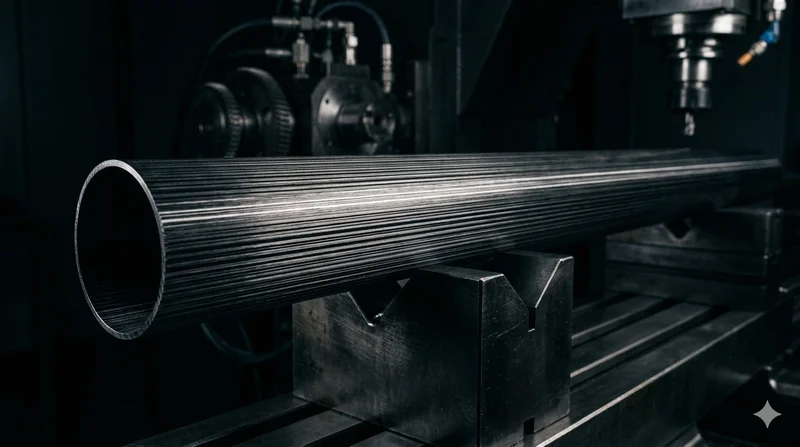
Unidirectional (UD) round tube with all fibers aligned axially for maximum longitudinal stiffness. Ideal for applications requiring high bending rigidity with minimal weight, such as shafts, struts, and structural reinforcements.