
Carbon fiber body armor is a phrase that circulates in forums and product listings far faster than the testing data behind it. Carbon laminate is light and stiff, and those two properties make it tempting as an armor material — but stiffness under a bending test and survivability under a rifle bulle
Introduction
Carbon fiber body armor is a phrase that circulates in forums and product listings far faster than the testing data behind it. Carbon laminate is light and stiff, and those two properties make it tempting as an armor material — but stiffness under a bending test and survivability under a rifle bullet are different questions, and the honest answer is that a bare carbon plate is not a ballistic stop. What carbon fiber does do well is everything around the threat: the carrier chassis, the spall liner, the stiff backing that keeps a ceramic strike face flat, and the protective shells on vehicles that never claim a rating in the first place.
This article separates the two jobs cleanly: what carbon fiber body armor can and cannot deliver against NIJ-rated threats, and where the same layup technology shows up in carbon fiber body parts, drone fuselages, and RC shells that need toughness, not bulletproofing.
What Carbon Fiber Body Armor Can and Cannot Do
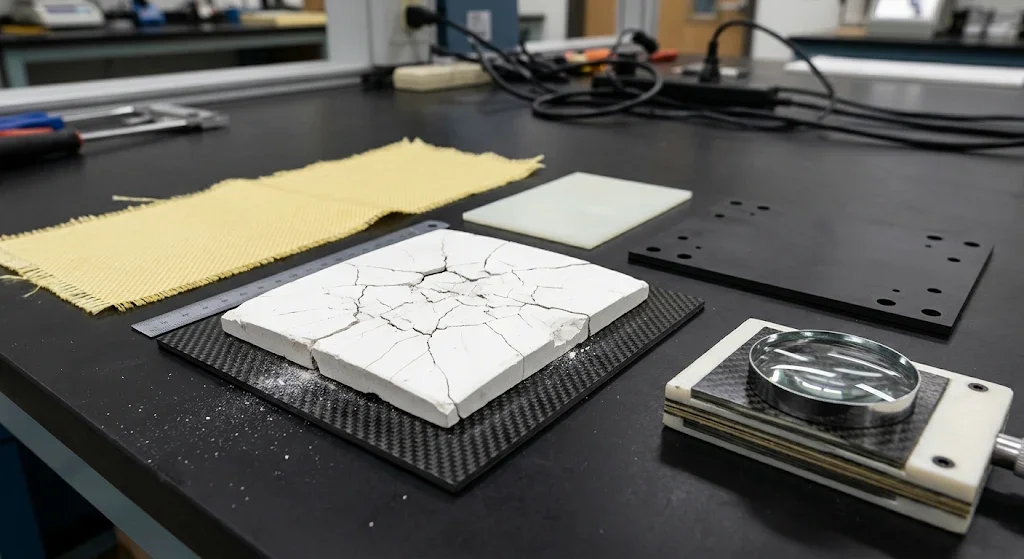
Against handgun and rifle threats, armor works by deforming and capturing the projectile across a fibrous network — aramid yarns stretch and grip, UHMWPE layers melt-draw and capture, ceramics shatter the tip and erode the core. Carbon fiber behaves differently: its fibers are strong in tension along the axis but the laminate is brittle through thickness, so a high-velocity impact cracks the matrix, delaminates plies, and can shed sharp fragments of its own. A carbon plate may defeat a low-energy threat by brute stiffness, but it does not reliably capture bullets, and it fails without the ductile warning that metal plates give.
| Material | Density | Primary mechanism | Role in an armor stack |
|---|---|---|---|
| Carbon fiber laminate | 1.6 g/cm³ | Stiffness, fragmentation risk | Backing stiffness, spall liner, carrier |
| Aramid (Kevlar-type) | 1.4 g/cm³ | Stretch and capture | Soft panels, fragment containment |
| UHMWPE | 0.97 g/cm³ | Melt-draw capture | Soft panels, plate backing |
| Alumina / silicon carbide | 3.5 - 3.2 g/cm³ | Shatter and erode | Strike face on hard plates |
| AR500 steel | 7.8 g/cm³ | Plastic deformation | Target plates, spall jackets |
The practical rule: carbon fiber belongs in the layers that manage energy after the strike face has done its work, never as the strike face itself.
Where Carbon Earns Its Place: Backing, Spall Liners, and Carriers
In a properly built hard plate, carbon fiber earns three legitimate roles. First, backing stiffness: a ceramic strike face cracked on first impact needs a flat, stiff substrate underneath to keep distributing the residual energy across the full panel instead of letting it punch through locally — a thin carbon laminate does that at a fraction of the weight of an equivalent aluminium backing. Second, spall containment: after the strike face breaks up the projectile, the fragment spray has to be trapped; carbon-aramid hybrid wraps and liners are used commercially for exactly this, with the carbon providing hoop stiffness and the aramid providing the stretch that traps fragments. Third, the carrier itself: the plate carrier chassis, cummerbund stiffeners, and quick-release frames are structural parts under constant flex, where carbon's fatigue stiffness beats polymer and its weight beats steel.
None of these roles involve stopping a bullet directly. All of them affect whether the rated insert behind the face actually performs on the second and third hit, which is why armourers who specify carbon in a system are specifying it as structure, not as protection.
Carbon Fiber Body Parts, Drone Bodies, and RC Shells: Same Layup, Different Threat
The layup discipline that qualifies carbon for armor sub-structure is the same discipline behind the softer side of the catalogue. Carbon fiber body parts — motorcycle helmet shells, chest protectors, fairing panels — are impact structures: they spread a point load across a laminate and sacrifice themselves once, then get replaced. That is a completely different design brief from a rated ballistic plate, even though both are cut from carbon sheet. The difference shows up in the layup: quasi-isotropic with toughened resin for parts that must not shard, versus the tightly controlled ply sequences of a backing laminate.
The same logic explains carbon fiber drone bodies and carbon fiber rc body shells. A drone fuselage built from carbon sheet protects avionics and batteries from crash energy, not from small-arms fire; an RC car body does the same for servos and speed controllers. Both are legitimate carbon fiber applications with real drop-test requirements, and both become misleading the moment they are marketed with ballistic vocabulary. Keep the categories separate: toughness structures in one bucket, NIJ-rated stacks in another.
NIJ Levels and What They Actually Test
The NIJ standard rates armor, not materials. Level IIIA covers common handgun rounds up to .44 Magnum against soft panels; Level III covers 7.62×51 millimetre NATO ball against hard plates; Level IV adds armour-piercing .30-06 M2 with a ceramic strike face. Each certification is a system certification — a specific plate, at a specific thickness, with a specific backing — so a carbon-carbon laminate that passes a home drop test has no standing in any of these categories. Ask three questions of any supplier claiming carbon armor performance: which NIJ level, which independent laboratory, and which batch serial number ties the test report to your order.
- Claim check: if the listing shows no NIJ number and no lab, it is a structural product, not armor.
- Weight check: hard plates that weigh less than 2.5 kilograms for a 10 x 12 inch single-curve rifle plate are almost always polymer-backed ceramic — carbon alone never gets there while still stopping Level III.
- Damage check: any dropped plate with visible delamination or edge cracks should be retired, whatever its rating, because the laminate's residual strength is now unknown.
Frequently Asked Questions
Can a carbon fiber plate stop a bullet on its own?
Not at any rating worth relying on. Carbon laminate is brittle through thickness: a high-velocity impact cracks the matrix and delaminates rather than stretching to capture the projectile. In testing, bare carbon plates either stop low-energy threats by brute stiffness or fail by fragmentation — neither behaviour is how a NIJ-certified plate is validated.
Where does carbon fiber actually appear inside body armor systems?
Three places: stiff backings that keep a ceramic strike face flat after first impact, spall liners that trap fragment spray with hoop stiffness, and the structural parts of the carrier — chassis, cummerbund stiffeners, and quick-release frames — where fatigue stiffness and low weight matter more than ballistic capture.
Are carbon fiber drone bodies or RC shells any kind of armor?
No. They are toughness structures: carbon sheet laid up to spread crash energy and protect avionics, batteries, or servos. They share layup technique with armor sub-structure but have no ballistic rating, and marketing them with protection language misleads buyers on both sides of the category.
Conclusion
Carbon fiber body armor is a study in boundaries: the material is exceptional as structure and mediocre-to-dangerous as a ballistic barrier. Treat carbon as the chassis, backing, and containment layer inside a certified system — never as the thing that stops the round — and keep the wider family of carbon fiber body parts, drone fuselages, and RC shells in the toughness category where their drop-test credentials actually apply. When a supplier blurs that line, the test report is the first thing to ask for, and the absence of one is the answer.
YongXian supplies carbon fiber sheet and cut parts for armor sub-structure, carriers, and protective shells: quasi-isotropic laminates with batch traceability, toughened resin options, and interlaminar data on request. Review sheet specifications or send your drawing for a quote.
Part of topic
Related Articles
- Carbon Fiber Rods for Fishing: Blank Selection for Builders
- Carbon Fiber Toe Plates: Rocker Design in Footwear
- Carbon Fiber Drones (carbon fiber drones): Airframes, Payloads, and Cost Impact
- Best Carbon Fiber Rod: Application-Based Picks
- The Crust Carbon Fiber: What the Term Means in Searches
- Carbon Fiber Rod for Drone: Spars, Arms, and Sizing
Interested in Our Products?
Contact our team for competitive pricing and technical specifications.
Get a QuoteRelated Products

Round Carbon Fiber Tube — 3K Plain Weave T700
Standard round carbon fiber tube manufactured from Toray T700 grade fiber with 3K plain weave. Offers balanced strength and stiffness for general industrial applications including robotics, automation, sports equipment, and aerospace structures.

Square Carbon Fiber Tube — 3K Twill T700
Square cross-section carbon fiber tube manufactured with 3K twill weave for torsional strength. Preferred for structural frames, trusses, and support columns where rectangular geometry offers design flexibility.

Round Carbon Fiber Tube — 3K Twill
Lightweight and ultra-stiff round tubes ideal for drone frames, robotics, and structural applications.

Round Carbon Fiber Tube — UD Unidirectional T700
Unidirectional (UD) round tube with all fibers aligned axially for maximum longitudinal stiffness. Ideal for applications requiring high bending rigidity with minimal weight, such as shafts, struts, and structural reinforcements.

Carbon Fiber Plate — 3K Twill T700 3.0mm
Medium-thickness 3.0mm carbon fiber plate offering significantly higher load capacity while maintaining attractive 3K twill finish. Suitable for structural brackets, reinforcement plates, and load-bearing panels.