
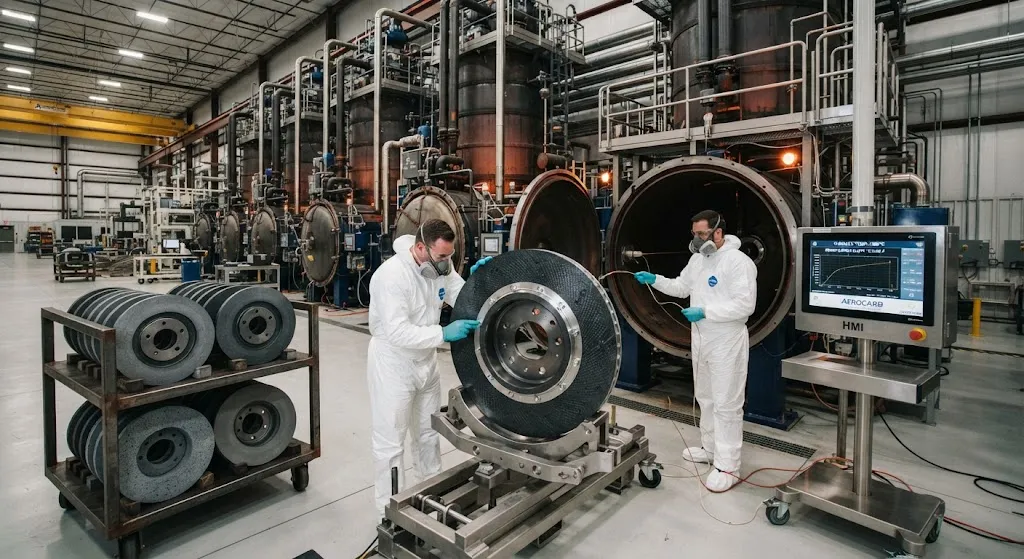
Carbon-carbon (C/C) brake discs are the highest-performance friction and heat-management component in commercial aviation, capable of absorbing the kinetic energy of a landing aircraft at temperatures that would destroy steel brakes. Because carbon fibers and the carbon matrix that bind
Introduction
Carbon-carbon (C/C) brake discs are the highest-performance friction and heat-management component in commercial aviation, capable of absorbing the kinetic energy of a landing aircraft at temperatures that would destroy steel brakes. Because carbon fibers and the carbon matrix that binds them retain their structural and frictional properties well beyond 1,000 °C, C/C brakes stop aircraft more reliably, weigh less, and last far longer than their metallic predecessors. This is why nearly every commercial jet and most military fighters now land on carbon brakes.
In August 2026 Collins Aerospace announced a $200 million expansion of its Spokane, Washington carbon brake plant, adding roughly 70,000 square feet and boosting output by an estimated 50 percent. The expansion centers on Duracarb, Collins' proprietary carbon brake technology, and reflects a multi-year ramp in commercial and military brake demand. This article explains what carbon-carbon brakes are, how the Duracarb expansion changes supply, and what the technology means for buyers specifying brake systems.
Why Carbon-Carbon Dominates Aviation Braking
An aircraft brake converts the kinetic energy of landing into heat. A large wide-body landing generates enough heat to raise steel brake discs to temperatures where they weaken, warp, and wear quickly. Carbon-carbon solves this because its components tolerate extreme temperatures:
| Property | Carbon-Carbon Brake | Steel Brake | Design Impact |
|---|---|---|---|
| Operating temperature | Up to ~1,500 °C capability | Practical limit ~500-600 °C | More energy absorbed per landing |
| Weight per disc | Roughly 40% lighter | Heavier dense steel | Lower landing-gear and fuel payload |
| Service life | Often 1,500-3,000 landings | Fewer landings between overhauls | Fewer replacements over life |
| Specific heat | ~0.71 kJ/kg-K near ambient | ~0.45-0.50 kJ/kg-K | More heat stored per kg |
| Thermal conductivity | High, tailorable in-plane | Moderate | Rapid heat spread, lower peak temps |
Two properties do most of the work. First, the high specific heat and thermal conductivity let a carbon-carbon rotor absorb and spread heat so quickly that peak disc temperatures stay manageable even through aborted takeoffs and repeated landings. Second, the material does not lose its friction or structural integrity at operating temperatures, so the brake stays effective through the entire cycle rather than fading as steel does.
How Carbon-Carbon Brakes Are Manufactured
Carbon brakes are built from carbon fiber preforms that are densified with a carbon matrix. The process determines cost, performance, and production capacity, which is why Collins' plant expansion is significant:
- Fiber preform: Needled or woven carbon fiber is formed into the annular disc shape, creating a porous skeleton with the necessary in-plane and through-thickness properties.
- Densification: The preform is densified by chemical vapor infiltration (CVI), where a hydrocarbon gas decomposes and deposits carbon inside the preform, or by liquid impregnation and pyrolysis of resin or pitch.
- Heat treatment: The parts are heated to graphitization temperatures, which tailors friction and wear behavior and stabilizes the material for repeated thermal cycling.
- Finishing and oxidation protection: Discs are machined to final tolerances and given a surface treatment or oxidation inhibitor to extend life and control the friction coefficient.
The densification step is the capacity bottleneck. CVI furnaces run for long cycles and occupy floor space, so a 70,000-square-foot expansion translates directly into more furnaces, more throughput, and finally lower unit costs as the fixed investment is spread across more discs.
Collins' $200 Million Spokane Expansion and Duracarb
Collins Aerospace's Duracarb is a carbon-carbon brake line developed to reduce wear and extend time between overhauls while maintaining the stable, high friction coefficient that pilots expect. The $200 million Spokane investment increases footprint by roughly 70,000 square feet and lifts capacity by approximately 50 percent, positioning the plant for a multi-year demand ramp:
| Factor | Detail | Why It Matters |
|---|---|---|
| Investment | $200 million | Largest single C/C brake capital program in recent years |
| Footprint increase | ~70,000 sq ft | New furnaces, machining, and inspection capacity |
| Capacity lift | About 50% | Covers commercial and military ramp |
| Technology | Duracarb proprietary C/C | Lower wear, longer overhaul interval |
| Primary driver | Narrowbody and fighter demand | Fleet growth raises brake throughput |
Commercial narrowbody production rates are rising in parallel with a military modernization cycle, and both push the same material through the same furnaces. The expansion is timed so that new capacity arrives as legacy and lease fleets reach their brake-replacement intervals, giving Collins and its buyers a more predictable supply chain through the middle of the decade.
Supply, Cost, and Cycle Implications for Buyers
For airlines, MRO providers, and leasing companies, carbon brake supply is as much a scheduling question as a materials one. Long CVI cycles mean capacity must be reserved months in advance, and brake replacement intervals rarely align with convenient maintenance slots:
- Lead time: Carbon brake discs typically require weeks to months of lead time because densification is slow and furnace capacity is finite.
- Pooling: Operators rotate discs in and out of a brake pool, so a stable supply of rotors and stators keeps aircraft on schedule without holding excess inventory.
- Overhaul cycle: Duracarb and similar low-wear C/C chemistries extend time between overhauls, reducing the total number of discs an operator must buy and stock over a fleet's life.
- Cost per landing: Although an individual carbon disc is far more expensive than steel, its much longer life and lower weight push the cost per landing below steel, which is the metric airlines actually manage.
The practical consequence of the expansion is a more elastic supply curve: as capacity grows, buyers gain negotiating room on lead times and unit pricing even as total demand climbs. Operators planning fleet-wide brake overhauls should align their material orders with the new capacity becoming available rather than competing for legacy spot supply.
Material Quality and India's Aerospace Supply Chain
Rising carbon brake demand is also pulling upstream carbon fiber manufacturers into the aerospace brake supply chain. Carbon fiber producers supplying the high-modulus and high-density grades used in brake preforms must certify consistent fiber properties, tow handling, and oxidation resistance, because a defect in a single preform row propagates through many expensive densification cycles.
For buyers, the quality gate is end-of-thermal-cycle performance: friction coefficient stability, wear rate, and dimensional integrity after repeated high-temperature landings. Suppliers that publish consistent batch data, maintain traceability, and support qualification testing are the ones that survive audit when a new-brake program scales. The Spokane expansion and similar investments globally are training this discipline into a wider slice of the carbon supply chain, with knock-on benefits for gears, structures, and propulsion components that share the same fiber base.
Frequently Asked Questions
Why are carbon-carbon brakes preferred over steel in aviation?
Carbon-carbon brakes absorb far more heat per unit weight because they combine a high specific heat with high thermal conductivity, and they retain friction and structural strength at the extreme temperatures generated during landing and rejected takeoffs. This allows lighter brake assemblies, shorter stopping distances in critical cases, and much longer service life between overhauls. On a cost-per-landing basis, carbon brakes are typically cheaper than steel even though each disc costs more, because they last several times longer and reduce the weight penalty that airlines pay for across every flight. For wide-body and high-cycle narrowbody fleets, the operating economics of carbon brakes are decisive.
How does the Duracarb technology reduce brake wear?
Duracarb is Collins' carbon-carbon brake chemistry tuned to reduce wear and extend the interval between overhauls. Wear reduction is achieved by controlling the density and microstructure of the carbon matrix, by optimizing the fiber arrangement in the preform, and by applying a surface treatment or oxidation inhibitor that protects the friction surface from the oxidation that drives material loss. The result is a more stable friction coefficient across the landing temperature range and a lower average wear rate, which translates into more landings before a disc must be removed and re-densified or replaced. This is what makes the material attractive to high-cycle operators where brake overhaul frequency is a major maintenance cost.
Does the $200 million expansion signal a shortage of carbon brakes?
No, the expansion is a response to expected demand growth, not a shortage fix. Collins is adding roughly 70,000 square feet and about 50 percent capacity to match a multi-year ramp in commercial narrowbody production and military modernization. Because carbon brake densification is slow and furnace capacity is finite, lead times can stretch during demand spikes, so proactive capacity investments smooth the supply curve and keep lead times predictable. For buyers, the effect is a more elastic supply chain and improved negotiating position on lead times and pricing, rather than a signal of imminent scarcity.
What are the main properties to check when sourcing carbon-carbon brake discs?
Buyers should verify friction coefficient stability across the operating envelope, the average wear rate and overhaul interval, maximum service temperature, and dimensional integrity after repeated thermal cycling. They should also confirm that the supplier maintains batch-level traceability on fiber and densification, publishes consistent test data, and supports qualification and audit during a program scale-up. Some operators also assess oxidation protection and the availability of pooled rotors and stators to keep maintenance schedules flexible. These properties together, rather than any single number, determine whether a carbon brake system meets a fleet's cost-per-landing and dispatch-reliability targets.
Conclusion
Carbon-carbon brakes are the accepted standard for aviation because they convert a landing's kinetic energy into heat more safely, more lightly, and more durably than any metallic alternative. Collins Aerospace's $200 million Spokane expansion and its Duracarb technology mark a deliberate bet that commercial and military brake demand will climb through the middle of the decade, and they give the supply chain the furnace capacity to meet it. For operators and MRO providers, the opportunity is a more predictable and elastic brake supply that lowers cost per landing and reduces the risk of dispatch delays.
Carbon-carbon is one of many high-performance carbon applications where sourcing the right material and the right supplier matters as much as the technology itself. Explore our carbon fiber materials and components for friction, structural, and thermal applications, or contact our technical team to discuss your brake or high-temperature program requirements.
Part of topic
Related Articles
- Carbon Fiber Mooring for Floating Offshore Wind: Fatigue and Corrosion in Deep Water
- Carbon Fiber Bicycle Frame Optimization: Layup Design and Manufacturing for Competitive Racing
- Carbon Fiber CFRP Retrofit for Infrastructure: Bridge and Building Seismic Strengthening
- Carbon Fiber Medical Imaging Equipment: Lightweight Gantry and Couch Structures for MRI/CT
- Carbon Fiber EV Battery Enclosures: Crash Safety and Electromagnetic Shielding Design
- Carbon Fiber Structures for Low-Altitude Economy: UAV Airframes and eVTOL Components
Interested in Our Products?
Contact our team for competitive pricing and technical specifications.
Get a QuoteRelated Products

Carbon Fiber Plate — 3K Twill T700 3.0mm
Medium-thickness 3.0mm carbon fiber plate offering significantly higher load capacity while maintaining attractive 3K twill finish. Suitable for structural brackets, reinforcement plates, and load-bearing panels.

Carbon Fiber Plate — 3K Twill T700 1.5mm
Thin 1.5mm carbon fiber plate with 3K twill weave surface. Lightweight and stiff, commonly used for covers, panels, drone bodies, and applications requiring a premium aesthetic appearance.

Square Carbon Fiber Tube — 3K Twill T700
Square cross-section carbon fiber tube manufactured with 3K twill weave for torsional strength. Preferred for structural frames, trusses, and support columns where rectangular geometry offers design flexibility.
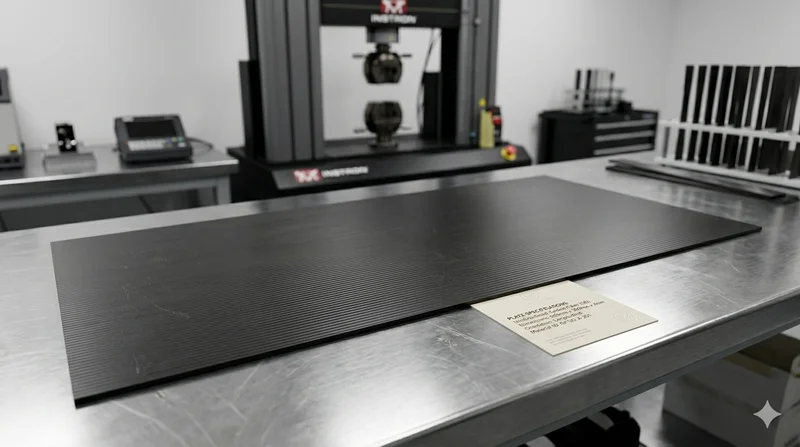
Carbon Fiber Plate — UD Unidirectional T700
Unidirectional carbon fiber plate with all fibers oriented in a single direction for maximum strength along the fiber axis. Essential for structural reinforcements, splints, and applications where load direction is predictable.
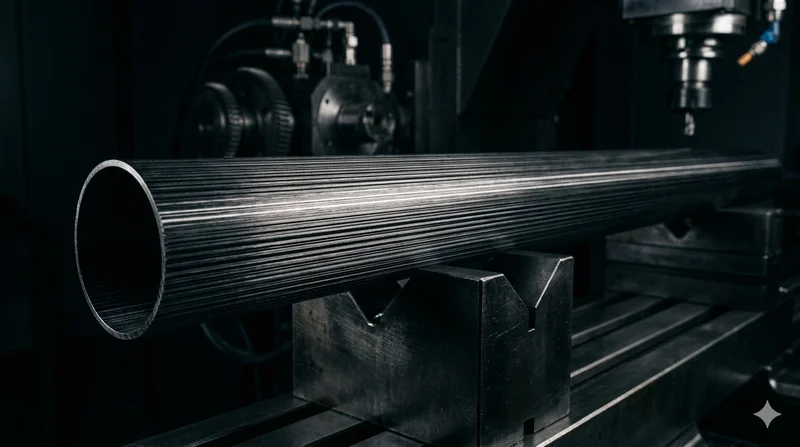
Round Carbon Fiber Tube — UD Unidirectional T700
Unidirectional (UD) round tube with all fibers aligned axially for maximum longitudinal stiffness. Ideal for applications requiring high bending rigidity with minimal weight, such as shafts, struts, and structural reinforcements.