
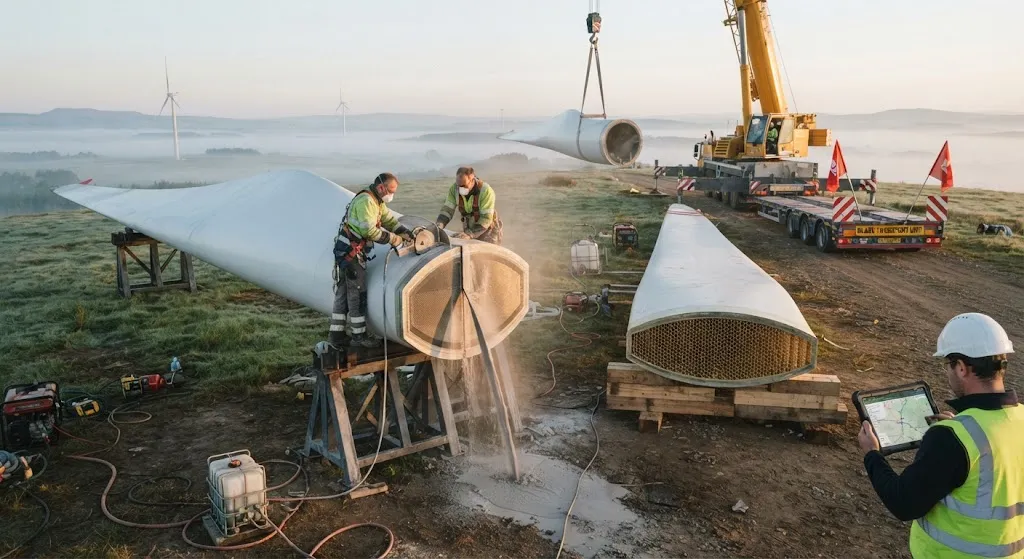
Every wind turbine blade eventually becomes a disposal problem, and the first industrial step of that problem is dismantling and pre-processing. A modern blade is 60-115 meters long, weighs 20-40 tonnes and is built from a mix of glass fiber, carbon fiber, epoxy, balsa and adhesives. It
Introduction
Every wind turbine blade eventually becomes a disposal problem, and the first industrial step of that problem is dismantling and pre-processing. A modern blade is 60-115 meters long, weighs 20-40 tonnes and is built from a mix of glass fiber, carbon fiber, epoxy, balsa and adhesives. It cannot be trucked in one piece, and the way it is cut and classified on site determines everything that follows: transport cost, recycling yield and the value of the recovered material. This stage, called decommissioning and pre-processing in the CIRCLE4WIN value chain, is where wind blade recycling is won or lost.
Why Cutting Strategy Sets the Economics
Transport is the first constraint. Road haulage of a 100-meter blade requires an out-of-gauge convoy with police escorts, route surveys for bridge clearance and curvature radius, and special permits in every jurisdiction it crosses. For most decommissioning sites, the practical answer is to cut the blade into sections short enough for standard or oversized-lift trailers, typically 10-16 meter segments that fit within legal road envelopes.
- Cut location: The blade root near the hub, the mid-span joint, and the tip are cut lines with different material densities; pre-planning the cut plan saves a day of crane time.
- Cut method: Diamond wire saws, hydraulic shears and abrasive waterjet are the practical options; abrasive waterjet is preferred where carbon fiber layers must not be thermally damaged.
- Segment sizing: Segments of 10-16 meters match road envelopes; below 3 meters they fit shipping containers, which opens the export route at the cost of more cutting labor.
Blade decommissioning logistics specialists such as IX Decom handle the abnormal-load transport side: route planning, permits, escort coordination and multimodal transfers that move segments from remote wind farms to port or processing hubs.
The On-Site Dismantling Sequence
A typical single-blade removal runs through a disciplined sequence. First, the rotor is indexed so the target blade hangs vertically or horizontally accessible; then the blade bolts at the pitch bearing are released and the blade is lifted by crane onto trestles or a transport frame. On the ground, the blade is cut to the agreed section plan, with the cut points selected to avoid adhesive bond lines where possible. Workers follow confined-space and dust-control procedures because blade interiors contain balsa dust, glass splinters and, in carbon blades, conductive fiber dust that can damage electrical equipment nearby.
Safety and contamination control converge at this stage. Metals — root studs, lightning protection, edge protectors — must be separated before shredding, because a single steel bolt can wreck a granulator and contaminate a whole batch of recovered fiber. Gelcoat and paint layers are chemically inert but add contamination to recovered fiber grades, which is why clean cut lines and pre-sorting at the wind farm matter for the material's final value.
The Size Reduction Chain
After transport to a processing hub, blades pass through a staged size reduction chain. Each stage reduces particle size and separates materials progressively.
| Stage | Input size | Output size | Typical equipment | Purpose |
|---|---|---|---|---|
| 1. Sectioning (on site) | Whole blade, 60-115 m | 10-16 m segments | Diamond wire saw, hydraulic shear | Road / sea transport |
| 2. Primary shredding | 10-16 m segments | Below 300 mm | Industrial two-shaft shredder | Volume reduction |
| 3. Metal and core separation | Below 300 mm | Sorted fractions | Magnetic separator, air classifier | Remove bolts, balsa, PU foam |
| 4. Granulation | Below 300 mm | 2-10 mm granulate | Granulator, rotor mill | Feedstock for recovery routes |
| 5. Milling and sieving | 2-10 mm granulate | Fiber-rich fraction below 3 mm | Hammer mill, vibratory sieve | Fiber / resin powder separation |
The output of the chain is not one material but several: fiber-rich granulate, resin-rich powder, separated balsa and foam, and scrap metal. Each fraction has its own buyer, and the quality of sorting at each stage directly sets the price of every fraction.
Feedstock Grading Decides the Recovery Route
Feedstock grading is the decision system that routes each batch to the most economical recovery process. The two dominant questions are fiber type and contamination level. Glass fiber blades have no carbon value and are typically routed to cement co-processing, where the blade material substitutes for coal and sand in the kiln. Carbon fiber blades are more valuable and are routed to pyrolysis or solvolysis, which recover the carbon fiber for reuse in new composites.
| Feedstock grade | Fiber type | Contamination | Recommended route | Relative value |
|---|---|---|---|---|
| A — clean carbon sections | Carbon fiber dominant | Low (clean cuts, minimal coating) | Pyrolysis / solvolysis fiber recovery | Highest |
| B — hybrid or bonded carbon | Carbon with glass shells | Medium (adhesive, core residue) | Solvolysis or upgraded cement route | Medium |
| C — glass-dominant reject | Glass fiber dominant | High (gelcoat, metals, foam) | Cement co-processing / energy recovery | Lowest |
Contamination limits are strict: cement kiln operators cap chlorine and metal content, and fiber recyclers specify maximum resin and coating fractions. Analyzing a representative sample of each batch — by burn-off test, fiber content measurement and elemental analysis — is standard practice before a batch is committed to a route.
Economics and the Path to Scale
The economics of blade pre-processing are still being scaled. Cutting, transport and shredding cost more per tonne than landfill in most regions, which is why regulation and landfill bans are the main demand drivers. As volumes grow, the industry is moving toward mobile pre-processing units that shred at or near the wind farm, cutting transport cost, and toward automated sorting that reduces the labor content of the grading step. Both trends are necessary for blade recycling to reach the scale the industry's 2030 decommissioning wave will require.
Frequently Asked Questions
Why can't blades be recycled whole?
Blades are too large to transport and too heterogeneous to process in one pass. A blade combines glass fiber, carbon fiber, resins, balsa, foam, adhesives and metal fittings. Every recovery process — pyrolysis, solvolysis, cement co-processing — accepts a limited particle size and a defined material composition. So the blade must be cut into transportable sections, shredded to the process's input size, and sorted by fiber type and contamination before any recovery route can run. This staged pre-processing is not optional overhead; it is what makes every downstream recovery step physically and economically possible.
What does a decommissioning logistics specialist like IX Decom actually do?
IX Decom and similar specialists manage the abnormal-load transport of decommissioned blades. Their work covers route planning under real road constraints, securing permits from every authority along the route, arranging police escorts and convoy management, coordinating crane and loading operations at the wind farm, and organizing multimodal transfers to ports for sea freight. In practice they act as the transport backbone between the wind farm and the processing hub, turning the physical challenge of moving a 100-meter blade into a scheduled, documented logistics operation.
Can carbon fiber be recovered after the blades are shredded?
Yes, but only if the feeding material is prepared correctly. Carbon fiber is recovered from shredded blade material by thermal (pyrolysis) or solvolytic processes that remove the resin matrix and leave the fiber. The recovery quality depends on how clean the feedstock is: metal must be removed, coating content must be low, and carbon-rich batches must not be mixed with glass-dominant batches. This is why pre-processing plants grade feedstock into classes A, B and C before it reaches the recycler. When contaminations are controlled, recycled carbon fiber from blades can be reused in new composite products such as cladding, tooling and secondary structures.
Conclusion
Dismantling and pre-processing is the gate that controls the entire wind blade recycling value chain. Cutting strategy sets transport economics, the size reduction chain determines which fractions can be sold, and feedstock grading decides whether a blade becomes valuable recovered carbon fiber or kiln fuel. As the decommissioning wave builds toward 2030, suppliers of cutting equipment, abnormal-load logistics and pre-processing capacity are as strategic as the recyclers themselves.
If your project involves decommissioned blade materials, recycled fiber feedstocks or composite processing equipment, review our composite material range or contact our engineering team to discuss your material and processing requirements.
Part of topic
Related Articles
- Carbon Fiber Mooring for Floating Offshore Wind: Fatigue and Corrosion in Deep Water
- Carbon Fiber Bicycle Frame Optimization: Layup Design and Manufacturing for Competitive Racing
- Carbon Fiber CFRP Retrofit for Infrastructure: Bridge and Building Seismic Strengthening
- Carbon Fiber Medical Imaging Equipment: Lightweight Gantry and Couch Structures for MRI/CT
- Carbon Fiber EV Battery Enclosures: Crash Safety and Electromagnetic Shielding Design
- Carbon Fiber Structures for Low-Altitude Economy: UAV Airframes and eVTOL Components
Interested in Our Products?
Contact our team for competitive pricing and technical specifications.
Get a QuoteRelated Products

Carbon Fiber Plate — 3K Twill T700 1.5mm
Thin 1.5mm carbon fiber plate with 3K twill weave surface. Lightweight and stiff, commonly used for covers, panels, drone bodies, and applications requiring a premium aesthetic appearance.

Square Carbon Fiber Tube — 3K Twill T700
Square cross-section carbon fiber tube manufactured with 3K twill weave for torsional strength. Preferred for structural frames, trusses, and support columns where rectangular geometry offers design flexibility.
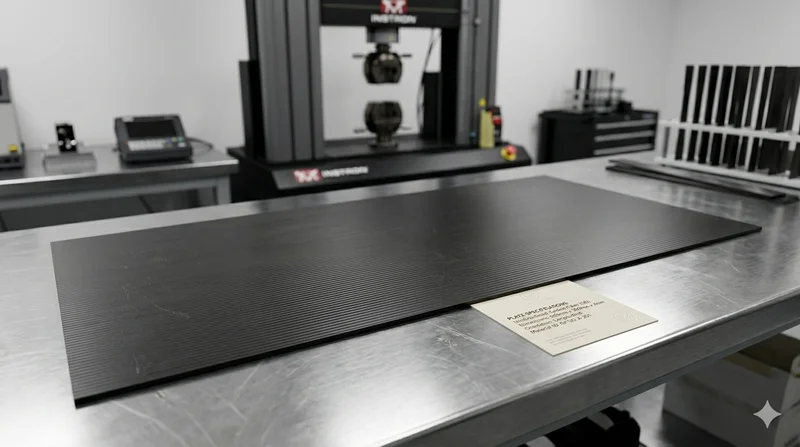
Carbon Fiber Plate — UD Unidirectional T700
Unidirectional carbon fiber plate with all fibers oriented in a single direction for maximum strength along the fiber axis. Essential for structural reinforcements, splints, and applications where load direction is predictable.
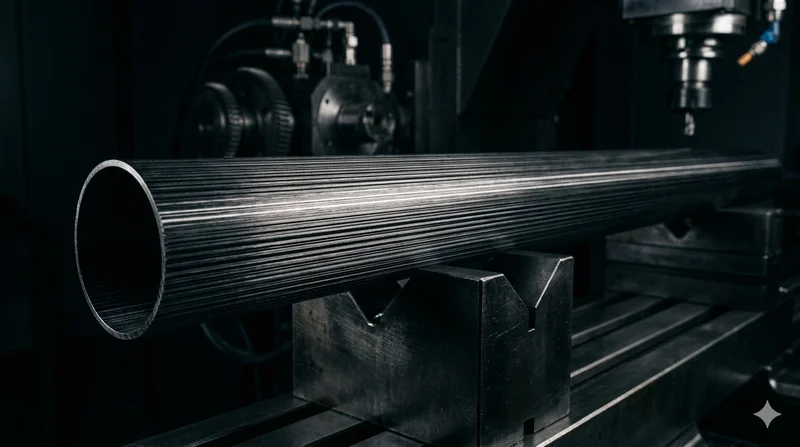
Round Carbon Fiber Tube — UD Unidirectional T700
Unidirectional (UD) round tube with all fibers aligned axially for maximum longitudinal stiffness. Ideal for applications requiring high bending rigidity with minimal weight, such as shafts, struts, and structural reinforcements.
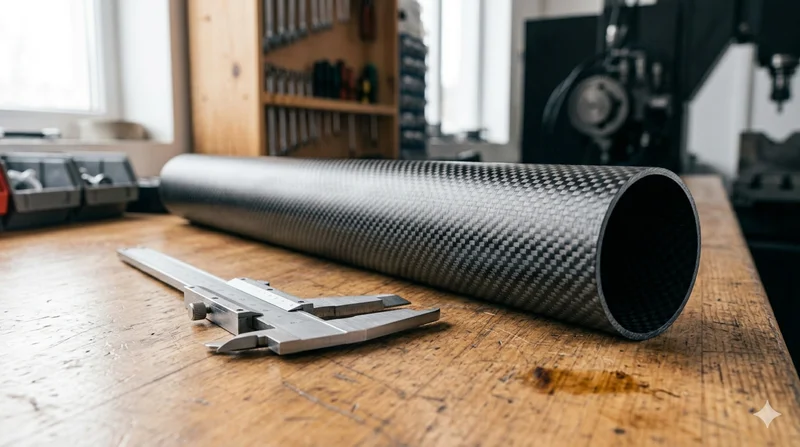
Round Carbon Fiber Tube — 3K Plain Weave T700
Standard round carbon fiber tube manufactured from Toray T700 grade fiber with 3K plain weave. Offers balanced strength and stiffness for general industrial applications including robotics, automation, sports equipment, and aerospace structures.