
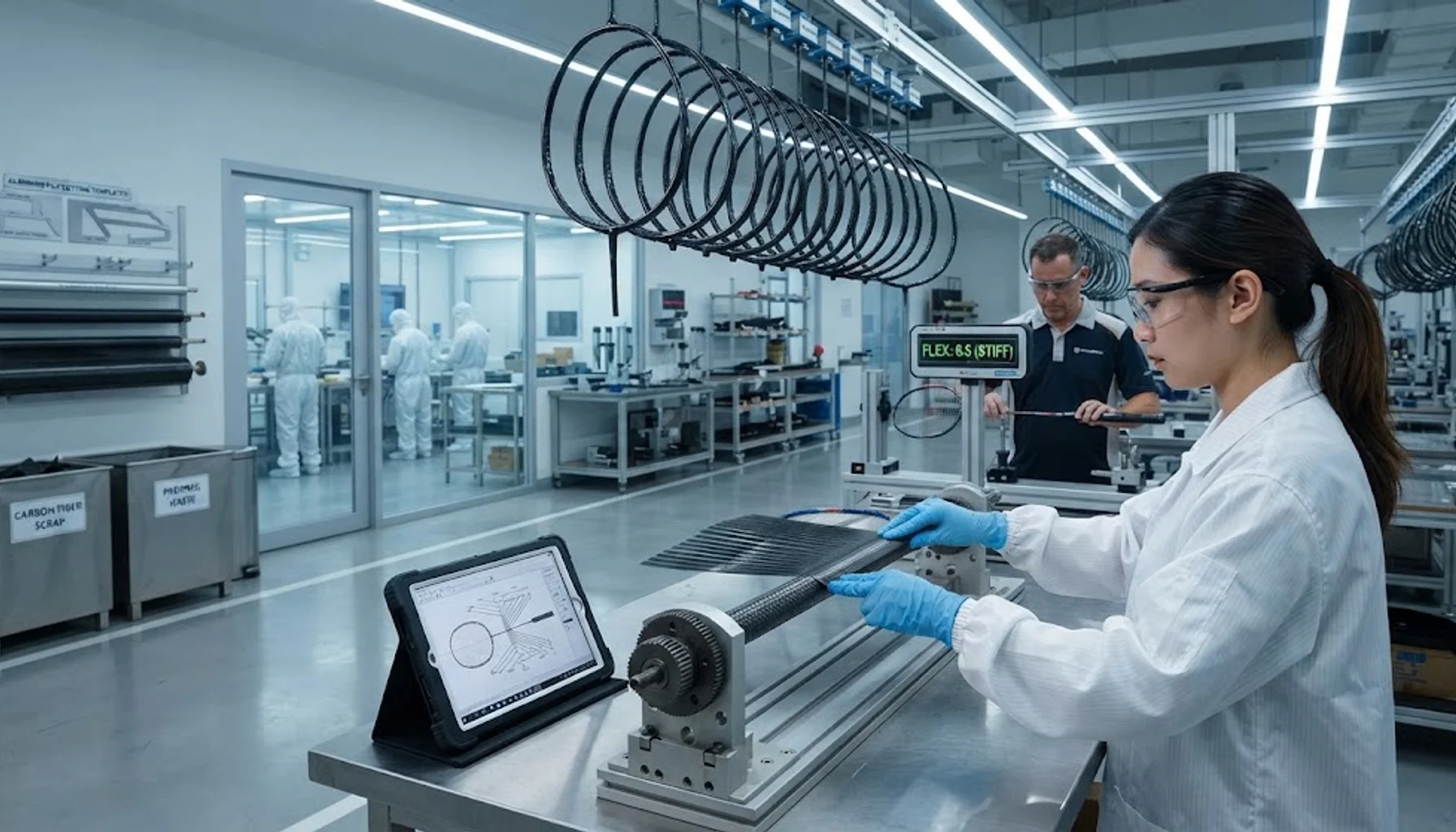
Modern badminton rackets use high-modulus carbon fiber with stiffness ratings from 80 to 100+ flex points. This article explains how carbon fiber layup, resin content, and frame geometry affect racket performance.
Introduction
Carbon fiber has revolutionized badminton racket design since its introduction in the 1980s, transforming a sport dominated by steel and aluminum frames into one where advanced composite materials determine competitive advantage. Modern badminton rackets represent one of the most carbon-fiber-intensive sporting goods, with frame weights of 75–95 grams achieved through ultra-thin carbon fiber layups, sophisticated resin systems, and precision manufacturing processes that rival aerospace production standards.
The performance envelope of a badminton racket — its stiffness profile, weight distribution, moment of inertia, and vibration characteristics — is fundamentally determined by carbon fiber selection, layup architecture, and manufacturing quality. Understanding how these variables interact is essential for players seeking to optimize their equipment for specific playing styles and for manufacturers competing in a market where performance differentiation drives premium pricing.
Carbon Fiber Selection for Badminton
Premium badminton rackets incorporate multiple grades of carbon fiber within a single frame, each selected for specific mechanical properties:
High-Modulus (HM) carbon fiber (40–50 ton modulus): Used in the shaft and lower frame for maximum stiffness and energy transfer. HM carbon provides the highest specific stiffness of any commercial fiber, enabling shafts that flex and recover with minimal energy loss. The high modulus also enables thinner shaft walls, reducing weight while maintaining stiffness.
Ultra-High-Modulus (UHM) carbon fiber (50–70 ton modulus): Reserved for premium rackets, UHM carbon is used in critical stiffness zones — typically the shaft center and frame throat. The extremely high modulus (up to 700 GPa) provides maximum energy return, but at increased cost and reduced impact resistance.
Intermediate-Modulus (IM) carbon fiber (30–40 ton modulus): Used in the frame head and mid-section for balanced stiffness and impact resistance. IM carbon provides better vibration damping than HM, improving player comfort during extended play.
Standard-Modulus (SM) carbon fiber (23–30 ton modulus): Used in impact-prone areas — frame top and sides — for maximum toughness and damage tolerance. SM carbon absorbs impact energy better than higher-modulus fibers, protecting the frame from cracking during off-center hits or accidental ground contact.
Shaft Design and Stiffness
The shaft is the most performance-critical component of a badminton racket, as it determines the energy transfer from player to shuttlecock. Shaft design variables include:
Flex rating: Measured on a standardized scale (typically 80–100+ points), flex rating indicates the shaft's resistance to bending. Flexible shafts (80–85 points) provide more timing forgiveness and are preferred by control-oriented players. Stiff shafts (91–100+ points) transfer energy more efficiently and are preferred by power players and advanced competitors.
Layup architecture: The shaft's carbon fiber layup typically consists of 0° plies for longitudinal stiffness combined with ±45° plies for torsional rigidity. The ratio of 0° to ±45° plies determines the flex profile: more 0° plies create a stiffer shaft with sharper flex transition; more ±45° plies create a more progressive flex with better torsional stability.
Shaft diameter and wall thickness: Thinner shafts (6.0–6.5 mm diameter) flex more easily and are lighter, but may feel too flexible for powerful players. Thicker shafts (7.0–7.5 mm) provide more stiffness and stability, but add weight. Wall thickness (0.4–0.8 mm) interacts with diameter to determine the overall stiffness profile.
Frame Geometry and Weight Balance
The frame head determines the racket's weight distribution and moment of inertia, which directly affect swing speed, power generation, and defensive reaction time:
Head-heavy balance (MOI > 300 kg·cm²): Concentrates mass in the frame head, increasing momentum during the swing and generating more power on smashes. Head-heavy rackets favor aggressive attacking play but require more strength and technique to control. Typical application: singles players with powerful smash technique.
Head-light balance (MOI < 280 kg·cm²): Distributes mass toward the handle, enabling faster racket head speed and quicker defensive reactions. Head-light rackets favor fast-paced doubles play and net exchanges. Typical application: doubles players and players with quick wrist action.
Even-balance (MOI 280–300 kg·cm²): Distributes mass evenly between head and handle, providing versatility for all-court play. Even-balance rackets are the most popular choice for recreational and intermediate players.
Manufacturing Process
Premium badminton rackets are manufactured using processes that parallel aerospace production:
Pre-preg layup: Carbon fiber pre-preg sheets are cut to precise patterns and layered on mandrels according to the engineered layup sequence. The layup process is typically manual for premium rackets, with technicians placing individual plies to achieve the exact fiber orientation specified in the design.
Autoclave cure: The layed-up mandrels are placed in an autoclave and cured at 120–130°C under 4–6 bar pressure for 2–4 hours. The autoclave pressure consolidates the laminate, removing voids and ensuring intimate contact between plies. Cure cycle precision is critical: temperature variations of ±5°C can cause stiffness variations of ±3 flex points.
Mandrel extraction: After cure, the internal mandrel is extracted — a delicate operation that requires the mandrel to collapse or dissolve without damaging the cured laminate. Some manufacturers use soluble mandrels that dissolve in hot water; others use collapsible metal mandrels with complex extraction mechanisms.
Finishing: The cured frame is trimmed, sanded, painted, and fitted with grommets, grip, and string. Surface finish quality is critical for premium rackets, requiring multiple paint coats and clear coats to achieve the required gloss level and scratch resistance.
Performance Testing and Quality Control
Badminton racket manufacturers employ rigorous testing to ensure consistency:
Stiffness testing: Each racket is tested on a flex machine that measures deflection under standardized loading. Production tolerance is typically ±2 flex points — a tight specification that requires excellent process control.
Weight and balance: Rackets are weighed and balanced to within ±2 grams and ±5 mm balance point tolerance.
Vibration testing: Impact vibration is measured using accelerometers. Premium rackets achieve vibration frequencies above 180 Hz (reducing perceived vibration) with damping times below 20 milliseconds.
Durability testing: Sample rackets from each production lot undergo fatigue testing — 10,000 impact cycles at 80% of design load — to verify structural integrity.
Conclusion
Carbon fiber technology has transformed badminton from a sport of simple metal frames to one of advanced composite engineering. The interplay of carbon fiber modulus selection, shaft layup architecture, frame geometry, and manufacturing precision creates a performance envelope that directly impacts competitive outcomes. As carbon fiber technology continues to advance — with new fiber grades, automated manufacturing, and digital design tools — badminton rackets will continue to push the boundaries of what is possible in sporting goods engineering.
Part of topic
Related Articles
- Carbon Fiber Mooring for Floating Offshore Wind: Fatigue and Corrosion in Deep Water
- Carbon Fiber Bicycle Frame Optimization: Layup Design and Manufacturing for Competitive Racing
- Carbon Fiber CFRP Retrofit for Infrastructure: Bridge and Building Seismic Strengthening
- Carbon Fiber Medical Imaging Equipment: Lightweight Gantry and Couch Structures for MRI/CT
- Carbon Fiber EV Battery Enclosures: Crash Safety and Electromagnetic Shielding Design
- Carbon Fiber Structures for Low-Altitude Economy: UAV Airframes and eVTOL Components
Interested in Our Products?
Contact our team for competitive pricing and technical specifications.
Get a QuoteRelated Products

Carbon Fiber Plate — 3K Twill T700 3.0mm
Medium-thickness 3.0mm carbon fiber plate offering significantly higher load capacity while maintaining attractive 3K twill finish. Suitable for structural brackets, reinforcement plates, and load-bearing panels.

Carbon Fiber Plate — 3K Twill T700 1.5mm
Thin 1.5mm carbon fiber plate with 3K twill weave surface. Lightweight and stiff, commonly used for covers, panels, drone bodies, and applications requiring a premium aesthetic appearance.

Square Carbon Fiber Tube — 3K Twill T700
Square cross-section carbon fiber tube manufactured with 3K twill weave for torsional strength. Preferred for structural frames, trusses, and support columns where rectangular geometry offers design flexibility.
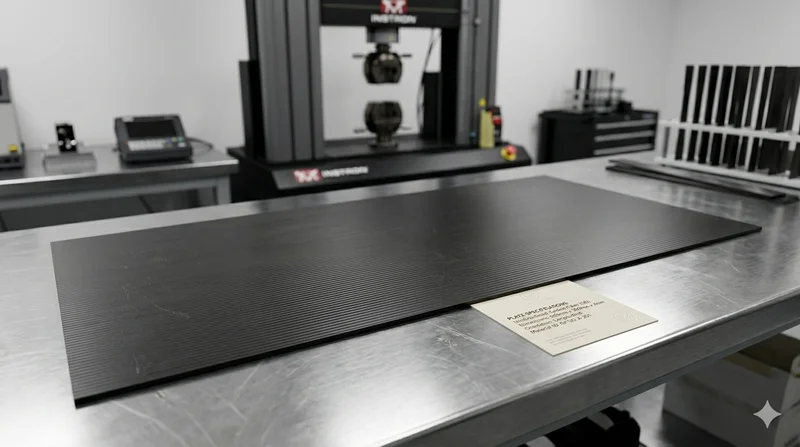
Carbon Fiber Plate — UD Unidirectional T700
Unidirectional carbon fiber plate with all fibers oriented in a single direction for maximum strength along the fiber axis. Essential for structural reinforcements, splints, and applications where load direction is predictable.
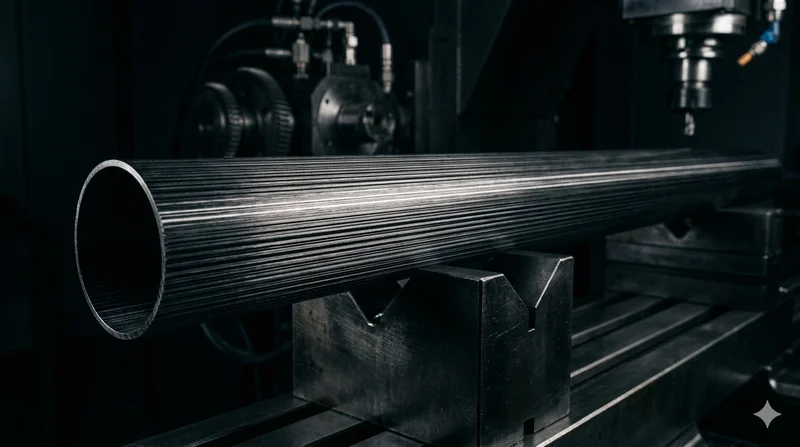
Round Carbon Fiber Tube — UD Unidirectional T700
Unidirectional (UD) round tube with all fibers aligned axially for maximum longitudinal stiffness. Ideal for applications requiring high bending rigidity with minimal weight, such as shafts, struts, and structural reinforcements.