
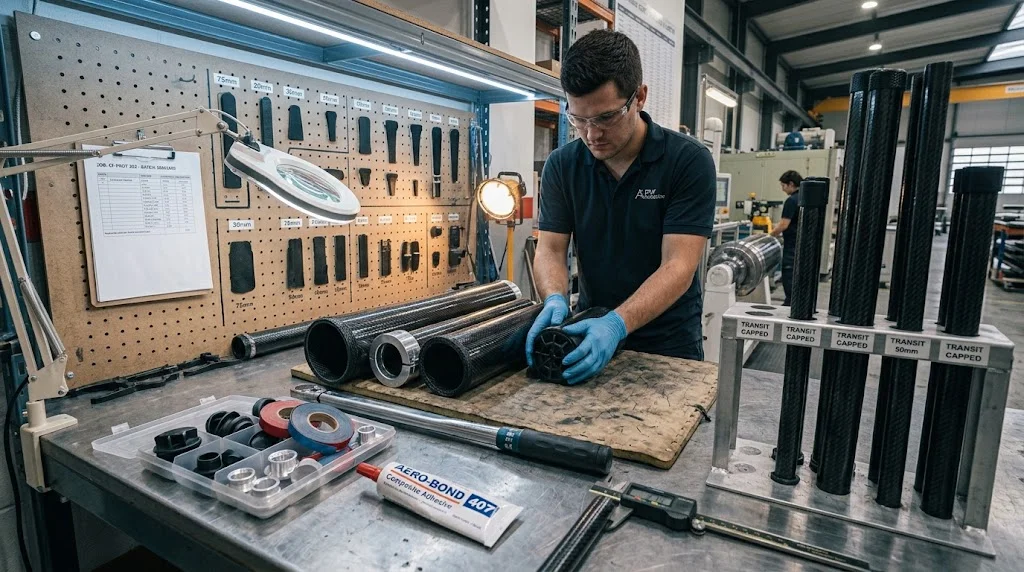
A carbon fiber tube protector is any fitting, sleeve or coating that keeps a tube's cut edges, exposed rims and clamp zones from becoming the start of a delamination. Carbon laminate is strong in-plane and vulnerable at the edge: a single dropped tube can start a split at an unsealed rim that grows
Introduction
A carbon fiber tube protector is any fitting, sleeve or coating that keeps a tube's cut edges, exposed rims and clamp zones from becoming the start of a delamination. Carbon laminate is strong in-plane and vulnerable at the edge: a single dropped tube can start a split at an unsealed rim that grows under vibration for months before it is visible from outside. This guide covers what to protect, which protector type suits which exposure, and how carbon fiber tube inserts, caps and clamps are specified so the protection does not cost more stiffness or clearance than it saves in damage.
Protection matters most where tubes are handled, shipped and re-fitted repeatedly — robotics frames, camera masts, tent and awning poles, slide rails and anything using carbon fiber tubes as a structural member rather than a sealed enclosure.
What a Carbon Fiber Tube Protector Actually Does
Four distinct threats drive the choice of protection:
- Edge crush and split: The laminate at a cut rim carries load across the plies rather than along them. Impact at the rim — a tube knocked against a bench, a set screw tightened onto bare wall — starts a split that follows the fiber. An end cap or sleeve moves that impact into a material designed to deform.
- Abrasion and handling wear: Tubes that slide in and out of racks wear the outer ply at the contact band. Where the rubbing is expected, a replaceable sleeve or guard strip costs a fraction of a replacement tube.
- Moisture wicking at unsealed edges: An open cut edge wicks water into the outer plies along the fibers. Over a season this shows as white fuzz and, in freeze-thaw cycles, as edge swelling. Sealing is the cheapest protector there is.
- Point loads from hardware: Clamps, set screws, pins and hangers concentrate load into a few square millimeters. A load-spreading collar or sleeve keeps bearing stress below the laminate's limit.
Choosing a Carbon Fiber Tube Protector for Your Exposure
The table matches protector type to the threat it addresses, with the practical limits that decide selection.
| Protector type | Primary threat addressed | Typical material | Temperature range | Indicative cost per tube end |
|---|---|---|---|---|
| End cap, push-in or adhesive | Rim impact, moisture ingress, handling | PVC, PA6, TPU, aluminium | -20 to 80 C (TPU to 100 C) | $0.30-2.50 |
| Edge trim / rim guard | Sharp rim, paint damage, vibration fretting | Flexible PVC, EPDM | -30 to 90 C | $0.40-1.80 per metre |
| Shrink sleeve / protective film | Surface abrasion, transit scuffing | PE heat-shrink, PVC film | -40 to 105 C | $0.20-1.20 per tube |
| Silicone or rubber-lined clamp collar | Crush from fasteners, point loads | Aluminium collar + silicone liner | -50 to 200 C | $2.00-9.00 |
| Bonded metal insert | Thread pull-out, repeated assembly | 6061 aluminium, stainless, PEEK | -40 to 150 C (PEEK higher) | $1.50-12.00 |
| Composite wear band (wrap) | Cyclic rubbing at rack contact points | Glass-fibre tape, aramid wrap | up to 120 C | $1.00-4.00 |
The rule of thumb: protect the rim first (caps and sealing), the clamp second (lined collars), and the surface last (film or wrap). Surface protection is cosmetic on a bench and structural only where repeated sliding occurs.
Carbon Fiber Tube Inserts for Serviceable Ends
Where a tube must accept a bolt, a rod end or a repeated assembly cycle, a bonded carbon fiber tube insert is the correct answer rather than threading the laminate directly:
- Sizing: Insert wall should be at least 1.0-1.5 mm, engagement length at least 1.5x the thread nominal diameter, with the adhesive gap held at 0.1-0.3 mm. For an M8 insert in a 30 mm OD tube with 2.5 mm wall, pull-out typically exceeds 5 kN.
- Material choice: Aluminium 6061 for lightness and machinability, stainless where corrosion or higher thread strength governs, PEEK where chemical exposure or electrical isolation is required.
- Installation: Abrade the bore, solvent-wipe, apply adhesive on both parts, insert with a slight twist, and cure fully before loading. Inserts fitted dry or with retaining tape alone are the most common field failure of this joint type.
- Edge sealing: Seal the exposed rim after fitting — the insert protects the inside, not the annular edge left visible.
Caps, Clamps and Mounting Hardware
Two components do most of the daily work. Carbon fiber tube caps close the end: push-in caps suit round tubes in light duty and stop dust and splashes; adhesive or tapered caps suit outdoor poles where pull-out from vibration is a risk. For load-bearing ends, prefer caps with a flat bearing face so axial load passes through the cap into the wall rather than into a thin lip.
Carbon fiber tube clamps need the liner rule enforced: no stainless set screw or bare metal band should touch the laminate. Silicone or EPDM liners spread the contact patch and drop local bearing stress by roughly a factor of three; without them, clamp pressure above about 0.3 MPa at the wall crushes the plies, and the damage is invisible until the tube splits. For sliding adjustments, use a two-piece clamp with a broad footprint rather than a single-point pin.
Inspection and Damage Prevention Routine
Protection fails quietly, so a short routine catches most problems early:
- Before commissioning: Check that every cut edge is sealed, every rim has its cap or trim, and every clamp has its liner installed.
- Weekly in service: Run a finger along exposed rims looking for fuzz, check clamp torque against the specification (over-torque is the number one cause of field splits), and look for white powder at joints — that is crushed matrix, not dust.
- After any impact: Tap the tube along its length; a dull tick near an end indicates delamination even when the surface looks intact. Isolate the tube and inspect before refitting.
- In transit: Tubes travel in sleeves or bundles with end protection fitted; loose tubes in a vehicle rack rub at exactly the points where the first split appears.
Frequently Asked Questions
Do carbon fiber tubes really need end caps and edge protection?
Any tube with an exposed cut edge does. The edge is where plies are unsupported, where moisture enters, and where impact energy concentrates — three of the four most common field failures. Sealed, capped ends cost under a dollar per tube and remove the majority of those failures; unprotected edges turn a structural tube into a consumable.
Which carbon fiber tube clamps are safe to use?
Only clamps with a compliant liner and a controlled torque. Silicone or EPDM lining spreads the load and keeps local pressure below roughly 0.3 MPa; two-piece designs with a broad footprint are better than single-point set screws for sliding joints. Never tighten bare metal directly onto the laminate, and record the torque value so later maintenance does not creep upward.
Can I thread or drill a tube end without an insert?
You can, but you should not for anything loaded. Threading or drilling bare laminate concentrates stress at the thread roots and lets moisture into the cut fibers; a bonded metal insert moves the thread into a material designed for it and keeps the laminate in compression under a controlled bond line. For light, non-repeating fixture holes, drill with a step reamer, deburr, seal the edge and keep bearing pressure low.
Conclusion
Treat the edge as the weak point it is: seal every cut, cap every rim, line every clamp, and put a bonded insert wherever threads or repeated assembly appear. Protection of this kind costs under a few dollars per tube and removes the failure modes that retire tubes early — rim splits, wicking, and crushed clamp zones — while leaving the laminate to do the job it was chosen for.
We supply tubes with ends prepared to your drawing — capped, sealed, insert-bonded or left raw — along with the matching carbon fiber tube inserts and profiles: browse our carbon fiber tube range or contact our engineering team with your diameter, wall, end treatment and annual volume.
Part of topic
Related Articles
- Carbon Fiber RC Body: Lightweight Shells for On-Road and Off-Road Cars
- Carbon Fiber FPV Drone Frame: Geometry, Materials and DIY Builds
- Pultruded Carbon-Fiber Leaf Springs: Composite Suspension for Commercial Vehicles
- Carbon Fibre Drone Frame: UK Buying Guide
- Filament Wound Pressure Vessel: Design, Standards and Manufacturing
- Carbon Fiber Car Parts: Structural vs Cosmetic Components Explained
Interested in Our Products?
Contact our team for competitive pricing and technical specifications.
Get a QuoteRelated Products

Round Carbon Fiber Tube — 3K Plain Weave T700
Standard round carbon fiber tube manufactured from Toray T700 grade fiber with 3K plain weave. Offers balanced strength and stiffness for general industrial applications including robotics, automation, sports equipment, and aerospace structures.
Carbon Fiber Plate — 3K Twill T700 1.5mm
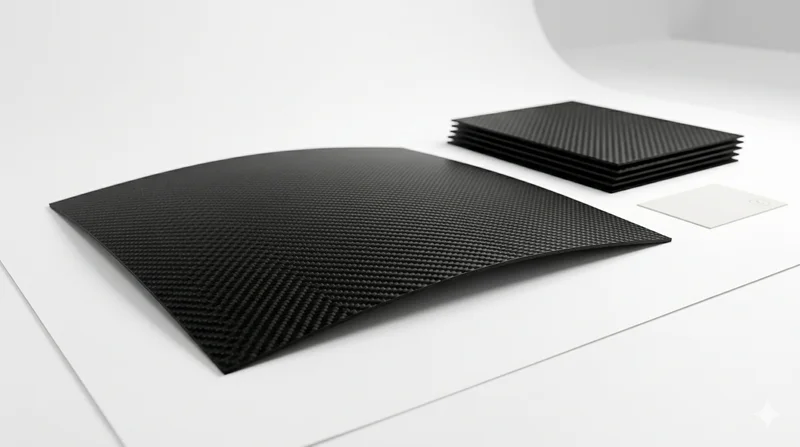
Thin 1.5mm carbon fiber plate with 3K twill weave surface. Lightweight and stiff, commonly used for covers, panels, drone bodies, and applications requiring a premium aesthetic appearance.

Square Carbon Fiber Tube — 3K Twill T700
Square cross-section carbon fiber tube manufactured with 3K twill weave for torsional strength. Preferred for structural frames, trusses, and support columns where rectangular geometry offers design flexibility.

Round Carbon Fiber Tube — 3K Twill
Lightweight and ultra-stiff round tubes ideal for drone frames, robotics, and structural applications.

Round Carbon Fiber Tube — UD Unidirectional T700
Unidirectional (UD) round tube with all fibers aligned axially for maximum longitudinal stiffness. Ideal for applications requiring high bending rigidity with minimal weight, such as shafts, struts, and structural reinforcements.