The carbon fibre drone frame is the structural skeleton of a multirotor: bottom and top plates, arms, standoffs and camera mounts, cut from flat sheet and bolted into a rigid cage that has to survive hard landings while staying light enough to buy flight time. In the UK, the buying decision sits ins
Introduction
The carbon fibre drone frame is the structural skeleton of a multirotor: bottom and top plates, arms, standoffs and camera mounts, cut from flat sheet and bolted into a rigid cage that has to survive hard landings while staying light enough to buy flight time. In the UK, the buying decision sits inside two conversations at once — the engineering one (stiffness, arm geometry, plate thickness, fastener layout) and the regulatory one (registration, operator ID, UKCA marking, and where you are legally allowed to fly). Most first-time buyers over-optimise one and ignore the other; a frame that is perfectly specified for a 7-inch long-range build can still ground you if it misses the mark on paperwork, and a fully registered airframe with floppy 2 mm arms will end its life in a hedgerow on the first windy sortie.
This guide covers how to choose a carbon fibre FPV drone frame (or a camera-platform frame) by geometry and material, what UK law actually requires of the operator, where British builders buy stock and custom plates, and what realistic prices look like across the three common classes.
Choosing a Carbon Fibre Drone Frame: Geometry, Thickness and Mass
Frame geometry dictates the flight character before any tune is applied. The three axes that matter are wheelbase (motor-to-motor diagonal), arm layout, and plate stack height:
| Class | Wheelbase | Arm / plate design | Typical frame mass | Plate thickness |
|---|---|---|---|---|
| 5-inch freestyle FPV | 220-250 mm | Integrated unibody or 3-plate sandwich | 80-140 g | 2-3 mm |
| 7-inch long-range | 280-330 mm | Separate arms, 5 mm plates | 180-320 g | 3-5 mm |
| Cinema / survey quad | 350-550 mm | Foldable arms, plate + CNC mounts | 350-900 g | 2-4 mm plus layup mounts |
Arm length and cross-section control stiffness far more than brand does. A 5 mm arm at the motor root tapering to a 3 mm wrist gives a measurable stiffness gain over a constant 3 mm section with almost no mass penalty, because bending stiffness scales with the cube of thickness — halve the thickness and the arm loses seven-eighths of its resistance to motor-induced flutter. For any frame above 250 mm wheelbase, treat 5 mm root plates as the default rather than an upgrade.
Mass itself is the wrong single metric. Grams at the plate are cheap; grams at the end of a long arm are expensive, because they add rotating inertia to the PID loop and lower the first resonant mode of the arm. Compare advertised mass only when wheelbase and arm count match; otherwise compare mass divided by wheelbase squared, which is a rough proxy for how much frame you get per unit of swing weight. Plate finish matters too: matte 3K twill layup on a quasi-isotropic layup schedule outperforms a shiny unidirectional decorative plate of the same thickness, and CNC-drilled holes should be countersunk or chamfered to stop delamination initiating at fastener edges during the first crash.
UK Rules: CAA Registration, Operator ID and UKCA
Anyone flying a drone above 250 g or any camera-equipped drone in the UK must register with the Civil Aviation Authority and carry an Operator ID on the aircraft, and the pilot needs a Flyer ID (legacy term) or must pass the online competency test for their category. Registration is per-operator, not per-drone, and costs an annual fee; the Operator ID sticker goes on the airframe where it can be read without tools. Sub-250 g aircraft used for recreation escape registration only if they have no camera and are not classed as toys — a tiny FPV quad with a digital VTX camera still trips the camera rule in practice, so most British FPV pilots register anyway.
Operating categories split the airspace rules. The A1 category covers sub-250 g aircraft (Open category A1) and legacy C-classed drones flown over uninvolved people with limits; A2 covers flights close to people with a 50 m separation using C2-classed or equivalent aircraft; and A3 is flights over unpopulated areas with 150 m separation from residential, commercial and industrial zones. A bare carbon fibre drone parts build with no UKCA plate is legal to own and to fly as an Open-category legacy aircraft where the rules allow, but it cannot be sold as a new product in the UK without UKCA (or CE under the current mutual-recognition transition) marking and a declaration of conformity. If you are buying a complete ready-to-fly from a British shop, check that the finished aircraft carries the correct marking and that the seller can supply the declaration; if you are buying a bare frame, you are buying components and the marking question falls to whoever assembles and places the finished aircraft on the market.
Where UK Builders Buy Carbon Fibre Drone Frames
The UK market splits three ways, and most serious builders use two of them:
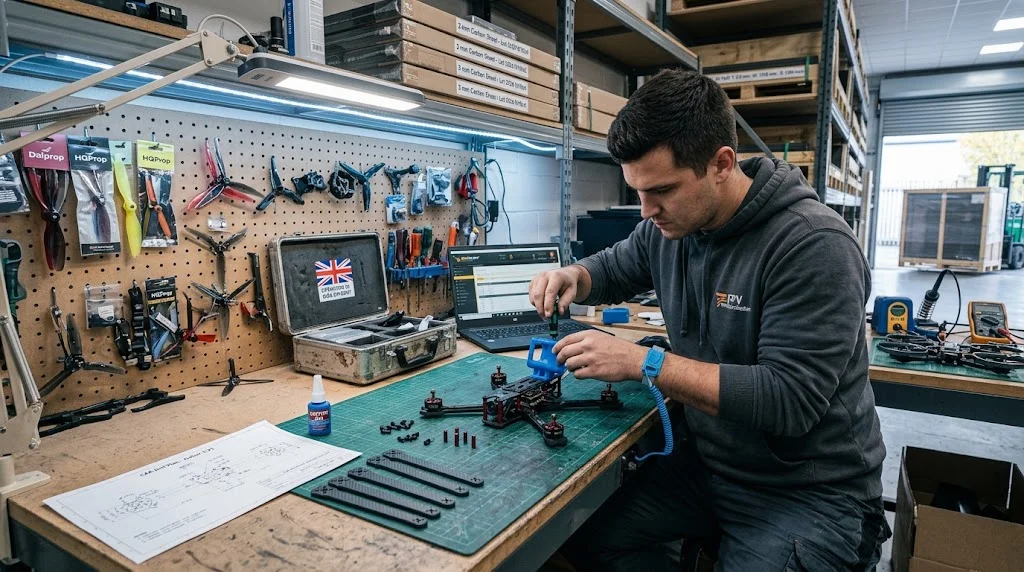
- British FPV shops: Stock frames from the major freestyle brands, next-day shipping, and the ability to buy a single arm or a replacement plate when you fold one. Expect to pay a premium over direct imports, in exchange for local warranty handling and someone who answers the phone when a batch of arms has a tolerance problem.
- Direct from frame designers: Several UK and European designers sell plates direct, often with configurator options for arm length, plate thickness and camera mount spacing. Lead time runs one to three weeks; the payoff is getting the exact geometry your build needs rather than the one the shop stocks.
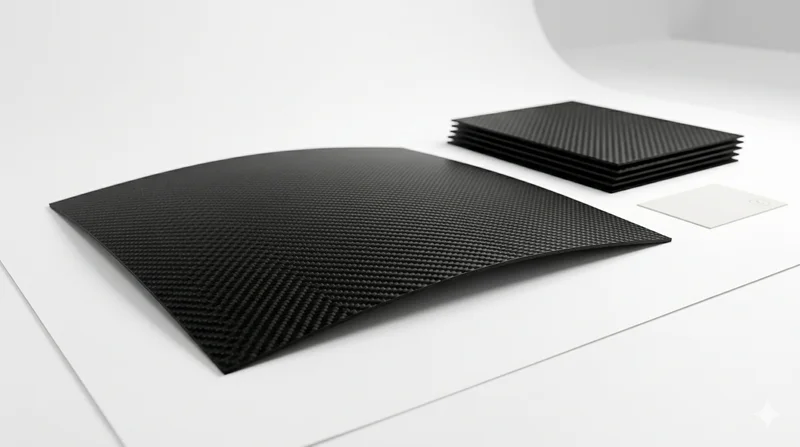
- Custom CNC plate cutting: For survey, cinema and one-off airframes, British machine shops and composite suppliers cut plates to your DXF from sheet stock in 3K or 6K layup. Unit cost is higher than a mass-produced frame, but you control hole pattern, plate outline and thickness to the millimetre, and you can order matching carbon fibre plate sheets for camera trays, antenna mounts and spares in the same order.
Whichever route you take, verify three things before money moves: the plate is genuine carbon fibre and not a fibreglass core with a carbon veil (the tell is price — a 500 x 500 mm 2 mm plate below roughly 30 GBP is fibreglass — and the knock test, which rings dull on G10 and sharp on carbon); the layup schedule is quasi-isotropic rather than a stack of unidirectional plies; and the supplier can state the resin system's glass transition temperature if you plan to fly in a hot enclosed battery bay or leave the aircraft in a car in July.
Frequently Asked Questions
Do I need a CAA Operator ID just for a bare carbon fibre frame?
No — registration attaches to the operation and the finished aircraft, not to a bag of plates in your workshop. You need the Operator ID once the aircraft is assembled and you intend to fly it outdoors in the UK, and a Flyer ID (or passed online competency) for yourself as the pilot. Keep the Operator ID sticker with the airframe case so the aircraft is marked before the first flight rather than after.
Is a UK-cut frame better than a direct import?
Not automatically, but the failure modes differ. A British shop will stock proven geometries, hold spares, and handle warranty; a direct import can be cheaper and offer geometry the local shop does not stock, but a folded arm means waiting two weeks for a replacement and eating the shipping. For a first build, buy the frame from a shop that stocks arms; for a second or third airframe where you already know the geometry you want, direct or custom cutting is usually worth the lead time.
What plate thickness do I actually need for a 7-inch long-range build?
Default to 5 mm arms and 4 mm top and bottom plates on anything from 280 to 330 mm wheelbase. The extra 20-40 g of frame mass against a 3 mm design buys a first resonant mode high enough that cruising on 7-inch props does not excite visible arm flutter, which shows up as high-frequency gyro noise and a tune that will not hold. If you are chasing every gram for a race build, stay at 3 mm and accept the lower stiffness; for long-range, mass is cheap and resonance is expensive.
Conclusion
A UK carbon fibre drone frame purchase is an engineering decision wrapped in a paperwork one. Match geometry to mission — wheelbase, arm cross-section and plate thickness — and refuse frames that save grams at the motor end of the arm where they cost you stiffness. On the regulatory side, register the aircraft, carry the Operator ID on the airframe, and know whether your build is being placed on the market under UKCA before you resell it. Get both sides right and the frame becomes the boring part of the build, which is exactly what a frame should be.
Browse our carbon fibre plate sheets and drone component stock or contact our team — we supply quasi-isotropic carbon fibre plates in 2K, 3K and 6K layup to British drone builders, machine shops and integrators, cut to size with documented tolerances.
Related Articles
- Filament Wound Pressure Vessel: Design, Standards and Manufacturing
- Carbon Fiber Car Parts: Structural vs Cosmetic Components Explained
- Carbon Fiber Drone Kit: Choosing, Building, and Flying a Carbon Fiber Frame
- Carbon Fiber Rod Repair Kit: Field Repairs for Fishing and RC Components
- Carbon Fiber Tube Cap: End Fittings and Sealing Solutions
- Carbon Fiber Plate in Shoes: Running, Cycling and Everyday Footwear
Interested in Carbon Fiber Plates?
Contact our team for competitive pricing and technical specifications.
Get a Quote