
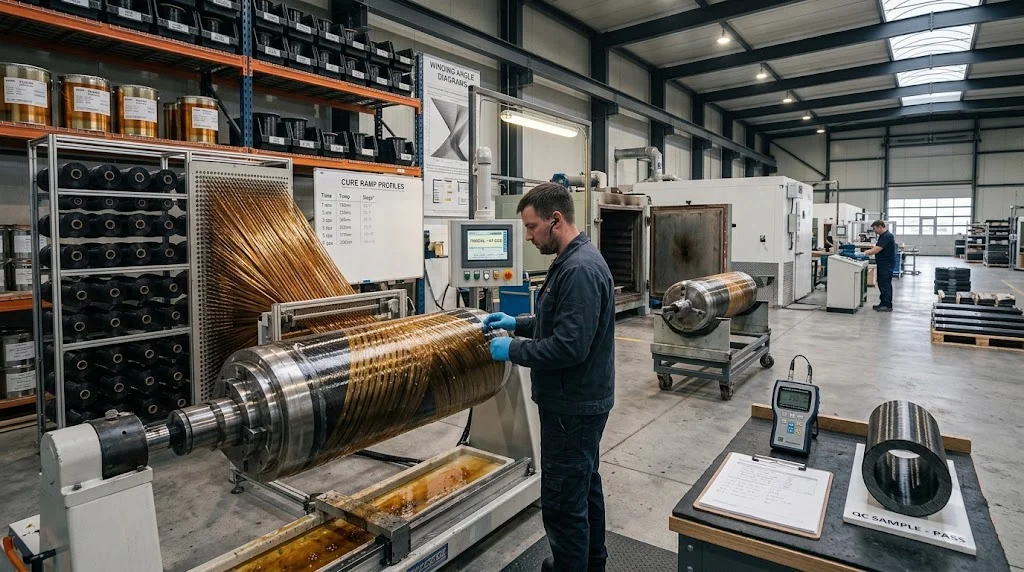
A filament wound pressure vessel is a composite cylinder built by winding resin-impregnated continuous fiber onto a liner or mandrel along programmed paths, then curing the shell into a structure that carries pressure with the fibers rather than with wall thickness alone. Almost every compressed nat
Introduction
A filament wound pressure vessel is a composite cylinder built by winding resin-impregnated continuous fiber onto a liner or mandrel along programmed paths, then curing the shell into a structure that carries pressure with the fibers rather than with wall thickness alone. Almost every compressed natural gas bus, hydrogen passenger vehicle and industrial gas cylinder above a few litres now uses some version of this construction, because the specific strength of a carbon overwrap is five to eight times that of steel at a fraction of the mass. What separates a vessel that passes certification from one that never leaves the test lab is not the concept — it is the geometry of the winding pattern, the liner choice, and a chain of manufacturing controls that hold fiber tension, void content and cure within narrow windows.
This guide walks through the design decisions (liner type, winding angles, bosses and domes), the standards framework that governs road and industrial vessels, and the process controls a filament winding shop must run to produce a qualified cylinder.
Designing a Filament Wound Pressure Vessel: Liner, Angles and Load Paths
Pressure vessel design starts with the liner, which defines the permeation boundary and much of the mass. The industry sorts vessels into four types, and the type drives both cost and certification path:
| Type | Liner | Composite share of load | Relative mass | Typical use |
|---|---|---|---|---|
| Type I | All metal (steel or aluminium) | None | 1.0 baseline | Stationary industrial gas |
| Type II | Metal, hoop-wrapped only | Hoop stress only | 0.65-0.8 | CNG buses, older fleets |
| Type III | Aluminium, fully overwrapped | Hoop and axial | 0.45-0.6 | CNG vehicles, SCBA |
| Type IV | Polymer (HDPE or PA), fully overwrapped | Hoop and axial | 0.35-0.5 | Hydrogen vehicles, aerospace |
The winding pattern follows the stress state. Hoop stresses in a thin-wall cylinder run about twice the axial stress, so the majority of passes are laid near 90 degrees — called hoop winding — to put fiber directly along the hoop load path. Axial and shear capacity comes from helical passes, typically in pairs at plus and minus 15 to 55 degrees, which close over the dome regions where a pure hoop path cannot follow the changing radius. A well-designed filament wound tank alternates these passes so that every fiber direction has a load to carry; excessive helical content wastes fiber on low-stress paths, while a hoop-dominant vessel fails at the polar bosses.
Bosses, necks and dome geometry concentrate the remaining design effort. Metal bosses are bonded or crimped into the liner and become the leak boundary; the composite must transfer load into them without crushing the liner or peeling at the interface. Dome angle control — keeping the winding geodesic or applying mechanical compensation where the path would slip — is the single most common source of winding-machine programming work.
Standards and Qualification for Filament Wound Pressure Vessels
Road-registered gas vessels follow a regional standard stack rather than one global rule. ISO 11439 covers natural gas vehicles; UN ECE R134 governs hydrogen vehicles in Europe and is closely aligned with the global technical regulation GTR No. 13; ISO 19881 extends the hydrogen framework to on-board vessels. Industrial and breathing-air cylinders typically fall under ISO 11119 series (composite cylinders with non-load-bearing liners) or national pressure equipment directives, while ASME Section X covers fiberglass pressure vessels in the North American code landscape. Each standard specifies design stress ratios, qualification test sequences, and periodic requalification intervals that operators must calendar from the manufacture date.
The qualification sequence itself is consistent across regimes even when numbers differ. A type test campaign runs static burst on a sample (commonly to 2.25 to 2.5 times the minimum expected operating pressure for gas service), fatigue cycling, environmental conditioning, and impact or drop tests. Fire performance matters for on-road hydrogen and CNG: a vessel must hold pressure for a defined period under a standardized flame before leaking or bursting. Production vessels then pass a proof pressure test at 1.5 times rated pressure plus a leak test, with batch samples pulled for destructive burst to keep the process honest.
Manufacturing Controls for a Filament Wound Pressure Vessel
On the winding machine, four variables carry most of the quality risk:
- Fiber tension: Tension scales with tow size — roughly 8 to 14 N for a 12K carbon tow, higher for 24K — and must stay consistent across the package. Tension drift produces wavy fibers that carry almost no load until the matrix cracks around them.
- Impregnation and fiber volume: Wet-out through a resin bath or injection eye sets the resin content; carbon volumes of 55 to 65 percent with void content below 2 percent are typical targets for structural windings. Dry spots and resin-rich pockets are both rejectable conditions.
- Cure schedule: The stated ramp, hold and cool rates in the resin system datasheet control Tg and residual stress. Skipping the cool-down ramp to save cycle time bakes in stress that shows up as early microcracking.
- Overwind sequencing: The order of hoop and helical passes, and the slip control on dome regions, decides whether fiber placement matches the finite-element load paths drawn in design.
After cure, autofrettage — a controlled over-pressure that permanently yields the liner slightly and leaves the composite in residual compression — measurably improves fatigue life and is standard practice for high-cycle hydrogen vessels. Final inspection adds ultrasonic or radiographic checks for delamination and liner wrinkles, dimensional checks of boss alignment, and documented leak testing before the serial number is stamped.
The same winding discipline produces the filament wound tubes and nozzles used as vessel subcomponents: dome liners, pigment bosses, and cylindrical sections that ship as filament wound carbon fiber tubes and are welded, bonded or threaded into the larger assembly. Shops that control tension and cure once can apply the same process window across both product families.
Frequently Asked Questions
Why did hydrogen vessels almost always move to Type IV?
Hydrogen service maximizes the value of mass savings and adds a permeation problem that polymers handle differently than metals. A Type IV polymer liner with a full carbon overwrap cuts vessel mass roughly in half against an equivalent Type III, improves vehicle range, and tolerates hydrogen permeation better when the liner material and liner-coating system are specified for the gas. The trade-off is higher unit cost and stricter liner qualification, which is why Type III remains common in CNG and breathing air.
How is a filament wound pressure vessel different from a filament wound tube?
A tube is open-ended and carries load along its axis and wall; a pressure vessel is a closed pressure boundary with domes, bosses and a leak-tight liner, designed against hoop and axial stresses simultaneously. The process is the same — resin-impregnated fiber wound on a mandrel — but the vessel adds dome angle control, boss integration, autofrettage and a full certification campaign that a plain tube does not require.
What inspection interval should I plan for in service?
Follow the standard the vessel was certified under, which defines both visual inspection and periodic requalification (typically involving hydrostatic retest or acoustic emission screening) measured from the date of manufacture, not from purchase. Fleet operators usually track a simple ledger: serial number, manufacture date, rated pressure, last requalification and station logs. Vessels that see fast fill cycles or salt exposure move to the shorter end of the interval.
Conclusion
A filament wound pressure vessel earns its certification through geometry and process control, not through fiber alone. Choose the liner type to match the gas, the duty cycle and the mass budget; balance hoop and helical passes so every fiber sits on a real load path; and hold tension, impregnation, cure and proof testing inside the windows the standard assumes. Do that consistently and the same winding line can produce road-qualified hydrogen cylinders and precision filament wound carbon fiber tubes with the same process discipline.
Explore our carbon fiber filament winding materials or contact our team — we supply carbon fiber tow, wet-winding resin systems and finished tube stock to composite pressure vessel manufacturers.
Part of topic
Related Articles
- Carbon Fibre Drone Frame: UK Buying Guide
- Carbon Fiber Car Parts: Structural vs Cosmetic Components Explained
- Carbon Fiber Drone Kit: Choosing, Building, and Flying a Carbon Fiber Frame
- Carbon Fiber Rod Repair Kit: Field Repairs for Fishing and RC Components
- Carbon Fiber Tube Cap: End Fittings and Sealing Solutions
- Carbon Fiber Plate in Shoes: Running, Cycling and Everyday Footwear