
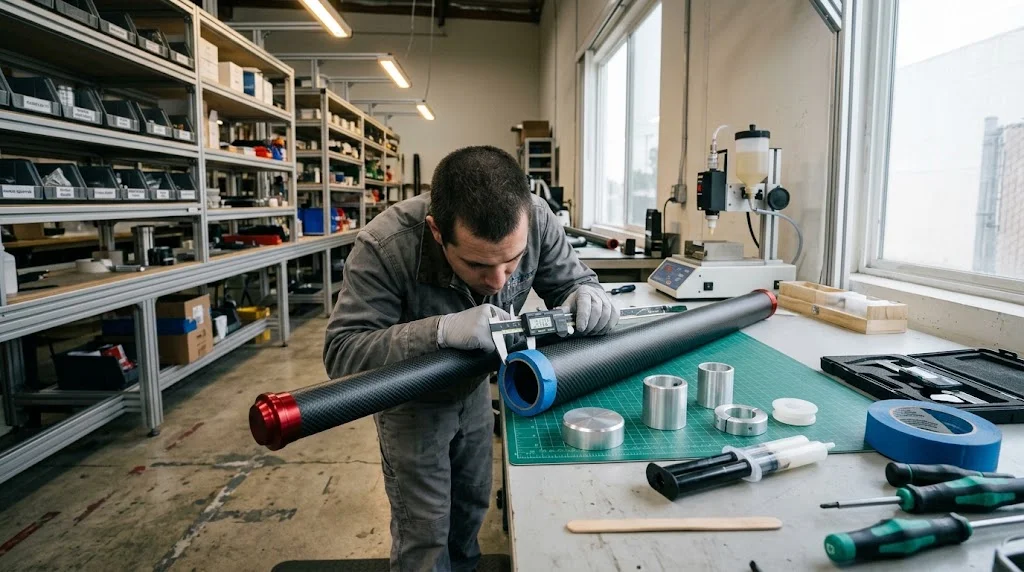
A carbon fiber tube cap closes the open end of a tube, and in doing so performs three jobs at once: it protects the laminate edge from impact and moisture ingress, it provides a machined interface for mounting hardware, and it transfers load from whatever is attached into the tube wall. That is why
Introduction
A carbon fiber tube cap closes the open end of a tube, and in doing so performs three jobs at once: it protects the laminate edge from impact and moisture ingress, it provides a machined interface for mounting hardware, and it transfers load from whatever is attached into the tube wall. That is why end fittings are where most carbon fiber tube assemblies succeed or fail. A beautiful pultruded tube with a loose press-fit cap that walks out under vibration is a failed assembly, while a correctly bonded carbon fiber tube inserts package with a matched cap can carry structural duty for decades.
This article covers the main cap and fitting families, how carbon fiber tube fittings interact with adhesives and clamps, and the practical assembly steps that keep a capped tube square, sealed, and strong.
Carbon Fiber Tube Cap and Insert Types Compared
End hardware for composite tubes falls into four families, and the right choice depends on whether the joint is structural, decorative, or sealing-critical.
| Type | Material | Fit Method | Load Rating | Best Use |
|---|---|---|---|---|
| Solid aluminum end cap | 6061-T6, anodized | Bonded or press-fit | High | Furniture legs, machine handles, structural posts |
| Hollow aluminum insert | 6061-T6 | Bonded sleeve | High | Threaded joints, adjustable feet, speaker stands |
| Nylon / POM plug | PA66, POM | Press-fit or bonded | Low-medium | Dust caps, light covers, non-structural ends |
| Steel adapter cap | Carbon steel, plated | Threaded + bonded | Very high | Tow hooks, hard mount points, trailer fittings |
Aluminum dominates because it machines to tight tolerance, anodizes well, and bonds to epoxy with surface preparation. Nylon caps are correct for pure protection: they close the tube, keep out dust, and cost almost nothing, but they should never be asked to carry a bending moment. Steel adapter caps appear where a certified mount is required and the extra mass is acceptable.
Fit, Bondline, and Adhesive Selection
Almost every serious carbon fiber tube cap is bonded, not just pressed on. Press fits alone rely on the elastic recovery of a thin laminate wall, which relaxes over time and temperature cycles. A proper bond uses three controls.
- Annular clearance: Design the insert OD to leave a 0.10-0.20 mm bondline. Too tight and starved joints result; too loose and the adhesive fillet carries shear in a thick, weak layer.
- Engagement length: Bond length of 1.5 to 2 times the tube OD is the working rule. A 25mm tube wants a 38-50mm insert; a 6mm precision tube with a small carbon fiber tube cap may only need 10-12mm engagement for light duty.
- Surface preparation: Abrade the inner tube wall with 120-180 grit, degrease with acetone, and abrade the aluminum insert to a matte finish. Epoxy grabs prepared composite and prepared aluminum far better than it grips smooth, contaminated surfaces.
Adhesive choice follows the environment. Toughened epoxy (Tg above 80 C) covers most indoor and vehicle work. Polyurethane or MS-polymer suits flexible joints that see vibration and thermal cycling, such as carbon fiber tube clamps on outdoor rails. High-temperature epoxy is required when caps sit near exhausts or industrial ovens.
Clamps, Collars, and Mechanical Alternatives
When disassembly is required, mechanical carbon fiber tube fittings replace the bonded joint. Split aluminum collars clamp around the tube outside diameter and carry a threaded boss; the clamp pressure is distributed by a thin elastomer liner that protects the laminate. The design rule is simple: clamp onto the tube wall, never into it, and never tighten a metal collar directly against dry carbon fiber, because the point loads crush fibers and create a delamination initiation site.
For capped tube ends that also carry lateral load, a combination approach works well: a bonded internal insert handles the axial and torsional duty, while an external collar provides the moment resistance and a serviceable interface. This hybrid is common in display systems, marine railings, and modular furniture, where a carbon fiber tube cap must look clean from outside yet still accept a bolt.
Assembly Sequence for a Carbon Fiber Tube Cap
A repeatable assembly sequence prevents the classic failures: tilted caps, starved bondlines, and squeeze-out inside the tube.
- Dry-fit the cap and mark the engagement depth on the tube.
- Abrade and degrease both surfaces; mask 5mm beyond the bond zone to keep squeeze-out off the visible laminate.
- Mix adhesive and apply a thin film to both the insert and the tube wall, then push home with a quarter turn to spread the adhesive evenly.
- Check squareness against a reference surface within the open time, then fixture the assembly until the adhesive reaches handling strength.
- Remove masking, clean squeeze-out with a plastic blade, and only then drill or machine any secondary features through the cap, never through unsupported laminate alone.
Done this way, a bonded carbon fiber tube cap routinely outlasts the structure it closes, and the tube edge stays sealed against moisture for the life of the assembly.
Frequently Asked Questions
Should a carbon fiber tube cap be bonded or press-fit?
Bonded, for anything structural or exposed to weather. A press fit can work for short-life dust caps in controlled indoor environments, but thermal cycling and vibration relax the interference and the cap walks out. If you need serviceability, use a bonded insert plus an external clamp rather than returning to a pure press fit.
What size cap fits a given carbon fiber tube?
Caps are matched to the tube outer diameter, not the inner diameter, and reputable suppliers publish fit charts in tenths of a millimeter. Measure the tube OD at both ends before ordering: a pultruded tube can vary slightly along its length, and a cap sized to the mid-span measure will rock on a tapered end. For custom tube, send the measured OD, wall thickness, and required engagement length with your inquiry.
How do carbon fiber tube clamps differ from end caps?
A clamp grips the outside of the tube at any point along its length and carries load through friction distributed by a liner; an end cap closes the tube end and transfers load through a bonded or threaded interface at the extremity. They are complementary: clamps allow adjustment and removability, caps seal and finish the end. Many assemblies use both, with a cap sealing the end and a clamp carrying the mounting load a few centimeters inboard.
Conclusion
The carbon fiber tube cap is a small component with an outsized effect on assembly life, sealing, and load transfer. Match cap type to duty: aluminum for structural bonding, nylon for protection, steel adapters for certified mounts. Control the bondline at 0.10-0.20 mm, engage the insert one and a half to two diameters, prepare both surfaces, and use mechanical carbon fiber tube fittings only with a liner and a wall-clamp design. YongXian supplies carbon fiber tubes and matching end hardware, and our engineering team can recommend cap and insert combinations for your diameter, load, and environment. Browse our carbon fiber tube range or contact us with your tube dimensions and end-use requirements.
Part of topic
Related Articles
- Carbon Fiber Plate in Shoes: Running, Cycling and Everyday Footwear
- Carbon Fiber Control Arms: Suspension Geometry and Composite Design
- Carbon Fiber Drone Frame: Selection Guide for Racing and Industrial Drones
- Carbon Fiber Plate with Morton's Extension: Metatarsal Support in Footwear
- Carbon Fiber Road Bike Wheels: Rim Profile and Spoke Choice
- S500 Carbon Fiber Quadcopter Drone Frame Kit: Specifications and Upgrades
Interested in Our Products?
Contact our team for competitive pricing and technical specifications.
Get a QuoteRelated Products

Carbon Fiber Plate — 3K Twill T700 1.5mm
Thin 1.5mm carbon fiber plate with 3K twill weave surface. Lightweight and stiff, commonly used for covers, panels, drone bodies, and applications requiring a premium aesthetic appearance.

Carbon Fiber Plate — 3K Twill T700 3.0mm
Medium-thickness 3.0mm carbon fiber plate offering significantly higher load capacity while maintaining attractive 3K twill finish. Suitable for structural brackets, reinforcement plates, and load-bearing panels.

Square Carbon Fiber Tube — 3K Twill T700
Square cross-section carbon fiber tube manufactured with 3K twill weave for torsional strength. Preferred for structural frames, trusses, and support columns where rectangular geometry offers design flexibility.

Round Carbon Fiber Tube — UD Unidirectional T700
Unidirectional (UD) round tube with all fibers aligned axially for maximum longitudinal stiffness. Ideal for applications requiring high bending rigidity with minimal weight, such as shafts, struts, and structural reinforcements.

Round Carbon Fiber Tube — 3K Plain Weave T700
Standard round carbon fiber tube manufactured from Toray T700 grade fiber with 3K plain weave. Offers balanced strength and stiffness for general industrial applications including robotics, automation, sports equipment, and aerospace structures.