
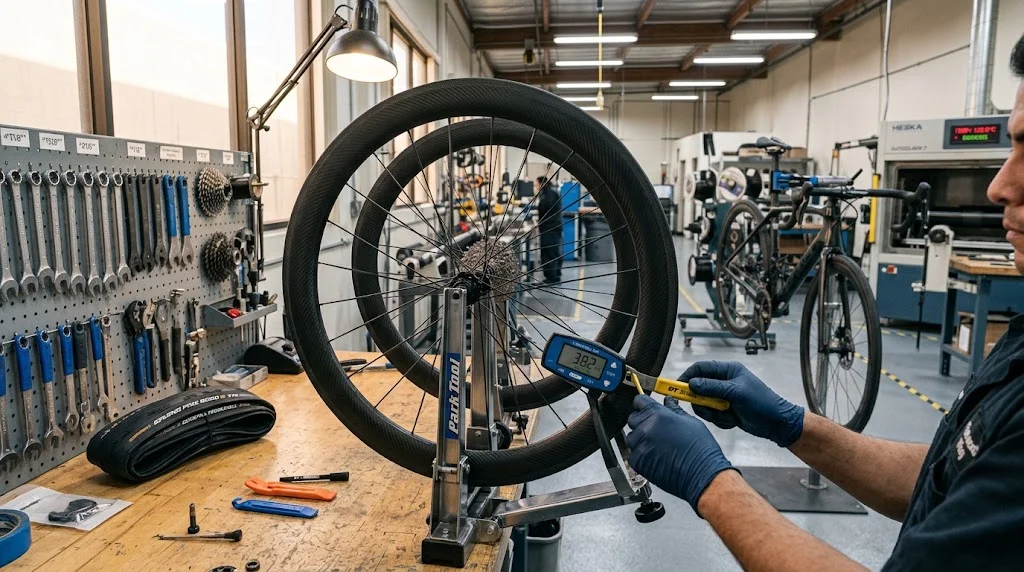
Choosing carbon fiber road bike wheels comes down to two engineering decisions that interact with every ride: the rim profile and the spoke choice. Rim depth sets the balance between aerodynamic drag, weight, and crosswind stability, while spoke count and lacing pattern set stiffness, load distribut
Introduction
Choosing carbon fiber road bike wheels comes down to two engineering decisions that interact with every ride: the rim profile and the spoke choice. Rim depth sets the balance between aerodynamic drag, weight, and crosswind stability, while spoke count and lacing pattern set stiffness, load distribution, and impact tolerance. Riders who get these two decisions right often go faster on the same fitness than riders who spend twice as much on the wrong wheelset, because a wheel that matches the terrain keeps speed higher through corners and climbs without punishing the rider in crosswind gusts.
The market has consolidated around a few sensible defaults, but the details still matter. Modern carbon fiber road bike wheels typically run 25-30 mm tubeless tires on 19-23 mm internal width rims, with rim depths ranging from 25 mm climbing wheels to 60-80 mm aero race wheels. This article breaks down the rim profile variables with concrete numbers, compares spoke configurations, and gives a clear selection framework so that a first carbon wheelset — or a second one — lands on the right profile for the riding you actually do.
Rim Profile Choices for Carbon Fiber Road Bike Wheels
Rim profile covers three variables: rim depth (the height of the rim section), rim width (internal and external), and rim shape (toroidal versus V-section). Depth dominates the drag-versus-weight trade, width determines how the tire profiles, and shape controls how the wheel behaves when the wind comes from an angle.
| Rim Depth Class | Pair Weight (typical) | Drag at 45 km/h (rel.) | Crosswind Behavior | Best Fit |
|---|---|---|---|---|
| Shallow climbing (25-32 mm) | 1250-1400 g | Baseline | Very stable | Steep climbs, light riders, windy regions |
| All-round (35-50 mm) | 1400-1550 g | 3-6% lower | Manageable for most riders | Group rides, mixed terrain, criteriums |
| Aero race (55-65 mm) | 1500-1700 g | 6-10% lower | Noticeable but predictable | Time trials, flat classics, solo efforts |
| Disc (70-80 mm rear / 50-60 mm front) | 1600-1850 g | 8-12% lower | Front wheel limits handling | Triathlon, flat time trials |
The aerodynamic numbers reflect wind tunnel and field test data for a rider at 45 km/h: moving from a 30 mm climbing rim to a 60 mm aero rim commonly saves 5-12 watts on flat terrain, which compounds over an hour into meaningful seconds. Above 80 mm, drag gains flatten while crosswind torque keeps rising, which is why professional road racing has settled mostly in the 50-65 mm band rather than going deeper.
Internal Rim Width and Tire Volume
Internal rim width controls the shape of the mounted tire, and tire shape now dominates real-world rolling and aerodynamic performance more than it did a decade ago. Narrow rims that pinch 28 mm tires into a lightbulb profile increase casing deformation and aerodynamic discontinuity; wider rims let the tire sidewall extend in a smooth continuation of the rim bed.
- 19 mm internal: The older standard. Works well with 23-25 mm tires but makes 28 mm tires bulbous; still common on climbing wheelsets optimized for 25 mm rubber.
- 21-23 mm internal: The current sweet spot for carbon fiber road bike wheels. A 28 mm tire measures roughly 30-31 mm mounted, sits aerodynamically flush with the rim, and allows lower pressure without rim strike.
- Hookless versus hooked beads: Hookless rims (ISO 5765 compliant) require tubeless tires rated for hookless use and typically cap pressure at 72-75 psi. Hooked rims accept both tubed and tubeless tires and tolerate higher pressures for riders who still prefer 23-25 mm setups.
- External width for brake track clearance: Rim-brake wheels need external width under 28 mm for caliper clearance, which limits how wide an external profile rim-brake designers can draw; disc-brake wheels have no such constraint and benefit most from modern wide profiles.
Spoke Count and Lacing Patterns for Carbon Road Wheels
Spoke choice sets how the wheel converts hub torque and rider weight into rim deflection. Fewer spokes save weight and drag but concentrate load; more spokes distribute load and survive impacts better. Lacing pattern determines whether spokes pull radially (efficient for braking torque-free front wheels) or at an angle (necessary wherever tangential torque exists).
- Front, rim brake: 18-20 spokes, radial. The front wheel carries no drivetrain torque, so radial lacing pulls the rim evenly and sheds weight. Below 18 spokes, local rim deflection at the valve and spoke holes rises sharply.
- Front, disc brake: 21-24 spokes, 2-cross. Disc rotors apply braking torque at the hub, so spokes must run at an angle to transfer it; radial lacing on a disc front wheel is a design error that shortens fatigue life.
- Rear: 24-28 spokes, 2-cross or 3-cross on the drive side. The drive side carries the torque of pedaling plus the majority of rider load. 2-cross keeps spoke bracing angles high enough for lateral stiffness while limiting the stress concentration at the nipple.
- Spoke section: bladed versus round. Bladed spokes (2.0 x 0.9 mm typical) cut roughly 0.5-1.5 watts per wheel at 45 km/h versus round 1.8 mm spokes, and many builders prefer them for tension consistency because the flat section resists spinning during truing.
Tension matters as much as count. A well-built carbon wheel lands spokes at 100-120 kgf on the drive side and 85-100 kgf on the non-drive side for rear wheels, with variation under 10% across the bed. Poor tension distribution — not low spoke count — is what causes premature nipple cracking and broken spokes on otherwise reputable wheelsets.
Matching Carbon Fiber Road Bike Wheels to Your Riding
The right selection depends on where the speed is. The framework below maps common riding profiles to rim and spoke configurations, assuming a rider around 70-80 kg on a modern disc-brake road bike.
| Riding Profile | Recommended Depth | Recommended Build | Tire Setup |
|---|---|---|---|
| Climbing-focused (1000+ m per ride) | 25-35 mm | 20 radial front / 24 2-cross rear | 28 mm tubeless, 25-30 mm internal rim |
| All-round club and endurance | 40-50 mm | 21-24 front / 24-28 rear, 2-cross | 28-30 mm tubeless, 21-23 mm internal |
| Criterium and sprinting | 50-65 mm | 24 front / 28 rear, 2-3 cross | 25-28 mm tubeless, stiff sidewall |
| Time trial and triathlon on flat courses | 60-80 mm rear, 50-60 front | 21 front / 24-28 rear | 25-28 mm, aero-optimized shape |
High performance carbon fiber in this context also means checking the details that separate durable wheelsets from fragile ones: spoke brand and section (Sapim or Pillar bladed spokes are common quality markers), rim bedding finish, hub bearing standard (36-60 bearing sizes from established suppliers), and warranty terms for crash replacement. Weight figures published by manufacturers are almost always the bare wheelset without skewers or tape; add roughly 60-100 g for the complete built state.
Frequently Asked Questions
Are deeper carbon fiber road bike wheels always faster?
No. Deeper rims are faster in a straight line at steady speed, but the advantage shrinks on hilly courses where weight penalty dominates and in gusty conditions where riders lose more speed correcting for crosswind than the rim saves in drag. For riders who race on mixed terrain, a 40-50 mm all-round wheel typically produces better average speeds than a 65 mm wheel that forces repeated position corrections. The crossover point where aero depth clearly wins is sustained flat riding above roughly 35 km/h.
How many spokes should carbon road wheels have?
For a typical 70-80 kg rider: 20-21 spokes radially laced in a rim-brake front wheel, 21-24 spokes in 2-cross for a disc front wheel, and 24-28 spokes in 2-cross on the rear drive side. Heavier riders (90 kg and above) should target the top of those ranges and confirm the builder's tension targets, because spoke fatigue life scales with the square of operating tension relative to the material limit. Very light riders can go one spoke lower per wheel without meaningful durability loss.
Can I run wider tubeless tires on older carbon rims?
Only if the rim is labeled tubeless-compatible and its internal width supports the tire. A 19 mm internal rim built in 2016 will mount a 30 mm tubeless tire poorly: bead seating becomes unreliable and the bulbous profile degrades handling. Older hooked rims without a tubeless bead shelf should run tubes with 25-28 mm tires instead. Always confirm the tire maker's published maximum pressure for hookless if the rim is hookless, and never exceed the lower of the tire or rim pressure limit.
Conclusion
Carbon fiber road bike wheels reward riders who choose deliberately: rim profile decides the aero, weight, and crosswind balance, while spoke count and lacing decide stiffness and durability. An all-round 40-50 mm wheel with 21-24 spokes and a 21-23 mm internal width fits the widest range of riders, while depth-specific builds make sense when the terrain is known and the objective is measurable time savings.
For projects and OEM programs that need carbon fiber bike parts — rims, spokes, hubs, or complete high performance carbon fiber wheelsets — explore our carbon fiber components range or contact our engineering team for layup, profile, and build recommendations matched to your riders and terrain.
Part of topic
Related Articles
- S500 Carbon Fiber Quadcopter Drone Frame Kit: Specifications and Upgrades
- Carbon Fiber Drone Propellers: Design, Balancing and Performance
- Carbon Fiber Plate in Hoka Running Shoes: Super-Shoe Technology Explained
- Carbon Fiber AR Grip: Material Performance for Firearm Components
- DIY Carbon Fiber Drone Frame: Design and Assembly Guide
- Carbon Fiber Tube You Need 50 mm OD 47 mm ID: Custom Dimensions Sourcing
Interested in Our Products?
Contact our team for competitive pricing and technical specifications.
Get a QuoteRelated Products

Carbon Fiber Plate — 3K Twill T700 1.5mm
Thin 1.5mm carbon fiber plate with 3K twill weave surface. Lightweight and stiff, commonly used for covers, panels, drone bodies, and applications requiring a premium aesthetic appearance.

Carbon Fiber Plate — 3K Twill T700 3.0mm
Medium-thickness 3.0mm carbon fiber plate offering significantly higher load capacity while maintaining attractive 3K twill finish. Suitable for structural brackets, reinforcement plates, and load-bearing panels.

Square Carbon Fiber Tube — 3K Twill T700
Square cross-section carbon fiber tube manufactured with 3K twill weave for torsional strength. Preferred for structural frames, trusses, and support columns where rectangular geometry offers design flexibility.

Round Carbon Fiber Tube — UD Unidirectional T700
Unidirectional (UD) round tube with all fibers aligned axially for maximum longitudinal stiffness. Ideal for applications requiring high bending rigidity with minimal weight, such as shafts, struts, and structural reinforcements.

Round Carbon Fiber Tube — 3K Plain Weave T700
Standard round carbon fiber tube manufactured from Toray T700 grade fiber with 3K plain weave. Offers balanced strength and stiffness for general industrial applications including robotics, automation, sports equipment, and aerospace structures.