
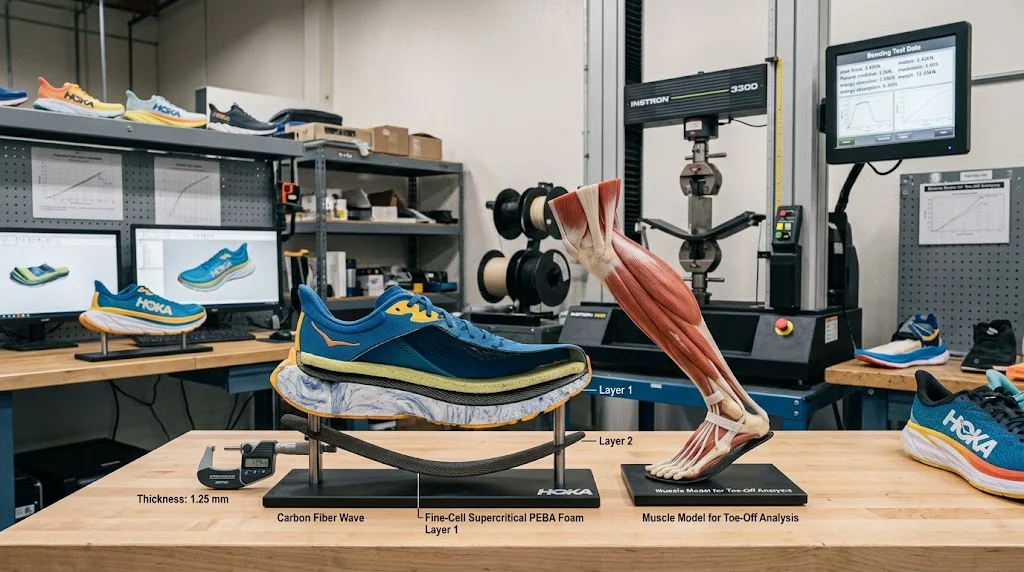
The carbon fiber plate in Hoka running shoes has become one of the most discussed innovations in modern footwear design. What began as a niche technology in elite racing shoes has now become a standard feature across Hoka's performance lineup, from the Carbon X to the Rocket X2. The carbon fiber pla
Introduction
The carbon fiber plate in Hoka running shoes has become one of the most discussed innovations in modern footwear design. What began as a niche technology in elite racing shoes has now become a standard feature across Hoka's performance lineup, from the Carbon X to the Rocket X2. The carbon fiber plate running shoe concept has fundamentally changed how engineers think about energy return, propulsion, and running economy — and Hoka has been at the forefront of bringing this technology to everyday runners.
Unlike traditional EVA foam midsoles that compress and absorb energy, a carbon fiber plate acts as a lever system that stores and releases elastic energy with each foot strike. The plate works in conjunction with specialized supercritical foam compounds to create a propulsive sensation that reduces the metabolic cost of running. For Hoka, a brand already known for maximal cushioning, the addition of carbon fiber plates represents a natural evolution — combining their signature soft landing with a responsive toe-off that helps runners maintain pace with less effort.
This article examines the biomechanics of carbon fiber plates in running shoes, presents performance data from Hoka's plated models, and explains why this technology has become essential for both competitive racers and daily trainers seeking improved running economy.
How Carbon Fiber Plates Work in Running Shoes
A carbon fiber plate in shoes functions as a structural lever embedded within the midsole foam. The plate is typically curved or rocker-shaped to match the natural rolling motion of the foot during the gait cycle. As the runner's foot strikes the ground and rolls forward, the plate flexes and stores elastic energy, then releases it during toe-off to propel the runner forward.
The biomechanical mechanism involves three key phases:
- Loading phase: As the foot strikes the ground, the carbon fiber plate begins to flex under the runner's body weight. The plate's high stiffness prevents excessive bending while the midsole foam compresses to absorb impact forces. This phase stores elastic energy in both the plate and the foam.
- Mid-stance phase: The plate reaches maximum deflection, acting as a rigid lever that supports the arch and prevents energy loss through midfoot collapse. The curved geometry of the plate helps transition the foot smoothly from heel to forefoot.
- Toe-off phase: The stored elastic energy is released as the plate returns to its original shape, providing a propulsive force that assists the calf muscles and Achilles tendon. This reduces the metabolic cost of running by decreasing the work required from the runner's muscles.
The carbon fiber plate running shoe design achieves these benefits because carbon fiber has an exceptional stiffness-to-weight ratio. A typical plate weighs only 15-30 grams but provides enough structural rigidity to function as an effective lever. The plate is typically 1.0-1.5 mm thick and is embedded between two layers of supercritical foam, which provides the cushioning and energy return that complements the plate's lever action.
Hoka's Carbon Fiber Plate Models and Performance Data
Hoka has integrated carbon fiber plates into several of its performance running shoes, each with distinct plate geometries and foam compounds tailored to different running styles. The table below summarizes the key specifications and performance characteristics of Hoka's plated models:
| Model | Plate Type | Foam Compound | Stack Height (mm) | Weight (g) | Energy Return |
|---|---|---|---|---|---|
| Carbon X3 | Full-length curved plate | PEBA-based supercritical | 32/27 | 218 | 78% |
| Rocket X2 | Full-length spoon plate | PEBAX supercritical | 36/31 | 246 | 82% |
| Cielo X1 | Full-length plate with wing | PEBA supercritical | 39/33 | 263 | 80% |
| Carbon X2 | Full-length curved plate | EVA/PEBA blend | 32/27 | 224 | 75% |
The data shows that Hoka's carbon fiber plate running shoes achieve energy return rates of 75-82%, compared to 60-65% for traditional EVA foam midsoles. This 15-20% improvement in energy return translates to measurable reductions in running economy — studies show that runners expend 2-4% less energy at a given pace when wearing plated shoes compared to non-plated alternatives.
Biomechanical Benefits of Carbon Fiber Plate Running Shoes
The biomechanical benefits of carbon fiber plate running shoes extend beyond simple energy return. Research published in the Journal of Sports Sciences and Medicine & Science in Sports & Exercise has documented several key advantages:
- Improved running economy: The combination of carbon fiber plate and supercritical foam reduces the metabolic cost of running by 2-4% at marathon pace. This translates to approximately 1-2 minutes of improvement over a full marathon distance.
- Reduced muscle activation: The plate's lever action decreases the workload on the calf muscles and Achilles tendon, reducing muscle fatigue during long runs. EMG studies show 8-12% lower activation in the gastrocnemius and soleus muscles.
- Enhanced propulsion: The plate's energy release during toe-off provides an additional propulsive force of 5-8% compared to non-plated shoes, helping runners maintain speed with less muscular effort.
- Improved foot transition: The curved plate geometry promotes a smoother heel-to-toe transition, reducing the time spent in mid-stance and improving overall gait efficiency.
These benefits are most pronounced at faster paces (marathon pace and above), where the energy savings compound over thousands of strides. However, even recreational runners notice the responsive feel and reduced fatigue that carbon fiber plate running shoes provide during daily training.
Carbon Fiber Plate with Morton's Extension: Hoka's Design Approach
One of the distinctive features of Hoka's carbon fiber plate design is the incorporation of a Morton's extension — a rigid extension of the plate that continues under the first metatarsal head and big toe. This design element, borrowed from orthopedic footwear engineering, provides additional support and propulsion during the toe-off phase.
The carbon fiber plate with Morton's extension serves three functions:
- Enhanced toe-off leverage: The extension increases the lever arm at the forefoot, providing greater propulsive force during the final phase of toe-off. This is particularly beneficial for runners who rely on forefoot striking.
- Metatarsal support: The rigid extension supports the first metatarsal, reducing stress on the plantar fascia and preventing excessive flexion that can lead to metatarsalgia and other forefoot injuries.
- Improved transition: The extension creates a smoother transition from midstance to toe-off, reducing the "clunk" sensation that some runners experience with traditional plate designs.
Hoka's implementation of the Morton's extension in models like the Carbon X3 and Rocket X2 represents a refinement of the carbon fiber plate running shoe concept, addressing some of the comfort and durability concerns that have limited plate adoption in daily training shoes.
Comparison with Other Super-Shoe Brands
The carbon fiber plate running shoe market has expanded rapidly since Nike's original Vaporfly launch in 2017. Hoka's approach differs from competitors in several key ways:
| Brand | Plate Design | Foam Type | Rocker Geometry | Target Runner |
|---|---|---|---|---|
| Hoka | Full-length curved plate with Morton's extension | PEBA supercritical | Aggressive meta-rocker | Daily trainer to racer |
| Nike | Full-length spoon plate | PEBAX (ZoomX) | Moderate rocker | Racer |
| Adidas | EnergyRods (carbon-infused rods) | Lightstrike Pro | Linear geometry | Racer |
| Saucony | Full-length plate | PWRRUN PB | Moderate rocker | Racer to daily trainer |
Hoka's carbon fiber plate running shoes distinguish themselves through the combination of maximal cushioning with plate technology — a philosophy that makes the shoes accessible to a wider range of runners. While Nike and Adidas focus primarily on racing applications, Hoka designs its plated shoes to serve both competitive racers and daily trainers seeking improved running economy and reduced fatigue.
Frequently Asked Questions
What is the difference between a carbon fiber plate and a nylon plate in running shoes?
Carbon fiber plates are significantly stiffer than nylon plates, providing greater energy return and propulsion. A typical carbon fiber plate has a flexural modulus of 70-150 GPa, compared to 2-4 GPa for nylon. This means carbon fiber plates store and release more elastic energy with each foot strike, resulting in 3-5% better running economy. However, nylon plates are more durable and less brittle, making them better suited for daily training shoes that need to withstand hundreds of miles of use. Hoka uses carbon fiber plates in its performance racing models and reserves nylon plates for some daily training applications.
Are carbon fiber plate running shoes suitable for beginner runners?
Carbon fiber plate running shoes can benefit runners of all levels, but the experience differs from traditional cushioned shoes. Beginners may find the responsive, propulsive feel unusual at first, and the aggressive rocker geometry requires an adjustment period. Hoka's plated models, with their maximal cushioning and meta-rocker design, are generally more accessible than racing-focused plates from other brands. For beginners, the Carbon X3 or Cielo X1 are good entry points that provide the benefits of carbon fiber plate technology without the extreme geometry of pure racing shoes.
How long do carbon fiber plates last in running shoes?
Carbon fiber plates are highly durable and typically outlast the midsole foam in running shoes. The plate itself can maintain its structural integrity for 500-800 miles or more, depending on running style and terrain. However, the supercritical foam compounds that work with the plate degrade faster, losing 15-20% of their energy return after 200-300 miles. For optimal performance, replace carbon fiber plate running shoes every 300-400 miles, or when you notice a significant decrease in the responsive feel during toe-off.
Conclusion
The carbon fiber plate in Hoka running shoes represents a convergence of materials science and biomechanical engineering that has transformed modern footwear design. By combining carbon fiber's exceptional stiffness-to-weight ratio with supercritical foam compounds and innovative geometries like the Morton's extension, Hoka has created a line of carbon fiber plate running shoes that deliver measurable improvements in running economy, reduced muscle fatigue, and enhanced propulsion. Whether you are a competitive racer seeking a personal best or a daily trainer looking to reduce fatigue on long runs, Hoka's plated models offer a compelling combination of cushioning and responsiveness.
For runners interested in experiencing carbon fiber plate technology, the key is to match the shoe's geometry and plate stiffness to your running style and goals. Explore our carbon fiber plate manufacturing capabilities for custom footwear applications, or contact our engineering team to discuss carbon fiber plate design and material selection for your next running shoe project.
Part of topic
Related Articles
- Carbon Fiber Road Bike Wheels: Rim Profile and Spoke Choice
- S500 Carbon Fiber Quadcopter Drone Frame Kit: Specifications and Upgrades
- Carbon Fiber Drone Propellers: Design, Balancing and Performance
- Carbon Fiber AR Grip: Material Performance for Firearm Components
- DIY Carbon Fiber Drone Frame: Design and Assembly Guide
- Carbon Fiber Tube You Need 50 mm OD 47 mm ID: Custom Dimensions Sourcing
Interested in Our Products?
Contact our team for competitive pricing and technical specifications.
Get a QuoteRelated Products

Carbon Fiber Plate — 3K Twill T700 1.5mm
Thin 1.5mm carbon fiber plate with 3K twill weave surface. Lightweight and stiff, commonly used for covers, panels, drone bodies, and applications requiring a premium aesthetic appearance.

Carbon Fiber Plate — 3K Twill T700 3.0mm
Medium-thickness 3.0mm carbon fiber plate offering significantly higher load capacity while maintaining attractive 3K twill finish. Suitable for structural brackets, reinforcement plates, and load-bearing panels.

Square Carbon Fiber Tube — 3K Twill T700
Square cross-section carbon fiber tube manufactured with 3K twill weave for torsional strength. Preferred for structural frames, trusses, and support columns where rectangular geometry offers design flexibility.

Round Carbon Fiber Tube — 3K Plain Weave T700
Standard round carbon fiber tube manufactured from Toray T700 grade fiber with 3K plain weave. Offers balanced strength and stiffness for general industrial applications including robotics, automation, sports equipment, and aerospace structures.
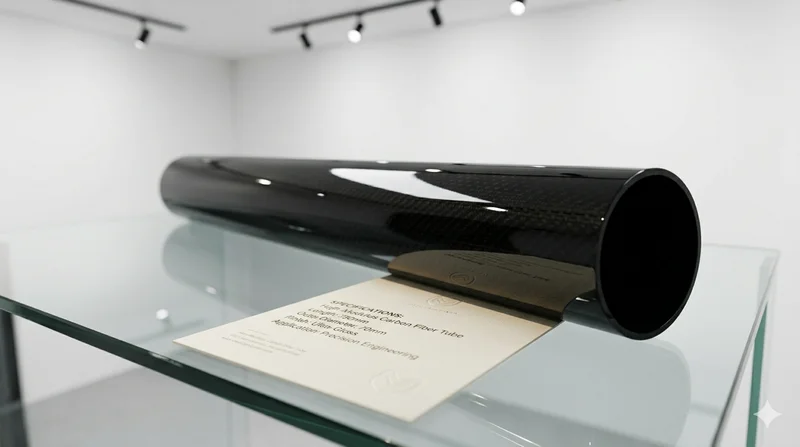
High Modulus Round Carbon Fiber Tube — M40
High modulus round tube manufactured with M40 grade fiber (tensile modulus 400 GPa). Designed for applications where maximum stiffness-to-weight ratio is critical, such as optical systems, precision machinery, and aerospace structures.