
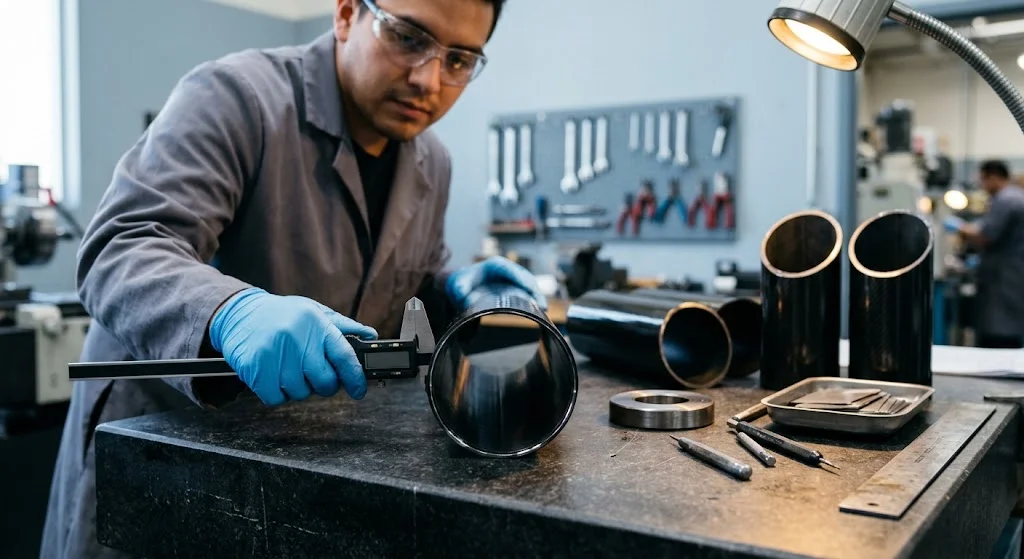
If you are searching for the carbon fiber tube you need 50 mm od 47 mm id, you have already discovered how rarely that exact pair appears in catalog listings. What you are specifying is a thin-wall precision tube: a 1.5 mm wall on a 50 mm outside diameter, a ratio that behaves very differently from
Introduction
If you are searching for the carbon fiber tube you need 50 mm od 47 mm id, you have already discovered how rarely that exact pair appears in catalog listings. What you are specifying is a thin-wall precision tube: a 1.5 mm wall on a 50 mm outside diameter, a ratio that behaves very differently from the thick-walled stock most catalogs lead with. That single pair of numbers drives everything downstream — the manufacturing process that can hold it, the tolerances you should demand, the layup that stops the tube from ovalizing under load, and whether you buy standard inventory or place a custom order.
This article breaks down what 50 mm OD and 47 mm ID really imply, how thin-wall carbon tube compares with common stock sizes such as a 25mm x 23mm x 1000mm carbon fiber tube, which winding methods suit the dimension, and exactly what to include in a RFQ so the delivered tube matches the drawing instead of almost matching it.
Carbon Fiber Tube You Need 50 mm OD 47 mm ID: Reading the Spec
Two numbers define the cross-section, but four properties govern whether the tube works:
- Wall thickness = 1.5 mm: (50 − 47) ÷ 2. A 1.5 mm wall classifies the tube as thin-walled — stiff in bending for its weight, but sensitive to point loads and clamp crush. If your design hangs mass off a bracket bolted through the tube wall, local reinforcement or a thicker section is required.
- Diameter tolerance: on a 50 mm OD, ±0.1 mm is achievable with roll wrapping on a precision mandrel; ±0.05 mm is achievable with grind-to-size finishing. Decide the tolerance by the mating part: press-fit shafts need the tighter band, structural sleeves can live with the standard one.
- Circularity and straightness: thin walls ovalize more easily during cure. Specify maximum ovality (typically ≤0.15 mm on this size) and straightness (≤0.5 mm over 1,000 mm) or accept the house standard — but state it in writing.
- Length and fiber orientation: specify cut length with end-face squareness (±0.5 mm), and whether you need 0°/90° hoop reinforcement or a ±45° bias for torsion-dominated loads.
The most common hidden assumption: buyers read "47 mm ID" as a bearing surface for a 47 mm shaft. Unless the tube is ID-finished, the bore carries a laminate tolerance of roughly ±0.1-0.2 mm; if a bearing fit matters, specify the ID as a finished dimension and expect the price to reflect the extra grinding step.
Thin-Walled vs Thick-Walled: Why the Ratio Matters
Catalogs default to thick-walled tube because it sells into mounting and framing jobs: a carbon fiber tube thick walled at 3 mm on a 50 mm OD is easy to bond, clamp and drill. At 1.5 mm wall the game changes. The stiffness-to-weight of the thin tube is actually higher — section inertia falls slower than mass when the wall thins on a large diameter — but buckling resistance and bearing strength under fasteners drop sharply.
| Property | 50×47 thin wall (1.5 mm) | 50×44 standard wall (3 mm) | 25×23 stock (1 mm) |
|---|---|---|---|
| Wall thickness (mm) | 1.5 | 3.0 | 1.0 |
| Weight per 1,000 mm (g) | ~145 | ~280 | ~55 |
| Bending stiffness (relative) | 1.00 (baseline) | ~1.75 | — |
| Specific bending stiffness | Highest | Lower | High |
| Drill/clamp tolerance | Sensitive | Forgiving | Sensitive |
| Typical use | Rollers, mast tubes, sensor booms | Frames, mounts, robot arms | Camera booms, antenna elements |
Standard stock sizes like the carbon fiber tube 25mm — commonly listed as 25mm x 23mm x 1000mm — exist because they cover high-volume uses, and plenty of buyers first price a carbon fiber tube 23mm listing before discovering their application needs the larger section. A 50×47 is outside that common band, which is precisely why it usually becomes a custom or semi-custom order rather than a shelf item.
Which Process Fits the Carbon Fiber Tube You Need 50 mm OD 47 mm ID
Three processes can deliver the dimension, with different strengths:
- Roll wrapping (mandrel winding): the natural choice. Prepreg or resin-impregnated prepreg sheets are wrapped on a precision ground mandrel of 47 mm, cured under shrink tape, then stripped. Holds ID tightly, allows tailored layup (hoop plies for OD stability, ±45° for torsion), and suits volumes from ten pieces to thousands.
- Filament winding: excellent for hoop-dominated thin walls and large diameters; on a 47 mm ID mandrel it produces very consistent OD, though surface finish shows winding patterns unless ground. Best when internal pressure or hoop strength drives the design.
- Pultrusion: profiles continuous constant sections; round tubes at this size exist but tolerances are looser and lengths are limited by line design. Fine for simple straight parts, poor for tight fit dimensions.
Post-processing decides fit quality: centerless or internal grinding for finished IDs, CNC facing for square ends, and ultrasonic inspection for voids in structural walls.
Sourcing the Carbon Fiber Tube You Need: What to Put in the RFQ
Custom orders fail most often at the specification stage, not the machine. A complete RFQ for a 50 mm OD 47 mm ID tube includes:
- Drawing with OD, ID, length, and which dimensions are critical — mark tolerances per feature rather than a blanket "±0.1".
- Load case: bending, torsion, axial, or compression; the layup conversation starts here.
- Environment: temperature range, UV exposure, chemical contact, and whether the tube is outdoors unpainted.
- Joining method: bonded, clamped, bolted, or press-fit — each constrains surface finish and tolerance.
- Quantity and schedule: prototypes at ten pieces and production at a thousand price very differently; state both.
Also request a first-article report: actual OD/ID/ovality measurements on three pieces from the first run. Suppliers who produce roll-wrapped aerospace-adjacent work publish these without hesitation; a reluctance to measure is itself information. For buyers weighing stock versus custom, the math is usually simple — when no shelf size matches within a millimeter of wall or diameter, custom pricing beats redesigning the assembly around a stock 25 mm tube.
Frequently Asked Questions
Is a 50 mm OD 47 mm ID carbon fiber tube strong enough for structural use?
It depends on the load path. In bending, a 1.5 mm wall at 50 mm OD gives an excellent stiffness-to-weight and outperforms aluminum tubing of the same mass. Under point loads, clamp crush or bearing on fasteners, the thin wall is the limiting factor — use spreader sleeves, bonded lugs or a local thicker section. Provide the load case and layup can be biased (more 0° plies for bending, hoop for pressure, ±45° for torsion) to compensate.
Can you supply this size in standard lengths, or only custom cuts?
Both paths exist. Roll-wrapped production naturally runs in long master tubes that are cut to order, so custom lengths cost little extra beyond facing; common stock lengths for specials are 500 mm, 1,000 mm and 2,000 mm. If your design accepts a stock length, ordering 1,000 mm pieces usually lands close to catalog pricing even for non-catalog diameters.
How does this compare with the common 25mm x 23mm x 1000mm stock tube?
The 25×23×1000 is a 1 mm wall tube that ships from shelf and suits light booms and spars; your 50×47 doubles the diameter at 1.5 mm wall, giving roughly four times the bending stiffness per unit length at about three times the weight. It is a different structural class — don't scale expectations linearly from the small stock size, and don't expect the 50×47 to be on the shelf.
Conclusion
The carbon fiber tube you need at 50 mm OD 47 mm ID is a thin-wall precision component: 1.5 mm of wall carrying the whole design, which makes process choice, tolerance statements and layup direction the three decisions that matter. Roll wrapping on a 47 mm mandrel with a specified ovality and a first-article measurement report is the reliable route; thick-walled stock and off-the-shelf sizes like 25mm x 23mm x 1000mm cover different jobs. YongXian manufactures roll-wrapped and wound carbon fiber tube to customer drawings, including thin-wall precision sizes. Browse our carbon fiber tube range or send your drawing to our team for a quote on your exact dimensions.
Part of topic
Related Articles
- Filament Wound Tank: Types, Design and Certification
- Carbon Fiber Plate Insert Shoe: Retrofit and Fit Guide
- How Are Carbon Fiber Drone Frames Made: Manufacturing Process
- What Are Carbon Fiber Tubes Used For: Application Overview
- Carbon Fiber Rods Fishing: Blank and Build Guide
- Carbon Fiber Rod Handles: Knife and Tool Applications
Interested in Our Products?
Contact our team for competitive pricing and technical specifications.
Get a QuoteRelated Products

Carbon Fiber Plate — 3K Twill T700 1.5mm
Thin 1.5mm carbon fiber plate with 3K twill weave surface. Lightweight and stiff, commonly used for covers, panels, drone bodies, and applications requiring a premium aesthetic appearance.

Carbon Fiber Plate — 3K Twill T700 3.0mm
Medium-thickness 3.0mm carbon fiber plate offering significantly higher load capacity while maintaining attractive 3K twill finish. Suitable for structural brackets, reinforcement plates, and load-bearing panels.

Square Carbon Fiber Tube — 3K Twill T700
Square cross-section carbon fiber tube manufactured with 3K twill weave for torsional strength. Preferred for structural frames, trusses, and support columns where rectangular geometry offers design flexibility.

Round Carbon Fiber Tube — UD Unidirectional T700
Unidirectional (UD) round tube with all fibers aligned axially for maximum longitudinal stiffness. Ideal for applications requiring high bending rigidity with minimal weight, such as shafts, struts, and structural reinforcements.

Round Carbon Fiber Tube — 3K Plain Weave T700
Standard round carbon fiber tube manufactured from Toray T700 grade fiber with 3K plain weave. Offers balanced strength and stiffness for general industrial applications including robotics, automation, sports equipment, and aerospace structures.