
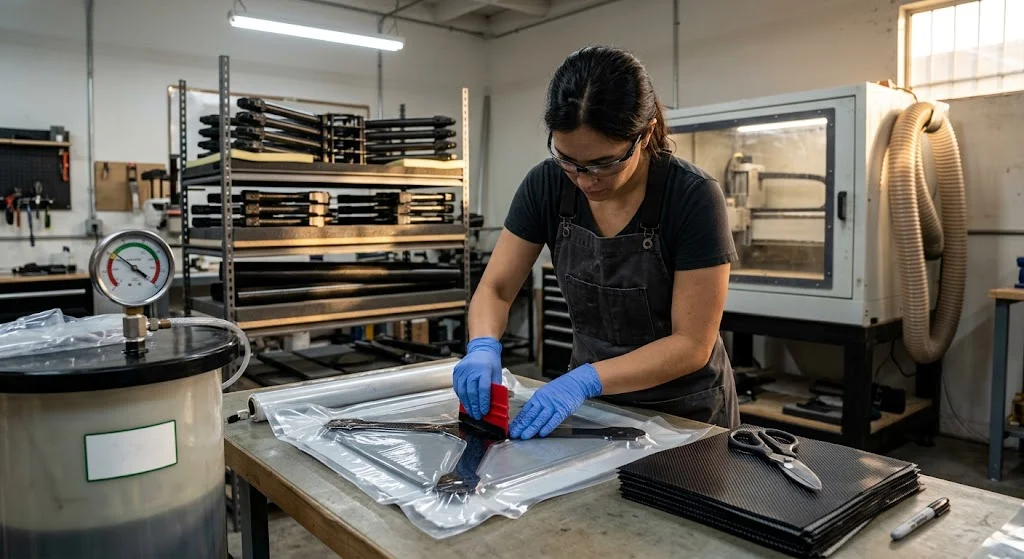
How are carbon fiber drone frames made? The short answer: cut, stack, cure, machine, inspect. Almost every multirotor frame on the market today is built from carbon fiber reinforced polymer (CFRP) — either as CNC-cut flat plates that bolt together, as molded monocoque shells, or as carbon fiber tube
Introduction
How are carbon fiber drone frames made? The short answer: cut, stack, cure, machine, inspect. Almost every multirotor frame on the market today is built from carbon fiber reinforced polymer (CFRP) — either as CNC-cut flat plates that bolt together, as molded monocoque shells, or as carbon fiber tube chassis structures where rolled tubes meet bonded corner nodes. This article walks through the full manufacturing process behind these three frame families, from CAD and fabric cutting to layup, curing, machining and quality control, and explains how a carbon fiber propeller drone drive train integrates with the finished airframe.
The process choices trace back to one trade: flat plates are cheap and stiff but leave cut edges exposed; molded shells are aerodynamic and elegant but need tooling; tube chassis frames are the lightest per unit span but demand precision joints. Understanding how each is made lets a buyer judge frame quality from the outside — by edge finish, ply alignment and hardware patterns — before any load test.
How Are Carbon Fiber Drone Frames Made: Plate Frames from CAD to CNC
Flat-plate frames — the dominant construction for FPV quadcopters, first-person drones and light inspection platforms — start as sheets of cured CFRP plate, typically 2-6 mm thick with quasi-isotropic or 0/90 layups. The production sequence is:
- CAD nesting: frame arms, center plates, camera mounts and hardware brackets are nested onto plate sheets in software to minimize scrap; a typical 5-inch quad scrap rate runs 25-40% on single-layer nesting and drops below 15% with multi-part interlocking layouts.
- CNC cutting: a router or waterjet follows the nested toolpaths. Router cutting uses compression bits at 18,000-24,000 rpm with dust extraction; waterjet cutting avoids dust entirely but can leave a slightly rougher edge that demands a finishing pass.
- Edge finishing and drilling: cut edges are deburred and countersunk; bolt holes are drilled undersize then reamed, because a sloppy hole in carbon plate acts as a crack starter under vibration.
- Surface prep: bonding faces are abraded and solvent-wiped; painted or UV-coated frames receive their finish after assembly to protect edge laminates.
Because the plate was cured at the sheet stage, frame assembly is mechanical: arm plates sandwich between center plates with steel or titanium fasteners, and arm thickness (commonly 3-5 mm on 5-inch class drones) sets both stiffness and crash replaceability — a broken arm is a spare part, not a totaled frame.
How Are Carbon Fiber Drone Frames Made: Molded Monocoque Shells
Molded frames trade field-repairability for aerodynamics and mass efficiency. They are made from prepreg or wet-layup carbon fabric formed in female molds:
- Tooling: a machined aluminum or composite mold defines the shell geometry; mold surface finish transfers directly to the part, so Class-A molds polish to under 0.8 micrometers Ra.
- Ply layup: cut prepreg plies (typically 3-8 plies of 3K twill or unidirectional tape, 90-200 gsm per layer) are stacked into the mold by hand or with a ply-placement head; plies are oriented so fibers follow the principal load paths around motor mounts and battery bays.
- Bagging and cure: the layup is vacuum-bagged and cured in an autoclave or oven — common cycles run 120-180 C at 0.3-0.7 bar for epoxy prepreg systems, 45-120 minutes depending on part thickness.
- Trim and join: cured shells are trimmed on a 5-axis router; upper and lower halves bond with structural adhesive or splice with internal carbon joins, and motor mounts are either co-cured inserts or bonded aluminum bosses.
Molded monocoques show up in cinema drones, long-endurance platforms and fixed-wing UAVs, where the smooth belly and enclosed avionics bay matter more than a five-minute arm swap in the field.
Carbon Fiber Tube Chassis: Node-and-Strut Frame Builds
Heavy-lift rigs, large survey drones and inspection platforms with long sensor booms increasingly use a carbon fiber tube chassis: roll-wrapped carbon fiber tubes and rods carry bending as struts, while machined aluminum or molded carbon corner nodes set the geometry. The build process differs from plate work in three ways:
- Tube cutting and facing: roll-wrapped tubes are cut on a fine-tooth carbide saw with a zero-degree rake, then faced square; the cut end is the critical surface, because a delaminated end crushed under a clamp is the most common field failure.
- Node bonding: tubes are adhesively bonded into node sockets with toughened epoxy, cure 24 hours at room temperature or 2 hours at 80 C; the adhesive fillet at the socket mouth carries the peel load that would otherwise split the tube wall.
- Alignment fixtures: the full frame is assembled in a flat jig while the adhesive cures; motor mount alignment within 0.2 mm across the diagonal is the practical acceptance target, since any twist shows up as vibration and trim drift in flight.
For arms, builders choose tube diameter and wall thickness against the motor thrust class — 16-22 mm OD tubes with 1.0-1.5 mm walls suit 5-inch props, while 25-30 mm tubes carry 15-inch heavy-lift arms. The same carbon fiber tubes and rods supply landing skids, camera booms and antenna masts on the same airframe.
Quality Control: What Separates Flight-Grade Frames from Decorative Carbon
Flight loads are unforgiving: a 5-inch racing quad sees 10-15 g peak arm acceleration in a crash, and a cracked ply that looks cosmetic on the bench becomes a folded arm mid-maneuver. Quality checks that matter at incoming inspection:
| Check | Flight-grade result | Decorative-grade warning sign |
|---|---|---|
| Edge finish after cutting | Sharp, clean ply lines; no fiber pullout | Fuzzy delaminated edge, whitened resin |
| Hole quality | Drilled undersize, reamed, countersunk concentric | Rough drilled holes, exit blowout |
| Ply alignment on arms | Fibers parallel to arm axis within a few degrees | Off-axis fabric, visible weave distortion at bends |
| Sound test (tap) | Sharp click along the whole arm | Dead thud indicating a delamination void |
| Hardware | Steel/titanium fasteners, countersunk flush | Soft aluminum screws, proud heads catching on grass |
For tube chassis frames, add a check of bond-line fillets at every node and a straightness sighting down each arm tube; for molded shells, inspect the internal ply surface for wrinkles or bridging in corners, which are invisible from outside but concentrate impact damage.
Frequently Asked Questions
Why is carbon fiber the default material for drone frames instead of aluminum?
Specific stiffness and damping. Carbon plate and tube offer two to three times the stiffness-per-kilogram of 6061 aluminum, which shrinks the frame mass budget and frees payload for batteries and sensors; the laminate's higher internal damping also attenuates motor vibration before it reaches the IMU, improving flight-controller signal quality. Aluminum survives impacts better in thin sections and is easier to field-repair with standard hardware, which is why landing skids and camera cages on carbon frames are sometimes still aluminum.
Can a cracked carbon drone frame be repaired?
Plate arms usually should not be repaired — they are cheap consumables, and a bonded repair changes stiffness and crash behavior unpredictably. Molded shells can be patched with carbon fabric and epoxy on the interior for non-critical cracks, but any crack crossing a motor mount or battery bay condemns the frame. Tube chassis arms are the exception: a damaged tube can be cut out and a replacement bonded into the same nodes, restoring the frame to near-original stiffness if the nodes are undamaged.
How does a carbon fiber propeller drone handle electrical bonding?
CFRP is electrically conductive, so the frame itself can serve as a ground plane, but the bond must be intentional: star-ground the ESC and battery grounds to a single frame point with a dedicated braid or copper strap instead of relying on screw-contact through painted carbon. Insulate antenna mounts and GPS modules from the frame, since the carbon stack attenuates and detunes antennas placed directly against it — standoffs of 10-15 mm restore most of the pattern.
Conclusion
How are carbon fiber drone frames made? Flat plates are CNC-cut from cured sheet and bolted for field service; molded shells are laid up in tooling for aerodynamic efficiency; tube chassis frames bond roll-wrapped carbon fiber tubes and rods into machined nodes for the best stiffness-per-span on heavy rigs. All three routes converge on the same quality gates — clean cut edges, sound plies, precise holes and disciplined bonding — and those gates are what you can inspect when comparing frames from different suppliers. YongXian manufactures roll-wrapped carbon fiber tubes, rods and CNC-cut CFRP plate for drone builders, with cutting, facing and insert-bonding services to tube-chassis tolerances. Browse our carbon fiber tubes, rods and plate or contact our team to discuss tube diameters, wall thickness and plate layups for your next airframe.
Part of topic
Related Articles
- Carbon Fiber Tube You Need 50 mm OD 47 mm ID: Custom Dimensions Sourcing
- Filament Wound Tank: Types, Design and Certification
- Carbon Fiber Plate Insert Shoe: Retrofit and Fit Guide
- What Are Carbon Fiber Tubes Used For: Application Overview
- Carbon Fiber Rods Fishing: Blank and Build Guide
- Carbon Fiber Rod Handles: Knife and Tool Applications
Interested in Our Products?
Contact our team for competitive pricing and technical specifications.
Get a QuoteRelated Products

Carbon Fiber Plate — 3K Twill T700 1.5mm
Thin 1.5mm carbon fiber plate with 3K twill weave surface. Lightweight and stiff, commonly used for covers, panels, drone bodies, and applications requiring a premium aesthetic appearance.

Carbon Fiber Plate — 3K Twill T700 3.0mm
Medium-thickness 3.0mm carbon fiber plate offering significantly higher load capacity while maintaining attractive 3K twill finish. Suitable for structural brackets, reinforcement plates, and load-bearing panels.

Square Carbon Fiber Tube — 3K Twill T700
Square cross-section carbon fiber tube manufactured with 3K twill weave for torsional strength. Preferred for structural frames, trusses, and support columns where rectangular geometry offers design flexibility.

Round Carbon Fiber Tube — 3K Plain Weave T700
Standard round carbon fiber tube manufactured from Toray T700 grade fiber with 3K plain weave. Offers balanced strength and stiffness for general industrial applications including robotics, automation, sports equipment, and aerospace structures.
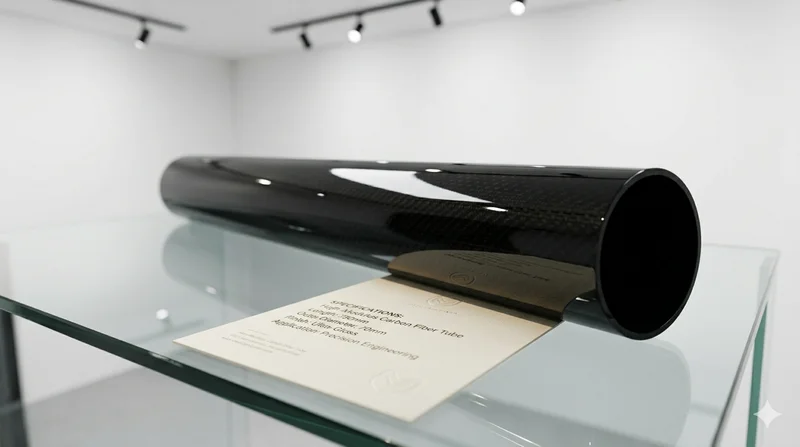
High Modulus Round Carbon Fiber Tube — M40
High modulus round tube manufactured with M40 grade fiber (tensile modulus 400 GPa). Designed for applications where maximum stiffness-to-weight ratio is critical, such as optical systems, precision machinery, and aerospace structures.