
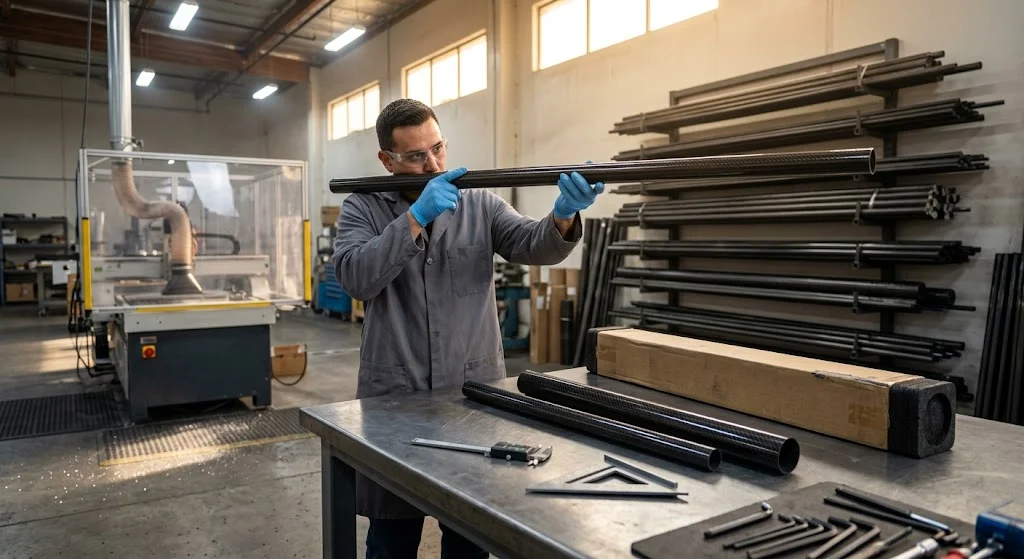
What are carbon fiber tubes used for in practice? Engineers reach for a carbon fiber reinforced polymer (CFRP) tube whenever a structure must stay stiff while shedding mass: robot arms, drone booms, camera sliders, machine-vision rails, marine masts, drive shafts and lightweight chassis frames all f
Introduction
What are carbon fiber tubes used for in practice? Engineers reach for a carbon fiber reinforced polymer (CFRP) tube whenever a structure must stay stiff while shedding mass: robot arms, drone booms, camera sliders, machine-vision rails, marine masts, drive shafts and lightweight chassis frames all follow the same material logic. A pultruded tube carries axial load like a miniature beam; a roll-wrapped tube balances bending, torsion and hoop strength; a braided tube tolerates impact and complex end geometry. This article maps the industries that consume carbon fiber tubes, compares carbon fiber tubes and rods as competing profiles, reviews carbon fiber tube chassis practice, and works through sizing with a concrete 23mm carbon fiber tube example.
The economics rest on specific stiffness. CFRP tubes density at 1.55-1.60 g/cm3 while delivering 60-140 GPa of axial modulus depending on architecture — roughly three to five times the stiffness per kilogram of 6061 aluminum (69 GPa at 2.7 g/cm3) and about three times that of mild steel. For a cantilevered arm or a long boom, that ratio converts directly into lower actuator torque, longer battery life or greater reach inside the same mass budget.
What Are Carbon Fiber Tubes Used For Across Industries
Demand concentrates wherever mass sits far from a pivot, spans a long unsupported length, or must stop vibrating quickly:
- Industrial robotics and automation: secondary arms, end-effector booms and gantry cross-beams on SCARA and cobot systems. Tube arms cut moving mass by 40-60% versus aluminum at equal tip deflection.
- UAVs and field robotics: arm booms, landing skids and sensor masts on multirotor and ground platforms. Carbon fiber tube chassis designs pair roll-wrapped tubes with bonded or bolted corner nodes.
- Imaging and broadcast: jib arms, slider rails, gimbal frames and light trusses. The 15-25 mm outside diameter class dominates camera rigging because it clamps into standard grip hardware.
- Marine and outdoor structures: sailboat masts and spars, outrigger poles, antenna masts and tent poles. Corrosion immunity removes the galvanic detailing that aluminum assemblies demand.
- Composite tooling and fixtures: vacuum-chamber rails, curing-oven racks and CNC fixture frames, where near-zero thermal expansion matters as much as low mass.
- Sporting goods: bicycle seatposts and fork blanks, hockey and polo shafts, fishing rod blanks — the consumer face of the same pultrusion and roll-wrapping technology.
What Are Carbon Fiber Tubes Used For in Robotics and Automation
Robotics is the highest-value-per-kilogram application. A cobot's outer link behaves as a cantilever beam: tip deflection scales with the cube of length and inversely with the product of modulus and section moment of inertia. Swapping an aluminum tube for a CFRP tube of equal outer diameter — made thinner because the specific stiffness is higher — cuts link mass without giving up stiffness. Integrators report 40-60% lower link mass, 15-25% gains in payload-to-robot-weight ratio, and shorter settling times, because the higher structural damping of the laminate (loss factor around 0.02-0.05 versus roughly 0.002 for aluminum) suppresses residual oscillation at the tool tip. Machine-vision systems borrow the same logic: a 23mm carbon fiber tube spanning 1.5-2 m as a camera rail keeps sag sub-millimeter under a 2 kg camera head, where a same-mass aluminum tube bows visibly.
Carbon Fiber Tubes and Rods: Choosing the Right Profile
Solid rods and hollow tubes are cut from the same families of fiber and resin, but the section shape decides the load cases they win:
| Profile | Typical axial modulus | Outside diameter range | Wall thickness | Best-fit applications |
|---|---|---|---|---|
| Pultruded UD tube | 100-140 GPa | 3-30 mm | 0.5-3 mm | Straight constant-section beams, guide rails, spars |
| Roll-wrapped tube | 60-110 GPa | 8-100 mm | 0.5-5 mm | Robot arms, camera rigging, UAV booms, drive shafts |
| Braided + infused tube | 40-70 GPa | 20-150 mm | 1-4 mm | Impact-tolerant structures, protective rails, complex ends |
| Solid pultruded rod | 120-150 GPa | 3-16 mm solid | n/a | Compression pins, dowels, threaded inserts, antenna whips |
Rods win in pure axial compression and wherever threads or pins must engage the end grain; tubes win in bending and torsion per gram, because material sits at the outer radius where the stress is. The working rule: bending-dominated load path, choose a tube; compression pin or solid insert, choose a rod — or bond a metal insert into a tube end and keep the mass advantage.
Carbon Fiber Tube Chassis: Design and Joining Practice
A carbon fiber tube chassis replaces welded sheet-metal frames with a node-and-strut topology: tubes carry the loads, corner nodes set the geometry. Four details decide whether such a chassis survives production:
- Joining method: structural epoxy bonding (film adhesive, 180-220 C cure or toughened room-temperature systems) transfers load continuously; bolted clamps simplify service but concentrate stress, so use wide sleeves and torque control.
- Galvanic isolation: CFRP is electrically conductive. Any fastener stack joining carbon to aluminum or copper needs glass-fiber isolation washers, non-conductive plating or a painted barrier, or the metal corrodes within a season of outdoor exposure.
- Thermal mismatch: CFRP expands 0.5-1.5 micrometers per meter per kelvin along the fiber, versus about 23 for aluminum. Long bonded joints in outdoor structures need compliant adhesive layers or slotted holes.
- End crush: tube ends under bolt load collapse in hoop tension. Bond in aluminum or steel inserts, or use through-bolts with spreader sleeves sized to the wall thickness.
Sizing in Practice: The 23mm Carbon Fiber Tube Class
The 23mm outside diameter class covers camera sliders, mid-size robot link tubes, bicycle-adjacent hardware and instrument masts. For a roll-wrapped quasi-isotropic tube at 90 GPa axial modulus, wall thickness drives both mass and bending stiffness:
| Wall thickness | Linear mass | Section inertia Ix | Relative bending stiffness EI | Typical use |
|---|---|---|---|---|
| 0.5 mm | ~55 g/m | ~2,200 mm4 | 1.0x baseline | Light rails, antenna masts, non-structural covers |
| 1.0 mm | ~110 g/m | ~4,200 mm4 | ~1.9x | Camera sliders, sensor booms, cobot link tubes |
| 1.5 mm | ~165 g/m | ~5,900 mm4 | ~2.7x | Load-bearing arms, chassis struts, drive shafts |
| 2.0 mm | ~220 g/m | ~7,300 mm4 | ~3.3x | Heavy booms, clamped node members, marine spars |
Doubling the wall from 1.0 to 2.0 mm triples bending stiffness for double the mass — the usual trade when a boom hits its deflection limit before its strength limit. When mass is the binding constraint, step up the modulus grade (standard to high modulus fiber) instead of the wall, and accept the higher fiber cost.
Frequently Asked Questions
Can carbon fiber tubes be cut and drilled like aluminum?
Yes, with the right tooling and dust control. Use carbide or diamond-coated bits at high spindle speed with a feed fast enough to cut rather than rub, back the exit face with a sacrificial board to prevent delamination, and extract dust with a HEPA vacuum — CFRP dust is abrasive, electrically conductive and a respiratory hazard. Saw blades with fine carbide teeth and zero tooth bevel produce the cleanest crosscuts on thin-wall tubes.
Are carbon fiber tubes electrically conductive?
Yes. The graphite fiber network makes CFRP moderately conductive along the fibers, so treat every tube as an electrical path. That property is useful for grounding frames and EMI shields, but it means carbon-to-aluminum joints corrode galvanically without isolation, and carbon tubes must not be assumed to insulate live conductors.
How do carbon fiber tubes join to metal structures?
Three methods cover most builds: structural adhesive bonding with surface preparation (abrasion plus solvent wipe) for permanent joints; bolted clamps with wide sleeves and isolation washers for serviceable joints; and bonded-in metal inserts that give threads in the tube end. Avoid drilling through thin-wall tubes without an insert — the bearing stress under the fastener head crushes the wall long before the fiber strength is used.
Conclusion
What are carbon fiber tubes used for? Wherever stiffness per kilogram, dimensional stability and corrosion immunity outrank raw material cost: robotics arms, UAV booms, camera rigging, marine spars, machine-vision rails and node-and-strut chassis frames. The selection path is consistent — pick the architecture (pultruded, roll-wrapped, braided) to match the dominant load, choose tube versus rod by bending versus compression, size wall thickness against the deflection limit, and detail the joins for galvanic isolation and end crush. YongXian manufactures pultruded and roll-wrapped carbon fiber tubes and rods in standard and custom diameters, including the 23mm class, with cutting, bonding-ready surface prep and insert fitting as value-added services. Browse our carbon fiber tube and rod range or contact our engineering team to spec wall thickness, modulus grade and end treatment for your structure.
Part of topic
Related Articles
- Carbon Fiber Tube You Need 50 mm OD 47 mm ID: Custom Dimensions Sourcing
- Filament Wound Tank: Types, Design and Certification
- Carbon Fiber Plate Insert Shoe: Retrofit and Fit Guide
- How Are Carbon Fiber Drone Frames Made: Manufacturing Process
- Carbon Fiber Rods Fishing: Blank and Build Guide
- Carbon Fiber Rod Handles: Knife and Tool Applications
Interested in Our Products?
Contact our team for competitive pricing and technical specifications.
Get a QuoteRelated Products

Carbon Fiber Plate — 3K Twill T700 1.5mm
Thin 1.5mm carbon fiber plate with 3K twill weave surface. Lightweight and stiff, commonly used for covers, panels, drone bodies, and applications requiring a premium aesthetic appearance.

Carbon Fiber Plate — 3K Twill T700 3.0mm
Medium-thickness 3.0mm carbon fiber plate offering significantly higher load capacity while maintaining attractive 3K twill finish. Suitable for structural brackets, reinforcement plates, and load-bearing panels.

Square Carbon Fiber Tube — 3K Twill T700
Square cross-section carbon fiber tube manufactured with 3K twill weave for torsional strength. Preferred for structural frames, trusses, and support columns where rectangular geometry offers design flexibility.

Round Carbon Fiber Tube — UD Unidirectional T700
Unidirectional (UD) round tube with all fibers aligned axially for maximum longitudinal stiffness. Ideal for applications requiring high bending rigidity with minimal weight, such as shafts, struts, and structural reinforcements.

Round Carbon Fiber Tube — 3K Plain Weave T700
Standard round carbon fiber tube manufactured from Toray T700 grade fiber with 3K plain weave. Offers balanced strength and stiffness for general industrial applications including robotics, automation, sports equipment, and aerospace structures.