
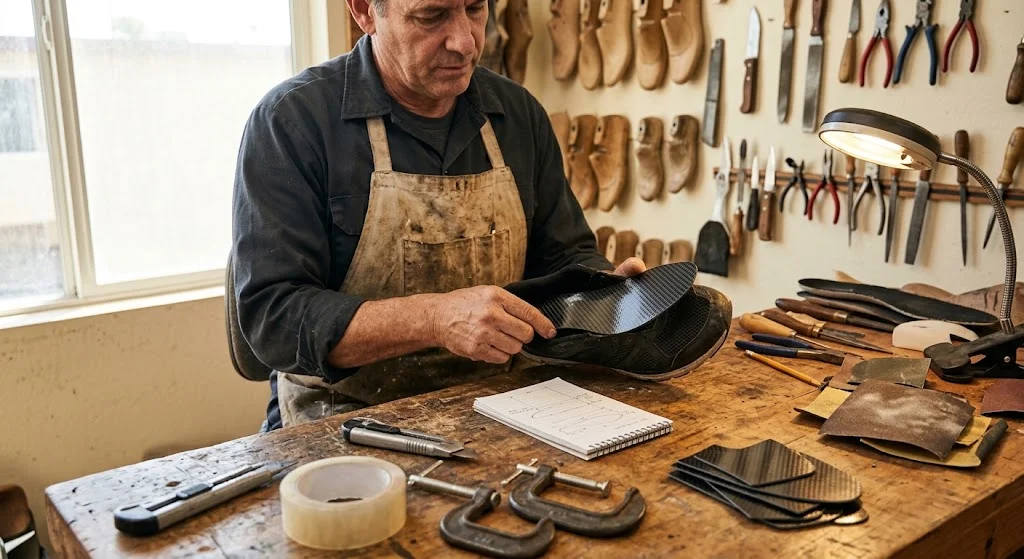
Every carbon fiber plate insert shoe project starts with the same question: can a stiff carbon plate really change how a shoe performs, and is it worth fitting one into footwear that was not designed around it? Since carbon-plated racing shoes moved from elite labs to retail shelves, runners, orthot
Introduction
Every carbon fiber plate insert shoe project starts with the same question: can a stiff carbon plate really change how a shoe performs, and is it worth fitting one into footwear that was not designed around it? Since carbon-plated racing shoes moved from elite labs to retail shelves, runners, orthotic fitters and DIY hobbyists have experimented with adding a carbon fiber plate to existing sneakers — some chasing the propulsive feel of super-shoes, others stiffening work boots or cycling shoes for specific tasks.
This guide explains how OEM carbon plates differ from aftermarket inserts, how a retrofit carbon fiber plate insert shoe build actually works step by step, what thickness and layup to choose, and where the fit risks sit. It also covers the biomechanics behind carbon fiber foot plate devices so you can decide whether a retrofit is sensible — or whether a shoe designed with an integrated plate is the better answer.
How Carbon Fiber Plates Work Inside Shoes
A plate inside a shoe does three jobs: it stiffens the forefoot so the metatarsophalangeal joints bend less during toe-off, it stores and returns elastic energy as it flexes and springs back, and it distributes pressure over a longer contact area. Laboratory tests on integrated racing plates show energy return improvements in the range of a few percent versus uncushioned foam alone — small numbers that compound over thousands of strides.
The effect depends on interaction with the midsole foam. A plate embedded in soft, thick foam acts as a lever: foam compresses under load, the plate bows, and the rebound flings the foot forward. A plate glued under a hard, thin sole does far less — there is no compliant material to leverage against. This is why an aftermarket carbon fiber plate for shoes works best in chunky, cushioned midsoles and does little for flat, firm ones.
Carbon Fiber Plate Insert Shoe in Running Shoes: OEM vs Aftermarket
Manufacturers integrate plates during midsole molding: the plate is positioned in the tool, foam is injected or poured around it, and the bond is chemical as well as mechanical. Aftermarket kits take a different route — a pre-cured plate, cut to a template, is bonded to the underside of an existing insole or into a carved pocket in the foam. The comparison:
| Aspect | OEM integrated plate | Aftermarket insert |
|---|---|---|
| Plate material | Unidirectional or woven prepreg CFRP, 0.6-1.2 mm | Pultruded or flat-wrap CFRP sheet, 1.0-2.0 mm |
| Bond | Co-cured with midsole foam | PU adhesive or contact cement, field-applied |
| Position accuracy | ±1 mm from design | ±5 mm typical, hand-cut |
| Stack height effect | None — designed in | +1-3 mm, may affect heel lock |
| Forefoot stiffness gain | Baseline (engineered) | 20-60% over stock, depending on thickness |
| Cost per pair | Embedded in shoe price | $15-60 materials |
The retrofit can approach OEM behavior only when the plate geometry matches the shoe's flex point and the foam is compliant enough to let the plate work.
Step-by-Step: Building a Carbon Fiber Plate Insert Shoe
A clean retrofit follows six steps, and skipping any of them is the usual cause of failure:
- Template and trace: remove the factory insole, trace it onto paper, and mark the flex line across the ball of the foot. The plate must end just proximal to the toe-off zone, not under the toes.
- Choose plate stock: 1.0-1.5 mm unidirectional CFRP for running shoes, 1.5-2.0 mm for stiffer cycling or work-boot applications. T300-class fiber is sufficient; modulus matters less than thickness here.
- Cut and de-burr: score-and-snap or wet-cut with a diamond disc, then round all edges with 120-grit paper — sharp laminate edges cut insoles and blister feet.
- Dry fit: place the plate inside the shoe, flex the shoe by hand, and confirm the plate does not bottom out at the heel or poke the toes during toe-off.
- Prepare and bond: scuff both surfaces, degrease with acetone, apply polyurethane adhesive to both faces, wait until touch-dry, then press under clamp or book weight for 12 hours.
- Break in: wear for short easy sessions first. Plate stiffness that feels lively at 1 km can fatigue the calf at 10 km — adaptation typically takes one to two weeks.
Carbon Fiber Foot Plate: Fit Risks and Biomechanical Limits
The same stiffness that helps performance can cause problems in a retrofit. A carbon fiber foot plate that is too rigid shifts load from the forefoot toward the Achilles and calf; runners returning from injury often find this aggravates calf strains or Achilles tendinopathy. Conversely, a plate that is too flexible simply wastes the effort — 2.0 mm plate under a dense sole may flex less than the sole itself.
Fit-specific risks deserve their own caution: added stack can reduce heel retention, requiring lace adjustment; a plate edge in the wrong position creates a pressure point under the metatarsal heads; and in shoes with existing orthotics, doubling up stiff layers often pushes the foot too high in the collar. Diabetics and people with peripheral neuropathy should avoid DIY plate retrofits entirely, since they cannot feel the pressure hotspots that cause tissue damage.
- Good candidates: cushioned trainers with soft foam, healthy runners seeking stiffness, cyclists adding plate stiffness to casual shoes, and protective boot stiffening for workshops.
- Poor candidates: already-stiff shoes, wearers with calf/Achilles history, narrow toe boxes, and any wearer with reduced sensation in the feet.
Frequently Asked Questions
Does adding a carbon fiber plate insert make any shoe run faster?
Not automatically. The plate needs compliant foam to lever against — in a soft, cushioned shoe, a well-placed insert can add a noticeable propulsive feel and reduce forefoot flex losses; in a hard, thin-soled shoe the effect is negligible. Expect the biggest gains in shoes with 25 mm+ midsole stacks, and treat marginal improvements as plausible rather than guaranteed — individual running economy varies more than plate effects do.
Will a carbon fiber plate insert damage my shoes?
It can, if done carelessly. Aggressive solvents can dissolve foam; sharp plate edges cut through insoles; and added stiffness concentrates flex at the plate tip, which can crack midsole foam at that line over time. Use acetone only on the plate and insole surfaces, round every edge, and end the plate before the natural flex crease to keep the damage zone outside the highest-strain area.
How thick should a carbon fiber foot plate be for a retrofit?
For running shoes, 1.0-1.5 mm is the practical window: enough to raise forefoot stiffness measurably without adding excessive stack or calf load. Cycling and work-boot applications tolerate 1.5-2.0 mm because the shoe geometry braces the foot differently. Above 2 mm in a running retrofit, most wearers report discomfort before they report performance gains.
Conclusion
A carbon fiber plate insert shoe retrofit is a legitimate modification with real biomechanical effects — but only when plate thickness, flex position and midsole compliance are matched to the wearer. Done well, it approximates the stiffness profile of integrated designs; done badly, it produces pressure points, calf fatigue and delaminating glue lines. For applications where precision matters more than improvisation, plates cut to your drawing deliver consistent thickness and fiber alignment that hand-cut sheet rarely matches. Explore our carbon fiber plate and sheet range for insert-grade stock, or contact our engineering team to discuss cut-to-size plates for footwear, orthotic and sporting applications.
Part of topic
Related Articles
- Carbon Fiber Tube You Need 50 mm OD 47 mm ID: Custom Dimensions Sourcing
- Filament Wound Tank: Types, Design and Certification
- How Are Carbon Fiber Drone Frames Made: Manufacturing Process
- What Are Carbon Fiber Tubes Used For: Application Overview
- Carbon Fiber Rods Fishing: Blank and Build Guide
- Carbon Fiber Rod Handles: Knife and Tool Applications
Interested in Our Products?
Contact our team for competitive pricing and technical specifications.
Get a QuoteRelated Products

Carbon Fiber Plate — 3K Twill T700 1.5mm
Thin 1.5mm carbon fiber plate with 3K twill weave surface. Lightweight and stiff, commonly used for covers, panels, drone bodies, and applications requiring a premium aesthetic appearance.

Carbon Fiber Plate — 3K Twill T700 3.0mm
Medium-thickness 3.0mm carbon fiber plate offering significantly higher load capacity while maintaining attractive 3K twill finish. Suitable for structural brackets, reinforcement plates, and load-bearing panels.

Square Carbon Fiber Tube — 3K Twill T700
Square cross-section carbon fiber tube manufactured with 3K twill weave for torsional strength. Preferred for structural frames, trusses, and support columns where rectangular geometry offers design flexibility.

Round Carbon Fiber Tube — UD Unidirectional T700
Unidirectional (UD) round tube with all fibers aligned axially for maximum longitudinal stiffness. Ideal for applications requiring high bending rigidity with minimal weight, such as shafts, struts, and structural reinforcements.

Round Carbon Fiber Tube — 3K Plain Weave T700
Standard round carbon fiber tube manufactured from Toray T700 grade fiber with 3K plain weave. Offers balanced strength and stiffness for general industrial applications including robotics, automation, sports equipment, and aerospace structures.