
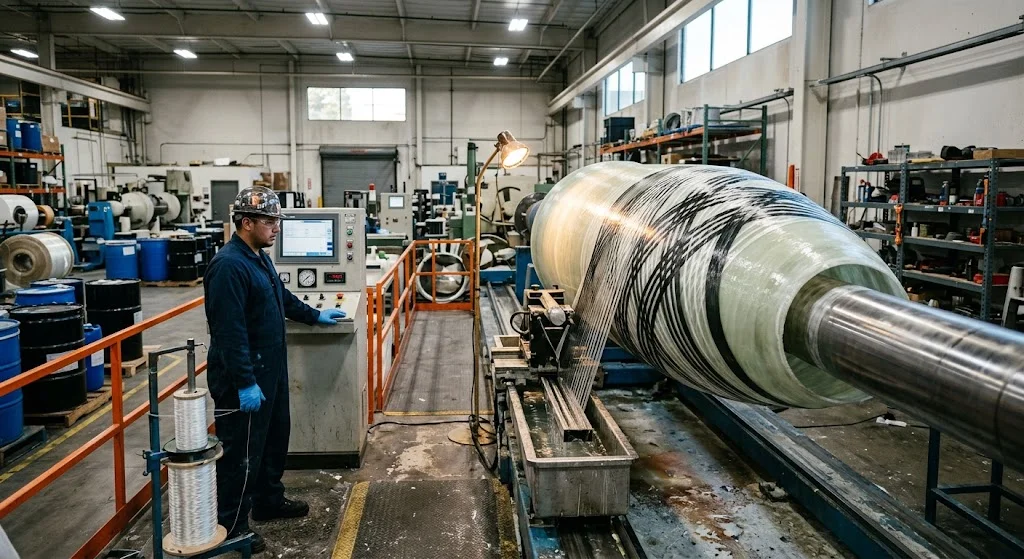
A filament wound tank is a hollow composite vessel built by winding continuous resin-impregnated fiber onto a mandrel or liner in precise patterns, then curing it into a rigid shell. Because fiber placement can be programmed, the structure puts strength exactly where loads act — hoop strength around
Introduction
A filament wound tank is a hollow composite vessel built by winding continuous resin-impregnated fiber onto a mandrel or liner in precise patterns, then curing it into a rigid shell. Because fiber placement can be programmed, the structure puts strength exactly where loads act — hoop strength around the barrel, axial strength at the ends — which is why filament wound tanks dominate gas storage, water treatment, chemical processing and mobility applications where steel vessels are too heavy and molded plastics are too weak.
This guide covers the main types of filament wound tank, the design variables that decide whether a vessel works, how the same winding technology produces filament wound frp pipe and epoxy tubes, which standards govern the category, and the certification steps a pressure-rated tank must pass before it can be sold.
Filament Wound Tank Types: What Gets Built and Why
Although the winding process is shared, tanks split into distinct families by duty:
| Type | Typical diameter | Design pressure | Common duty |
|---|---|---|---|
| Type I / III / IV pressure cylinders | 60-400 mm | 200-700 bar (gas) | Hydrogen, CNG, scuba, fire extinguishers |
| Storage tanks (atmospheric) | 0.5-4 m | Near-atmospheric | Water, wastewater, ion exchange, slurry |
| Chemical process vessels | 0.5-3 m | Up to 16 bar | Acid pickling, plating, scrubbers |
| Multi-compartment tanks | 0.8-2.5 m | Low pressure | Marine fuel/water, RV liquid storage |
| Filament wound frp pipe spools | 25-1200 mm | Up to 25 bar | Process piping, outfalls, slurry lines |
The pressure classes are not interchangeable: a 700-bar hydrogen cylinder is a different engineering world from an atmospheric storage tank, even though both are wound on similar machines. Wall build-up, fiber selection and quality documentation scale with the risk the vessel carries.
Designing a Filament Wound Tank: Fiber Angle, Liner and Bosses
Three decisions define the design:
- Winding angle: the helix angle sets the balance between hoop and axial properties. Near 90° (hoop winding) resists internal pressure efficiently in the barrel; layers at ±15-30° carry axial loads and hold the domes; polar layers at low angle wrap the poles where bosses sit. Most storage tanks use a hoop/hoop/helical stack; pressure cylinders add low-angle polar plies.
- Liner: the liner seals the vessel. Thin thermoplastic liners (PE, PA) handle water and corrosion cheaply; elastomeric liners tolerate flexing for gas service; seamless metal liners add impermeability for hydrogen. Filament wound tanks without a liner (self-supporting GRP shells) exist only for non-permeable liquids where microcracking is acceptable.
- Bosses and end fittings: metal bosses are the weakest link if handled badly. They are bonded into the dome with thickened resin and reinforced with radial and helical plies so load transfers gradually — a sharp laminate edge at the boss interface is the classic leak and failure path.
Resin choice follows the medium: epoxy for high mechanical performance and adhesion, polyester or vinyl ester for corrosion resistance at lower cost, and BMI or vinyl ester systems where temperature rises. Fiber is usually E-glass for storage, E- or S-glass for demanding pressure duty, and carbon-glass hybrids where stiffness and weight both matter.
How Filament Wound Tanks Are Made
Production runs on a winding machine with a programmable carriage: a roving creel feeds resin bath or pultrusion impregnation head, the eye traverses the rotating mandrel, and layers build in designed sequences. Curing follows — ambient for large polyester tanks, oven or autoclave cycles for epoxy pressure vessels. Then come machining of ports, hydraulic proof testing, and in many markets, third-party inspection before delivery. Quality is decided less by the winding head than by what surrounds it: fiber tension control, resin temperature, mandrel runout and cure records are the fields an audited buyer examines first.
Filament Wound FRP Pipe: The Same Technology, Different Geometry
Continuous filament winding is also how filament wound frp pipe is produced, and the pipe world feeds tank practice with proven standards. While small tanks follow product standards in each region, piping is governed by well-established specs such as ISO 14692 (glass-reinforced plastic piping), ASTM D2996/D2997 (filament-wound FRP pipe), and ASME B31.3 for process systems that incorporate composites. Manufacturers who can demonstrate compliance with these filament wound epoxy tubes standards and pipe standards are usually the same shops qualified to wind vessel reinforcements — auditing one discipline gives buyers confidence in the other.
The overlap is real in daily engineering: nozzles on chemical tanks are often short spools of filament wound pipe; the same epoxy systems qualified for pipe carry over to tank bodies; and pressure-test documentation formats mirror each other. A supplier fluent in both reduces the interface risk between vessel and connected piping.
Certification: Getting a Pressure-Rated Filament Wound Tank to Market
Atmospheric storage tanks need little formal certification — material declarations, dimensional checks and leak tests usually suffice. Pressure vessels walk a longer road:
- Design verification: burst prediction by netting theory or FEA, with knockdown factors for delamination, boss stress concentrations and environmental conditioning.
- Prototype testing: hydraulic burst test to destruction, plus pressure cycling (typically thousands of cycles), thermal cycling, and drop/impact tests where the vessel is portable.
- Type approval and surveillance: schemes such as TPED/DOT for gas cylinders, ISO 11439 for CNG tanks, ISO 19881/19882 for hydrogen vessels, and pressure equipment directives in the EU require notified-body review plus ongoing production audits — periodic visual inspection, proof tests and batch traceability.
- Marking and documentation: every certified tank carries serial, charge pressure, test date and standard reference; traceability back to fiber and resin lots is mandatory.
Budget-wise, certification is often a larger upfront cost than the winding line itself — but it is what converts a composite shell into a sellable pressure product.
Limitations Worth Knowing Before You Specify
No technology is free of trade-offs. Filament wound structures are anisotropic — weak through-thickness — so interlaminar design at ports and supports deserves attention; UV exposure degrades unprotected polyester surfaces, requiring gelcoat or topcoat; large tanks need transport planning because integral winding limits maximum diameter per site; and fire performance of organic matrices must be considered in enclosed spaces. Buyers comparing against steel should also weigh that repair methodology for composite tanks differs: bonded patch repair is acceptable in some codes, forbidden in others.
Frequently Asked Questions
What standards apply to a filament wound tank for drinking water?
Drinking-water duties typically reference national or regional potable-water approvals (for example NSF/ANSI 61 in North America or WRAS-type approvals in the UK) on top of the structural standard for the vessel class. The liner material must be potable-grade, and resin systems need extractable-compound testing. For storage at atmospheric pressure, structural standards such as ASTM D5365 or ISO tank design guides cover the winding itself, while the water approval governs materials contact.
How does a filament wound tank compare with a rotationally molded plastic tank?
Winding places fibers along the load paths, so a filament wound tank reaches much higher strength-to-weight and can hold pressure; rotomolding produces a homogeneous but unreinforced wall that sags under load and is limited to low or atmospheric duty. For large atmospheric water tanks rotomolding is cheaper; for anything pressurized, corroding, or weight-sensitive, winding wins decisively.
Can filament wound epoxy tubes and tank shells share one supplier?
Yes — and it is common. The same winding machinery, resin systems and testing culture produce filament wound epoxy tubes, frp pipe and tank reinforcements. Confirm three things: a quality system covering all product families, test reports for the pressure class you need, and clear documentation of which standards each product line is built to. A supplier who can show filament wound epoxy tubes standards compliance alongside tank type tests usually runs tighter process control overall.
Conclusion
The filament wound tank is a discipline of programmed fiber placement: winding angle decides how the shell meets pressure, liner decides what it can hold, and certification decides whether it can be sold for pressure service. The same technology that wraps process vessels also produces filament wound frp pipe and precision epoxy tubes, so suppliers fluent across the family bring documented process control to your project. YongXian supplies wound composite structures and precision carbon fiber and glass fiber tubes for demanding assemblies. Browse our composite products or contact our engineering team to discuss materials, tolerances and documentation for your vessel or piping program.
Part of topic
Related Articles
- Carbon Fiber Tube You Need 50 mm OD 47 mm ID: Custom Dimensions Sourcing
- Carbon Fiber Plate Insert Shoe: Retrofit and Fit Guide
- How Are Carbon Fiber Drone Frames Made: Manufacturing Process
- What Are Carbon Fiber Tubes Used For: Application Overview
- Carbon Fiber Rods Fishing: Blank and Build Guide
- Carbon Fiber Rod Handles: Knife and Tool Applications