
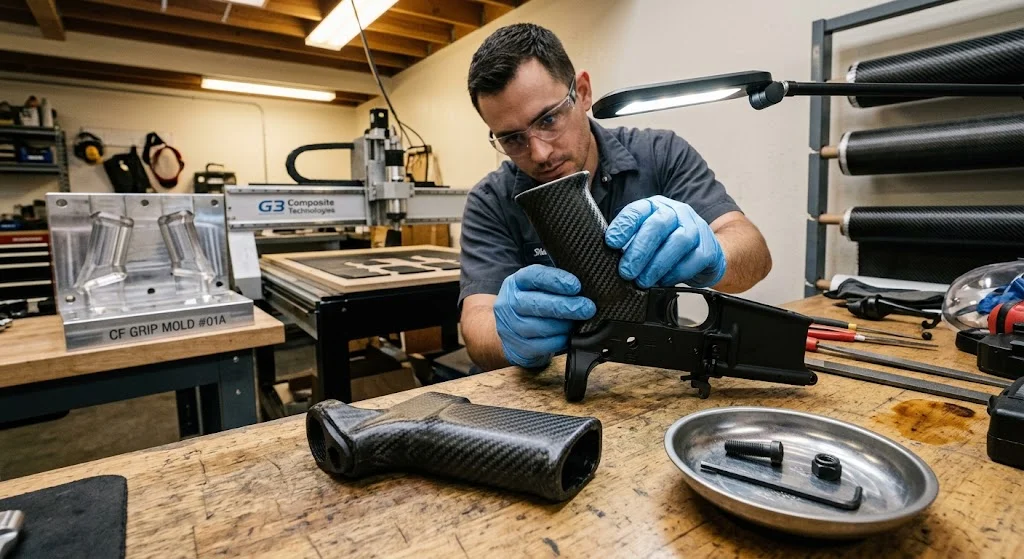
A carbon fiber AR grip brings race-car lightness to a rifle platform, but material selection matters more than the weave pattern on the surface. AR-15 style grips see sustained vibration from recoil, repeated impact from handling, and constant exposure to cleaning solvents — any of which can degrade
Introduction
A carbon fiber AR grip brings race-car lightness to a rifle platform, but material selection matters more than the weave pattern on the surface. AR-15 style grips see sustained vibration from recoil, repeated impact from handling, and constant exposure to cleaning solvents — any of which can degrade a decorative-grade composite. This article examines the mechanical performance of carbon fiber AR grip components, compares layup options, covers bonding details, and explains how carbon fiber small parts manufacturers maintain tolerances on curved, thin-walled grip shells.
Material Performance: Why Carbon Fiber for AR Grip Components
Carbon fiber reinforced polymer (CFRP) offers three properties that matter for firearm furniture:
| Property | CFRP (3K twill, epoxy) | Glass-filled polymer | 6061-T6 aluminum |
|---|---|---|---|
| Density (g/cm³) | 1.55-1.60 | 1.30-1.45 | 2.70 |
| Tensile strength (MPa) | 600-900 (laminate) | 80-120 | 310 |
| Flexural modulus (GPa) | 45-65 | 8-15 | 69 |
| Thermal expansion (µm/m·°C) | 2-5 (in-plane) | 30-50 | 23.6 |
| Solvent resistance | Excellent (epoxy) | Good | Excellent |
The flexural modulus is the number that changes how the grip feels: a carbon grip shell flexes less under hand pressure than a polymer grip, so trigger finger positioning stays consistent through a string of fire. Low thermal expansion means dimensional stability across -20°C to +60°C — a real advantage for competition rifles.
Layup and Wall Thickness: Designing a Carbon Fiber AR Grip
Grip shells are typically laid up in female molds from prepreg or wet-layup carbon fabric. Design choices that affect both feel and durability:
- Fiber orientation: 0° fibers along the grip axis carry recoil loads into the receiver; ±45° plies resist torsion. A balanced 0/±45/90 quasi-isotropic layup is standard for structural grips.
- Wall thickness: 1.2-2.0 mm typical. Most production grips land at 1.5 mm nominal.
- Core options: some designs use a foam or honeycomb core between carbon skins. Core gaps at the screw boss are a common failure point — the boss needs solid laminate or a metal insert.
- Surface finish: matte clear coat for tactical builds; high-gloss for competition. The clear coat must be solvent-resistant — automotive 2K polyurethane holds up to Hoppe's No. 9 and CLP.
Carbon fiber rod grips — tubular spine designs where a carbon tube runs the length of the grip — use a different architecture: a roll-wrapped carbon fiber solid rod carries the main load, with molded cheek panels bonded to it. Lighter, but needs a robust bond line at the rod-to-receiver interface.
Manufacturing Tolerances: How Carbon Fiber Small Parts Are Made to Spec
Grip shells are small, curved, thin-walled parts — exactly the geometry where hand layup introduces variability. Production processes that hold tolerances:
- Prepreg autoclave cure: the highest-consistency route. Prepreg plies are cut on a CNC ply cutter (±0.5 mm positional accuracy), laid into a polished aluminum mold, bagged, and cured at 120-180°C. Dimensional tolerance on the finished shell: ±0.3 mm on critical dimensions.
- RTM (resin transfer molding): dry preform in a matched mold, resin injected under pressure. Good for higher volumes; tolerance ±0.4 mm; cycle time 8-15 minutes per part.
- Trim and drill: cured shells are trimmed on a 5-axis router; grip screw holes and safety selector cutouts are CNC-drilled in the same fixture to maintain positional relationship within ±0.15 mm.
Inspection: C-scan ultrasonic inspection on structural grips checks for delamination and void content; tap testing on cosmetic parts catches gross voids. These tolerances matter because the grip must mate to a receiver with a specific grip screw boss geometry — a shell that is 0.5 mm out of position on the screw hole will crack at the boss under recoil load, not on the first range trip, but somewhere around round 500.
Bonding and Fastening: Attaching Carbon to Metal and Polymer
The grip-to-receiver joint is the highest-stress interface. Attachment methods ranked by robustness:
- Metal grip screw into threaded receiver boss: the standard method. Use a steel screw (not aluminum); torque to 2.5-3.5 N·m; add a threadlocker rated for metal-to-metal. The carbon shell must have a metal or solid-laminate insert at the screw boss.
- Adhesive bond to receiver tang: toughened epoxy (3M DP420 or equivalent) on a scuffed, solvent-wiped aluminum tang. Surface prep is everything — a bond to anodized aluminum without scuffing will fail at 30-40% of theoretical strength.
- Polymer lower receiver adapters: use a metal adapter plate or threaded insert — polymer creep under sustained screw load will loosen the joint over months.
For carbon fiber parts for cars that share the same manufacturing DNA — small molded CFRP shells bonded to metal substrates — the same surface prep and adhesive selection rules apply.
Finish, Solvent Resistance and Long-Term Durability
Firearm furniture lives in a chemical environment that would destroy decorative carbon. Validation checks that matter:
Exposure Acceptable result (2K PU clear) Failure mode (no/poor clear coat) Hoppe's No. 9 (24h soak) No color change, no softening Resin swell, white blush at edges CLP wipe (100 cycles) Gloss retention >90% Surface tack, fingerprint staining Salt fog (96h, ASTM B117) No blistering at hardware interfaces Galvanic corrosion at steel screw / carbon interface -20°C to +60°C thermal cycle (10 cycles) No delamination, dimensional change <0.1 mm Edge lift, clear coat craze The galvanic corrosion line deserves attention: carbon fiber is cathodic to steel and aluminum. In a salt-fog environment, an unprotected steel screw in a carbon grip boss will corrode faster than in a polymer grip. Mitigation: passivated or stainless hardware, anti-corrosion grease at the screw interface.
Frequently Asked Questions
Is a carbon fiber AR grip noticeably lighter than a polymer grip?
Yes, by 40-70 grams depending on design. A standard polymer grip weighs 85-110 g; a molded CFRP shell with metal inserts runs 45-70 g. On a competition rifle, that mass difference shifts the balance point rearward. For a hunting rifle carried for miles, the weight saving is real but modest.
Will a carbon fiber AR grip crack under recoil?
Not if the laminate is structural-grade and the screw boss has a metal or solid-laminate insert. Recoil loads are compressive along the grip axis and are carried by the 0° fibers into the receiver. Cracks initiate at stress concentrators — sharp corners, voids at the screw boss, or delaminated edges. Quality grips avoid all three.
Can I refinish or repaint a carbon fiber grip?
You can apply a new clear coat after scuffing with 400-grit and solvent-wiping, but you cannot change the weave appearance without removing the original clear — which risks sanding into the laminate. For a color change, hydro-dip or ceramic coating over the existing clear is safer.
Conclusion
A carbon fiber AR grip earns its place when the build demands stiffness, thermal stability and mass savings without sacrificing solvent resistance or joint reliability. The material choices — quasi-isotropic layup, 1.5 mm nominal wall, 2K polyurethane clear, metal inserts at the screw boss — are well-established in the CFRP small-parts industry and apply equally to carbon fiber rod grips and carbon fiber parts for cars. YongXian manufactures roll-wrapped carbon fiber tubes and rods and molds custom CFRP small parts to customer drawings. Browse our carbon fiber tubes, rods and custom parts or contact our engineering team to discuss layups, wall thickness and bonding details for your next CFRP component program.
carbon fiber AR gripcarbon fiber rod gripscarbon fiber small partscarbon fiber parts for carscarbon fiber grip panelscarbon fiber accessoriescarbon fiber stock materialcarbon fiber custom partsRelated Articles
- DIY Carbon Fiber Drone Frame: Design and Assembly Guide
- Carbon Fiber Tube You Need 50 mm OD 47 mm ID: Custom Dimensions Sourcing
- Filament Wound Tank: Types, Design and Certification
- Carbon Fiber Plate Insert Shoe: Retrofit and Fit Guide
- How Are Carbon Fiber Drone Frames Made: Manufacturing Process
- What Are Carbon Fiber Tubes Used For: Application Overview
Interested in Our Products?
Contact our team for competitive pricing and technical specifications.
Get a QuoteRelated Products
 plates
Carbon Fiber Plate — 3K Twill T700 1.5mm
Thin 1.5mm carbon fiber plate with 3K twill weave surface. Lightweight and stiff, commonly used for covers, panels, drone bodies, and applications requiring a premium aesthetic appearance.
View Product plates
Carbon Fiber Plate — 3K Twill T700 3.0mm
Medium-thickness 3.0mm carbon fiber plate offering significantly higher load capacity while maintaining attractive 3K twill finish. Suitable for structural brackets, reinforcement plates, and load-bearing panels.
View Product tubes
tubesSquare Carbon Fiber Tube — 3K Twill T700
Square cross-section carbon fiber tube manufactured with 3K twill weave for torsional strength. Preferred for structural frames, trusses, and support columns where rectangular geometry offers design flexibility.
View Product tubes
tubesRound Carbon Fiber Tube — 3K Plain Weave T700
Standard round carbon fiber tube manufactured from Toray T700 grade fiber with 3K plain weave. Offers balanced strength and stiffness for general industrial applications including robotics, automation, sports equipment, and aerospace structures.
View Product tubes
tubesRound Carbon Fiber Tube — UD Unidirectional T700
Unidirectional (UD) round tube with all fibers aligned axially for maximum longitudinal stiffness. Ideal for applications requiring high bending rigidity with minimal weight, such as shafts, struts, and structural reinforcements.
View Product