
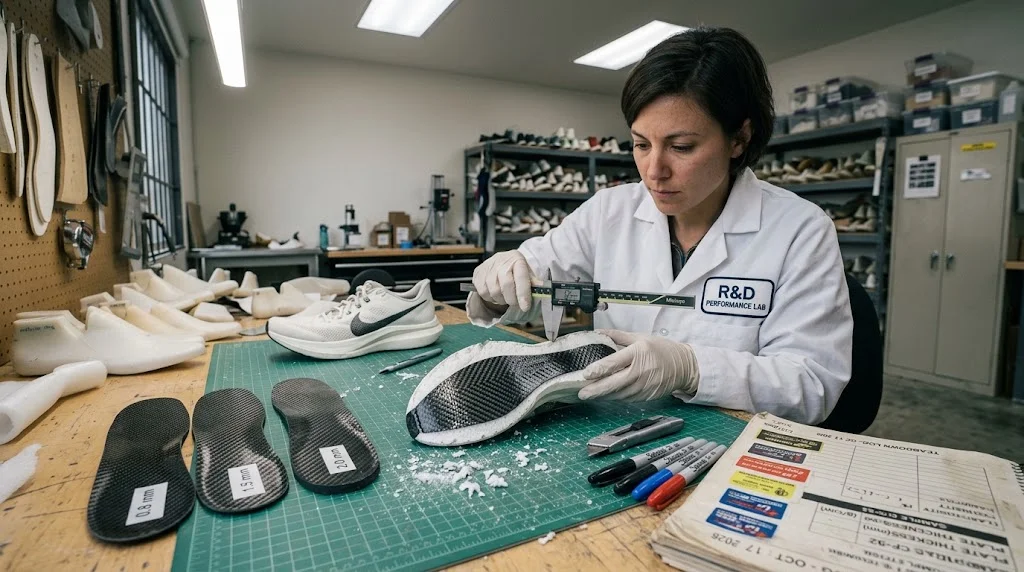
The carbon fiber plate in shoes is one of the most visible consumer uses of composites in the past decade, and the engineering behind it is more subtle than marketing suggests. A plate embedded in a midsole is not there to make the shoe "springy" in a magical sense: it stiffens the forefoot, sets a
Introduction
The carbon fiber plate in shoes is one of the most visible consumer uses of composites in the past decade, and the engineering behind it is more subtle than marketing suggests. A plate embedded in a midsole is not there to make the shoe "springy" in a magical sense: it stiffens the forefoot, sets a rocker curvature, and controls how the midsole foam deforms under load. Understanding those three functions is the difference between buying a genuine performance benefit and buying a carbon-look insole that does nothing.
This article covers the mechanics of a carbon fiber plate running shoe, how plates behave in cycling and everyday footwear, and how buyers can evaluate a carbon fiber plate insole or a factory plate shoe against real data rather than claims.
What the Plate Actually Does
Three mechanisms explain almost every performance claim around plated footwear.
- Forefoot stiffness: The plate raises the bending stiffness of the shoe at the metatarsal heads. In testing, plated racing shoes show 15-30 percent less energy lost at the forefoot fold compared with unstiffened foam shoes of the same midsole, which converts to a small but measurable improvement in running economy, typically 1-4 percent in lab studies.
- Rocker geometry: The plate fixes a curved profile from midfoot to toe, so the shoe rolls through toe-off instead of flexing. That shift moves work from the calf and ankle to the plate's lever, reducing metatarsal stress and smoothing cadence at speed.
- Foam control: Under a flat midsole, soft super-foams pancake and lose resilience over a stride. The plate distributes pressure more evenly across the foam, keeping deformation elastic rather than collapse-prone, which preserves energy return late in a race.
Carbon Fiber Plate in Shoes for Running, Cycling, and Everyday Use
The same material behaves very differently once you change the sport, because the load case changes.
| Application | Plate Role | Typical Stiffness (forefoot N/mm) | Plate Thickness (mm) | Benefit Level |
|---|---|---|---|---|
| Racing running shoe | Stiffness + rocker + foam control | 15-25 | 1.0-1.5 (carbon) | High (1-4% economy) |
| Training running shoe | Moderate stiffness | 8-14 | 0.8-1.2 or nylon | Low-moderate |
| Cycling road shoe | Full-platform power transfer | 40-80 | 2.0-3.0 (full sole) | High (sprint watts) |
| Ski / snowboard boot | Response and edge hold | 30-60 | 1.5-2.5 insert | Medium-high |
| Everyday / work shoe | Walk comfort rocker | 6-10 | 0.8-1.0 | Comfort, not speed |
In running, the return on investment is real but modest, and it concentrates in races and fast workouts. In cycling, where the shoe is clamped to the pedal, the plate removes sole flex under sprint power, and riders commonly report a firmer, more direct pedal feel rather than a "bounce." In everyday footwear the plate is a comfort device: the rocker shortens the lever arm of each step and reduces forefoot bending demand, which is why plated or rocker-structured daily shoes have found fans among people with metatarsalgia or hallux rigidus.
Carbon Fiber Plate Insole Options
Not every buyer wants a new pair of shoes. Aftermarket carbon fiber plate insole products, often sold as a carbon fiber plate shoe insert, split into three families, and the differences matter.
- Full-length rigid plates: Closest to a racing shoe plate. They raise stiffness across the whole forefoot and work best in roomy trainers with removable insoles. They shift fit, so expect a break-in period and possible pressure at the arch.
- Half-length or metatarsal pads with carbon backing: Stiffen only the toe-off zone, preserving rearfoot flexibility. These are the safer first step for runners adding a plate to a daily trainer.
- Custom-molded inserts: Made from a cast or scan, with a carbon or carbon-peek laminate shank tailored to the athlete's arch and preferred rocker point. This is the route most podiatry clinics take for patients who need both correction and stiffness.
Plate thickness is the dial that controls feel: 0.8 mm reads flexible and friendly; 1.5 mm approaches race-shoe stiffness in a trainer; above 2 mm most recreational runners lose more in comfort than they gain in economy.
Choosing a Carbon Fiber Plate Running Shoe: Practical Checks
When evaluating a factory carbon fiber plate running shoe or a plated cycling model, ask four questions. What is the plate material, carbon or nylon composite, because the price gap is large and nylon is legitimate for training use. What is the stack height and foam type, since the plate only works as part of a system. How stiff is the forefoot in measurable terms, and does the brand publish a number. And finally, what is the rocker radius: a shoe with a high plate but flat geometry still demands calf work at toe-off. Sellers who answer these questions with data are usually selling performance; sellers who lead with the carbon weave photo are usually selling looks.
Frequently Asked Questions
Does a carbon fiber plate in shoes really make you faster?
In racing shoes, yes, measurably. Peer-reviewed lab studies find 1-4 percent improvements in running economy with plated super-foam racing shoes versus the same foam without a plate, translating to roughly 1-2 percent in race time for trained runners. The effect shrinks with lower stiffness, poorer fit, or slower paces, and it does not appear reliably in casual joggers. For cycling shoes, the benefit is power transfer under sprint loads rather than economy percentages.
Can I add a carbon fiber plate insole to any running shoe?
Only if the shoe has a removable insole and enough volume. A rigid full-length plate in a slim racing flat will bottom out and create hot spots; the same plate in a high-stack trainer fits comfortably. Start with a half-length plate if you are unsure, wear the setup for short runs first, and stop if you feel metatarsal or arch pain that does not resolve within a few days. Existing foot conditions such as neuroma or sesamoiditis should be cleared with a clinician before adding stiffness.
How long do carbon plates in shoes last?
The plate itself outlives the foam. Carbon fiber plates rarely crack in normal use; the midsole foam above and below is the wear item, typically 400-800 km for race foams and 600-1000 km for trainers. Aftermarket carbon insoles last longer, often several seasons, because they see lower peak strains than a full shoe plate. Inspect insoles for delamination at the edges and replace them if the laminate softens noticeably.
Conclusion
The carbon fiber plate in shoes earns its place through three well-understood mechanisms: forefoot stiffness, rocker geometry, and foam control. In racing and cycling the gains are measurable; in everyday footwear the same physics shows up as comfort rather than speed. Buyers get the best result by matching plate stiffness and rocker to their sport, their volume, and their training load, whether that means a factory plate shoe or a carbon fiber plate insole added to a trusted pair. YongXian supplies the carbon fiber plate stock these products are cut from, in T300 and T700 grades and thicknesses from 0.4 mm. Browse our carbon fiber plate range or contact our team for sheet specifications suited to footwear and insole programs.
Part of topic
Related Articles
- Carbon Fiber Tube Cap: End Fittings and Sealing Solutions
- Carbon Fiber Control Arms: Suspension Geometry and Composite Design
- Carbon Fiber Drone Frame: Selection Guide for Racing and Industrial Drones
- Carbon Fiber Plate with Morton's Extension: Metatarsal Support in Footwear
- Carbon Fiber Road Bike Wheels: Rim Profile and Spoke Choice
- S500 Carbon Fiber Quadcopter Drone Frame Kit: Specifications and Upgrades
Interested in Our Products?
Contact our team for competitive pricing and technical specifications.
Get a QuoteRelated Products

Carbon Fiber Plate — 3K Twill T700 1.5mm
Thin 1.5mm carbon fiber plate with 3K twill weave surface. Lightweight and stiff, commonly used for covers, panels, drone bodies, and applications requiring a premium aesthetic appearance.

Carbon Fiber Plate — 3K Twill T700 3.0mm
Medium-thickness 3.0mm carbon fiber plate offering significantly higher load capacity while maintaining attractive 3K twill finish. Suitable for structural brackets, reinforcement plates, and load-bearing panels.

Square Carbon Fiber Tube — 3K Twill T700
Square cross-section carbon fiber tube manufactured with 3K twill weave for torsional strength. Preferred for structural frames, trusses, and support columns where rectangular geometry offers design flexibility.

Round Carbon Fiber Tube — UD Unidirectional T700
Unidirectional (UD) round tube with all fibers aligned axially for maximum longitudinal stiffness. Ideal for applications requiring high bending rigidity with minimal weight, such as shafts, struts, and structural reinforcements.

Round Carbon Fiber Tube — 3K Plain Weave T700
Standard round carbon fiber tube manufactured from Toray T700 grade fiber with 3K plain weave. Offers balanced strength and stiffness for general industrial applications including robotics, automation, sports equipment, and aerospace structures.