
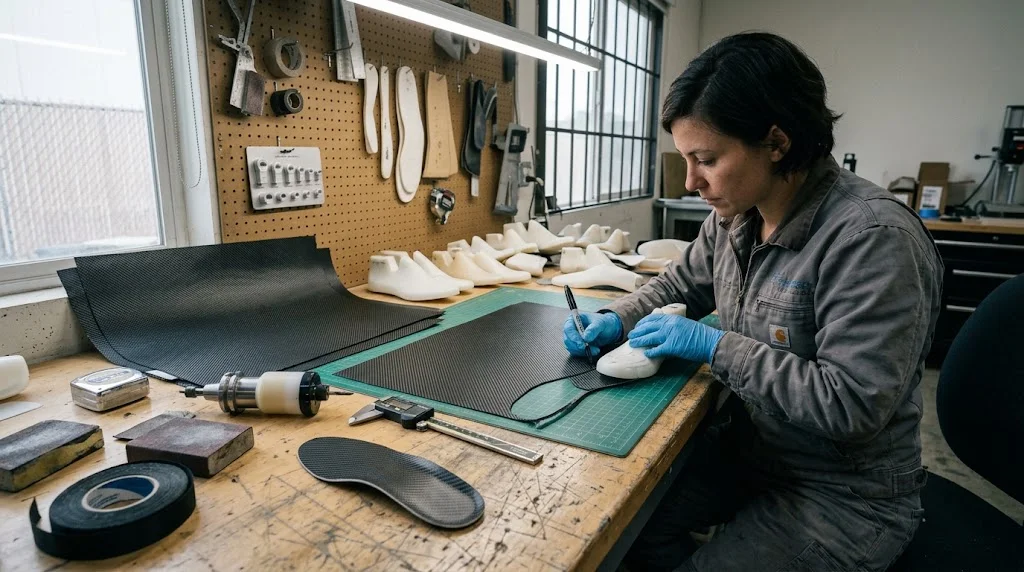
A carbon fiber plate with Morton's extension is an orthotic or footwear component that adds a lever arm ahead of the first metatarsal head, and it is one of the few forefoot modifications that combines a clear mechanical rationale with measurable walking outcomes. The extension is the portion of the
Introduction
A carbon fiber plate with Morton's extension is an orthotic or footwear component that adds a lever arm ahead of the first metatarsal head, and it is one of the few forefoot modifications that combines a clear mechanical rationale with measurable walking outcomes. The extension is the portion of the plate that continues past the joint line under the big toe, loading the first ray earlier in stance and altering how the forefoot distributes pressure during push-off. When that geometry is executed in carbon fiber rather than polypropylene or fiberglass, the plate can be made thinner and lighter while holding the same bending stiffness, which is why sports medicine clinics, diabetic footwear programs and performance running brands have all converged on the same basic construction.
This article explains what the modification does, how a carbon fiber plate with morton's extension should be specified from a clinical and manufacturing standpoint, and where projects typically go wrong. It covers the lever mechanics, the prescription parameters that matter, the layup decisions that determine stiffness, and the practical checks that keep a custom plate reproducible from the first pair to the hundredth.
What Morton's Extension Does to Forefoot Loading
Morton's extension shifts the pressure transition point of the forefoot by extending the rigid plate under the first metatarsophalangeal joint. In a normal shoe, load transfers across the metatarsal heads roughly together; with the extension in place, the first ray engages earlier, which can reduce peak pressure under the second and third heads and change the timing of hallux purchase during late stance. Clinicians prescribe the geometry for a handful of recurring reasons: big toe arthritis where motion must be limited, post-operative protection of the first ray, selected cases of hallux rigidus, and pressure management in diabetic forefoot ulcer risk.
The mechanical effect scales with three variables: how far the extension reaches, how stiff the plate is in bending, and how the underside of the extension is shaped against the shoe lasts. A short extension with high stiffness behaves differently from a long, gently ramped one, which is why the prescription and the manufacturing drawing have to describe the same object in the same units.
| Design variable | Typical clinical range | Effect of increasing the value | Manufacturing note |
|---|---|---|---|
| Extension length beyond the joint | 10 to 25 mm past the joint line | Earlier first-ray loading, more lever arm | Check against toe box volume in the finished shoe |
| Forefoot ramp angle | 4 to 12 degrees under the plate | Greater pressure under the first ray | Ramp is built into the mould, not sanded afterwards |
| Plate bending stiffness | Set by layup, typically 3 to 6 plies | More control of motion, more trade-off in comfort | Documented as a stiffness target, not only ply count |
| Plate thickness | 1.2 to 2.5 mm in the midfoot | Higher stiffness, harder to fit in slim footwear | Thickness must stay inside the shoe last envelope |
Carbon Fiber Plate with Morton's Extension in Footwear Design
Footwear brands approach the same geometry from the product side rather than the clinic side, and the requirements overlap but are not identical. A brand building a carbon fiber plate with morton's extension into a running or walking silhouette cares about stack height, outsole clearance, repeatability across sizes, and how the plate interacts with the midsole foam. The clinic cares about the anatomical endpoint of the extension and the pressure map under the foot. Both sides need the plate drawings to define the joint line reference, the extension tip position, and the ramp angle with the same tolerances.
Three integration details decide whether the plate behaves as intended inside a finished shoe:
- Last geometry: the extension must sit flat against the lasting board without a gap, because a bridged extension loads unevenly and can create a pressure point at the tip instead of distributing load along the lever.
- Forefoot volume: adding material under the first ray reduces toe box space, so the extension length has to be validated in the finished last rather than assumed from the flat drawing.
- Bond line: plates glued into footwear need surface preparation matched to the resin system, since an untreated carbon fiber surface will eventually delaminate under repeated flexing.
- Size grading: extension length usually scales with shoe size, and a single absolute value across a size run produces inconsistent clinical effects from size to size.
Brands that treat the plate as a midsole component rather than an insert typically get better consistency, because the plate geometry is fixed in the mould set and validated once per size instead of being adjusted at assembly.
Choosing a Carbon Fiber Plate Orthotic with Morton's Extension
For clinicians fitting a carbon fiber plate orthotic, the decision sequence starts with the indication and ends with material selection. The extension itself is rarely the question; the questions are how much stiffness the patient tolerates, how the device fits in the shoes they actually wear, and whether the plate will be a full-length device or a shorter construct that stops in the forefoot. Carbon fiber earns its place when the device must be thin: it delivers the stiffness of a thicker polypropylene plate at roughly half the thickness, which matters in dress shoes, cleats and skates where every millimetre of volume is contested.
Material choice also changes how the extension should be finished. A carbon fiber plate foot orthotic with a bonded extension tip should have the tip radiused and sealed, because exposed laminate edges wick moisture and lift over months of use. The table below compares the plate materials most often specified for this modification.
| Material | Relative stiffness at equal thickness | Typical thickness | Best suited to | Watch-outs |
|---|---|---|---|---|
| Carbon fiber and epoxy | Highest, about 3 to 4 times polypropylene | 1.2 to 2.0 mm | Thin footwear, sport, long lever arms | Brittle at sharp notches, needs sealed edges |
| Polypropylene | Baseline, flexible | 2.5 to 4.0 mm | Adjustable devices, forgiving fits | Bulky under the first ray, creeps under sustained load |
| Fiberglass and epoxy | Middle, about 1.5 to 2 times polypropylene | 1.5 to 2.5 mm | Budget custom devices | Thicker than carbon for the same effect |
| Prepreg carbon fiber | Highest with the tightest tolerance | 1.0 to 1.8 mm | Performance footwear programs | Higher cost, cure scheduling required |
Whichever material is chosen, the stiffness target should be written into the prescription or the purchase specification as a measurable value, because ply count alone does not describe a plate once fibre orientation, resin system and press cycle vary between batches.
Frequently Asked Questions
How far should a Morton's extension extend past the big toe joint?
Most prescriptions land between 10 and 25 millimetres beyond the joint line, with the exact figure set by the condition, the footwear volume available and the pressure map under the foot. Extensions at the shorter end are easier to fit and better tolerated in slim shoes, while longer extensions give a stronger lever for cases that need substantial first-ray loading. The figure should be drawn on the prescription, checked against the finished last, and recorded so a replacement device matches the original rather than being re-estimated.
Why use carbon fiber instead of polypropylene for this modification?
Carbon fiber reaches the required bending stiffness at roughly half the thickness of polypropylene, which is the decisive advantage whenever footwear volume is limited. It also creeps less under sustained load, so the ramp angle and extension position measured on day one still approximate the device after months of use. Polypropylene remains the better choice when adjustability and low cost matter more than thinness, and fiberglass sits between the two for budget custom work.
Can a carbon fiber plate with Morton's extension be built into a running shoe?
Yes, and several brands already integrate comparable geometry as a midsole component, but the integration has to be designed rather than retrofitted. The extension tip needs clearance inside the toe box, the plate must bond to a prepared surface rather than loose foam, and extension length should scale across the size run so a US men's 9 and a US men's 12 produce comparable clinical effects. Brands should validate the geometry on the finished last, not only on the flat drawing, before committing tooling.
Conclusion
A carbon fiber plate with Morton's extension is a small component with a specific job: move the timing and distribution of forefoot load by holding a rigid lever under the first ray, and do it in a package thin enough to live inside real footwear. The projects that work define extension length, ramp angle and stiffness as measurable numbers shared by clinician and manufacturer, and they validate the result in the finished shoe rather than on the drawing board alone.
YongXian supplies carbon fiber plate stock, prepreg and cut components for orthotic and footwear programs, with layup guidance and stiffness targets supported by batch documentation. Explore our carbon fiber products or contact our team with your extension drawing, target stiffness and annual volume for a sourced quotation.
Part of topic
Related Articles
- Carbon Fiber Tube Cap: End Fittings and Sealing Solutions
- Carbon Fiber Plate in Shoes: Running, Cycling and Everyday Footwear
- Carbon Fiber Control Arms: Suspension Geometry and Composite Design
- Carbon Fiber Drone Frame: Selection Guide for Racing and Industrial Drones
- Carbon Fiber Road Bike Wheels: Rim Profile and Spoke Choice
- S500 Carbon Fiber Quadcopter Drone Frame Kit: Specifications and Upgrades
Interested in Our Products?
Contact our team for competitive pricing and technical specifications.
Get a QuoteRelated Products

Carbon Fiber Plate — 3K Twill T700 1.5mm
Thin 1.5mm carbon fiber plate with 3K twill weave surface. Lightweight and stiff, commonly used for covers, panels, drone bodies, and applications requiring a premium aesthetic appearance.

Carbon Fiber Plate — 3K Twill T700 3.0mm
Medium-thickness 3.0mm carbon fiber plate offering significantly higher load capacity while maintaining attractive 3K twill finish. Suitable for structural brackets, reinforcement plates, and load-bearing panels.

Square Carbon Fiber Tube — 3K Twill T700
Square cross-section carbon fiber tube manufactured with 3K twill weave for torsional strength. Preferred for structural frames, trusses, and support columns where rectangular geometry offers design flexibility.

Round Carbon Fiber Tube — UD Unidirectional T700
Unidirectional (UD) round tube with all fibers aligned axially for maximum longitudinal stiffness. Ideal for applications requiring high bending rigidity with minimal weight, such as shafts, struts, and structural reinforcements.

Round Carbon Fiber Tube — 3K Plain Weave T700
Standard round carbon fiber tube manufactured from Toray T700 grade fiber with 3K plain weave. Offers balanced strength and stiffness for general industrial applications including robotics, automation, sports equipment, and aerospace structures.