
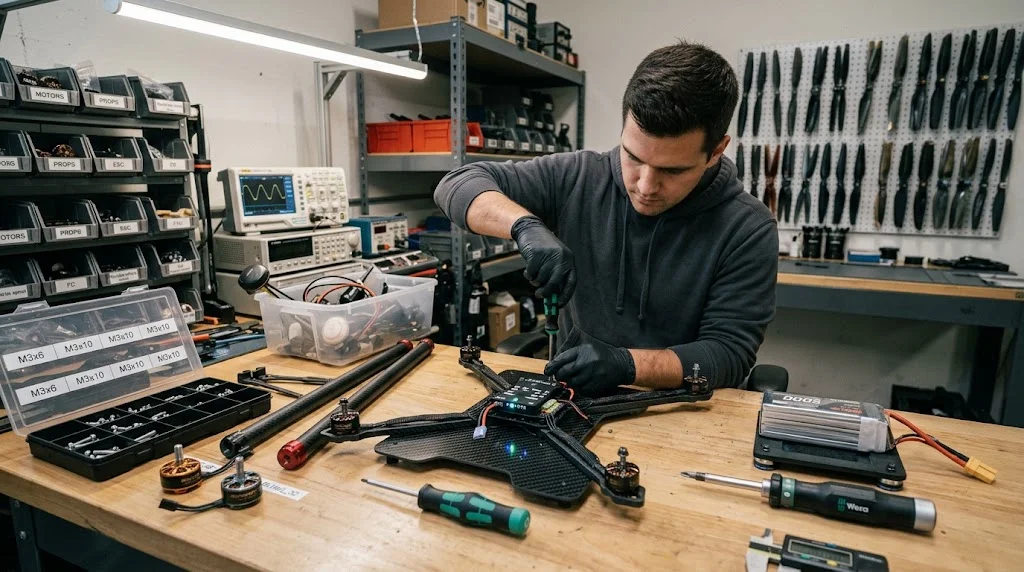
A carbon fiber drone kit is the fastest path from a parts box to a flying multirotor, but the market mixes finished ready-to-fly packages with bare frame kits that still need motors, ESCs, flight controller and radio gear. This guide explains what a kit actually contains, how to compare a carbon fib
Introduction
A carbon fiber drone kit is the fastest path from a parts box to a flying multirotor, but the market mixes finished ready-to-fly packages with bare frame kits that still need motors, ESCs, flight controller and radio gear. This guide explains what a kit actually contains, how to compare a carbon fiber drone frame on geometry and material rather than looks, what an S500-class carbon fiber quadcopter build looks like end to end, and which corners are safe to cut and which are not. Whether you are assembling a first FPV quad or specifying a frame for a payload platform, the decision tree below keeps the build honest.
Carbon fiber earns its place on multirotor frames for one reason: stiffness-to-weight. A frame that flexes under motor torque wastes power, confuses the flight controller's vibration filters, and fatigues at the arm roots. A carbon frame that is properly specified stays locked through aggressive maneuvers and hard landings, and the grams it saves go straight into flight time or payload. The kit approach matters because frame geometry, arm thickness and bolt patterns must match the motors and electronics you plan to fly — and the cheapest complete kit on a marketplace listing often mismatches those three.
What Is Included in a Carbon Fiber Drone Kit
Kit contents vary more than marketing copy suggests. The table below separates the frame-only kits from near-complete packages so you can budget the rest of the build.
| Kit level | Typical contents | What you still buy |
|---|---|---|
| Frame-only kit | Carbon fiber drone frame plates, arms, standoffs, hardware, sometimes prop guards | Motors, ESCs, flight controller, PDB, radio, props, battery |
| Frame + power kit | Frame plus motors, ESCs and power distribution board | Flight controller, radio gear, GPS, battery, props |
| Almost-ready-to-fly | Frame, motors, ESCs, flight controller pre-mounted, radio receiver | Transmitter, battery, charger, props, camera/FPV gear if not included |
| Ready-to-fly | Everything including transmitter, battery and charger | Time and a field; calibration only |
For most builders, the frame-only or frame-plus-power level offers the best value: you choose the flight controller and radio you trust, and you avoid paying twice for electronics you would replace anyway. Where kit listings get misleading is arm length and motor size. An S500 kit usually ships 5-inch to 6-inch props with 2212 or 2216 motors; a 7-inch long-range build needs different arms, different motors and often a different frame plate thickness. Match the kit to the prop size you intend to fly, not to a price point.
Choosing a Carbon Fiber Drone Frame: Geometry and Material
Frame choice decides everything downstream — motor size, prop clearance, battery placement and crash survivability. Four attributes matter more than any cosmetic cutout pattern:
- Wheelbase and layout: 250-class frames suit 5-inch props and freestyle flying; 330 to 450 class frames take 6- to 8-inch props for long range or light payloads; hexacopter and octocopter frames trade efficiency for redundancy on commercial platforms.
- Arm construction: plate arms are cheaper and stiff in one plane but concentrate stress at the mount; carbon tube arms with plate mounts flex less under asymmetric loads and are easier to replace after a crash.
- Plate thickness and layup: 2 mm bottom plates suit light 250 builds; 2.5 to 3 mm plates handle freestyle impacts; arm plates of 3 to 4 mm resist bending at the root. Ask whether the carbon is quasi-isotropic layup or a cheap woven-only schedule — the former holds up, the latter delaminates at the first hard strike.
- Mounting patterns: confirm 30.5 mm and 20 mm flight controller patterns, motor bolt circle (typically M3 on 16x19 or 19x19), and XT60 / battery strap routing before ordering. A frame that fits your stack saves an adapter plate and a re-solder session.
Weight claims deserve scrutiny. A genuine carbon fiber drone frame in the 250 class weighs 350 to 550 grams depending on plate count and arm style; glass-fiber hybrids painted to look like carbon run heavier and flex more. If a listing quotes an implausibly low frame weight with no layup detail, assume woven-only carbon and budget for arm replacements after the first season.
S500 Carbon Fiber Quadcopter Drone Frame Kit: Reference Build
The S500-class quadcopter remains a popular teaching and utility platform because the parts ecosystem is mature and the frame tolerates mistakes. A typical S500 carbon fiber quadcopter drone frame kit build looks like this:
- Frame: 500 mm wheelbase carbon frame with 2 mm bottom plate and 3 mm arms, integrated power distribution, 10-inch prop clearance.
- Motors and props: four 920-980 KV motors with 1045 or 1045R propellers for 3S to 4S operation; upgrade to 2216 900 KV for 4S efficiency.
- Power: 4-in-1 ESC or four 30 A ESCs, XT60 pigtail, low-ESR capacitor on the battery lead.
- Flight control: a full-size flight controller on 30.5 mm standoffs, GPS mount at the rear, barometer away from prop wash.
- Radio and failsafe: 2.4 GHz receiver with failsafe programmed to hold-last or descend; telemetry link for battery voltage and GPS state.
- Battery and balance: 4S 3000-5000 mAh pack on a vibration-damped tray, CG checked before first hover.
Build order matters more than component brands. Mount the flight controller and PDB first, route motor wires along the arms with strain relief at the plate, then solder motors last so you can replace one without disturbing the stack. Tighten standoffs to a firm hand-torque, not more — carbon plates crack under over-torqued bolts more readily than aluminium. Balance each prop before the maiden flight; an unbalanced 10-inch prop transmits vibration that mimics a failing bearing.
Build Checks Before First Flight
Before the maiden hover, run a fixed checklist regardless of kit level. Motor direction and props must match the flight controller's rotation convention; a reversed prop on one arm is the most common first-flight crash. Radio range-check at low power in an open field, then set failsafe with the transmitter off and confirm the craft disarms or descends. Check arm bolt torque, battery strap tension and GPS cable routing away from ESCs. Finally, hover at waist height for thirty seconds, listening for bearing noise and watching for drift — a well-built carbon fiber drone frame holds attitude with minimal correction, and any twitch at hover usually points to a loose arm bolt or an unbalanced prop rather than a tuning problem.
Frequently Asked Questions
Is a carbon fiber drone kit worth the premium over a plastic frame?
For anything beyond gentle line-of-sight flying, yes. Carbon's stiffness-to-weight keeps the frame from flexing under motor torque, which reduces vibration and extends bearing life. Plastic and glass-fiber frames are fine for trainers and indoor whoops, but they flex, they fatigue at the arm roots, and they absorb energy that a carbon frame reflects back into a survivable crash.
Can I upgrade an S500 quadcopter kit to a long-range carbon fiber drone?
Yes, with three changes: swap to 6- or 7-inch arms and matching motors, move to a 4S or 6S pack with higher capacity, and add a GPS + telemetry module the flight controller supports. The S500 carbon frame itself is usually stiff enough for 7-inch props; the weak points are motor KV and battery, not the plate.
How do I know if a frame is real carbon or painted fiberglass?
Real carbon has a visible woven or unidirectional fiber pattern under clear resin, feels colder to the touch than plastic, and rings when tapped. Painted fiberglass shows a paint surface with no fiber texture, feels warmer, and damps the tap. Ask the seller for the layup schedule — quasi-isotropic is the mark of a frame built to hold up.
Conclusion
A carbon fiber drone kit pays off when you match the frame geometry to your prop size, choose a layup that survives real impacts, and build in an order that keeps the stack serviceable. Start with the frame-only or frame-plus-power level, verify mounting patterns before ordering electronics, and treat the S500-class quadcopter as the mature reference platform it is. Browse our carbon fiber tubes and plates for tube arms and frame plate stock in the thicknesses serious builds need, or contact us with your wheelbase and motor size and we will recommend tube diameters and plate specs for your frame.
Part of topic
Related Articles
- Carbon Fiber Car Parts: Structural vs Cosmetic Components Explained
- Carbon Fiber Rod Repair Kit: Field Repairs for Fishing and RC Components
- Carbon Fiber Tube Cap: End Fittings and Sealing Solutions
- Carbon Fiber Plate in Shoes: Running, Cycling and Everyday Footwear
- Carbon Fiber Control Arms: Suspension Geometry and Composite Design
- Carbon Fiber Drone Frame: Selection Guide for Racing and Industrial Drones
Interested in Our Products?
Contact our team for competitive pricing and technical specifications.
Get a QuoteRelated Products

Carbon Fiber Plate — 3K Twill T700 1.5mm
Thin 1.5mm carbon fiber plate with 3K twill weave surface. Lightweight and stiff, commonly used for covers, panels, drone bodies, and applications requiring a premium aesthetic appearance.

Carbon Fiber Plate — 3K Twill T700 3.0mm
Medium-thickness 3.0mm carbon fiber plate offering significantly higher load capacity while maintaining attractive 3K twill finish. Suitable for structural brackets, reinforcement plates, and load-bearing panels.

Square Carbon Fiber Tube — 3K Twill T700
Square cross-section carbon fiber tube manufactured with 3K twill weave for torsional strength. Preferred for structural frames, trusses, and support columns where rectangular geometry offers design flexibility.

Round Carbon Fiber Tube — 3K Plain Weave T700
Standard round carbon fiber tube manufactured from Toray T700 grade fiber with 3K plain weave. Offers balanced strength and stiffness for general industrial applications including robotics, automation, sports equipment, and aerospace structures.

Round Carbon Fiber Tube — UD Unidirectional T700
Unidirectional (UD) round tube with all fibers aligned axially for maximum longitudinal stiffness. Ideal for applications requiring high bending rigidity with minimal weight, such as shafts, struts, and structural reinforcements.