
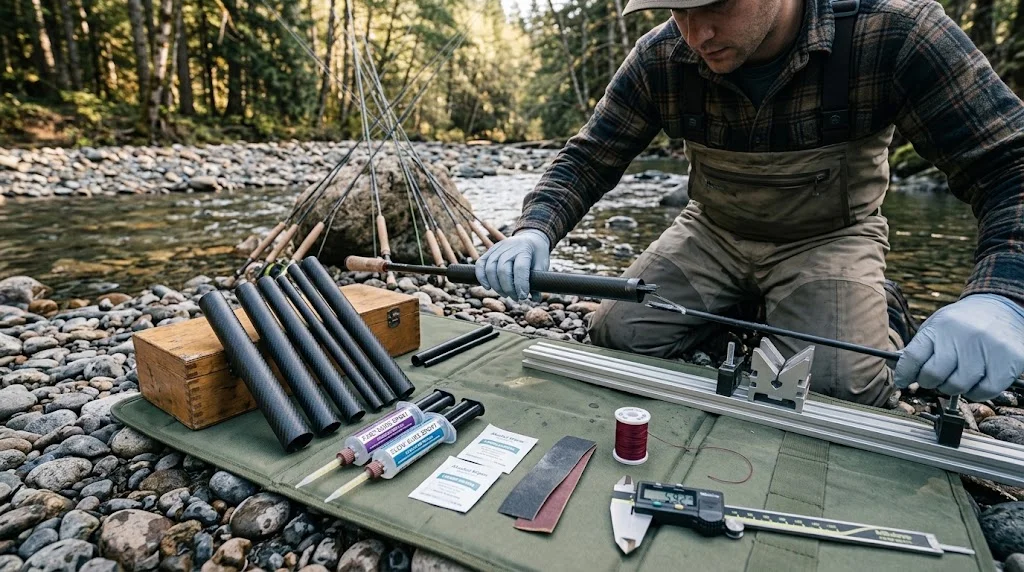
A carbon fiber rod repair kit is what stands between a snapped fishing rod section or a cracked RC pushrod and a trip to the trash can. Carbon fiber does not bend-fatigue back into shape like fiberglass; once a rod, tube or spar cracks through more than the surface resin, it needs a structural patch
Introduction
A carbon fiber rod repair kit is what stands between a snapped fishing rod section or a cracked RC pushrod and a trip to the trash can. Carbon fiber does not bend-fatigue back into shape like fiberglass; once a rod, tube or spar cracks through more than the surface resin, it needs a structural patch — a sleeve or a bonded splice that carries load around the break — and the right kit puts every one of those consumables in one box. This guide explains what belongs in the kit, compares the carbon fiber rod connection methods that actually hold under load, and walks through a carbon fiber tube repair procedure that works at a lake bank or a flight line, not just on a clean bench.
The same repair logic covers two very different user groups. Anglers break rod tips and mid-blank sections on the water, where speed and one-handed work matter more than cosmetics. RC hobbyists break landing gear, pushrods and camera booms on carbon fiber drone frames, where straightness after the repair decides whether the aircraft flies again. Both groups are repairing the same material with the same chemistry — epoxy bonded scarf or sleeve joints — so the procedure below applies to both, with notes on where the priorities diverge.
What a Carbon Fiber Rod Repair Kit Contains
A complete kit is judged by whether it lets you finish the repair the day the break happens, not by how many parts it lists. The table below shows the core contents of a practical field kit and why each item earns its place.
| Item | Typical spec | Role in the repair |
|---|---|---|
| Repair sleeves (carbon tube sections) | OD 2-12 mm, wall 0.3-1.0 mm, cut 50-100 mm | Sleeve over the break, carries bending load across the gap |
| Two-part epoxy, slow cure | 30-60 min pot life, lap shear 20-30 MPa | Bonds sleeve to rod; slow cure allows alignment time |
| Two-part epoxy, fast cure | 3-5 min pot life, for tacking | Tacks sleeve position before final bond |
| Alcohol wipes and sandpaper | 240-400 grit, lint-free wipes | Roughens and cleans the bonding surface |
| Alignment jig or V-block | Aluminium or nylon, V-groove | Holds both halves coaxial while epoxy cures |
| Spare tip sections and ferrules | Fishing rod sizes, 5-8 mm OD | Replaces shattered tips that cannot be sleeved |
| Silk thread and finish | 0.4 mm thread, thin finish | Wraps over the sleeve edge for abrasion protection |
Two items are commonly missing from cheap kits and both matter in the field: enough slow-cure epoxy to redo a bad alignment, and sleeves in more than one wall thickness. A sleeve that fits a 4 mm rod tip loosely will not carry load; a sleeve that is too thick adds stiff mass at exactly the point that must flex. Carrying three wall thicknesses in the sizes you actually break costs almost nothing and saves most trips.
Carbon Fiber Rod Connection Methods Compared
Before repairing, it helps to know which joint types exist, because the repair is really a re-connection of the two halves. Four methods cover almost every field repair:
- Internal sleeve joint: a smaller carbon tube slides inside both broken ends. Strength comes from the long glue line inside the bore; the outer diameter stays unchanged, which matters for rod actions and RC linkages. This is the default for fishing rod blanks and pushrods.
- External sleeve joint: a larger tube covers the break from outside. Easier to fit on-site and stronger in bending, but it adds diameter and a stiffness step that can start a new crack at the sleeve edge on flexible blanks.
- Scarf or tapered splice: both ends are sanded to a long taper and overlapped. Highest strength-to-weight and the stiffest option, but it needs tools, time and a stable work surface — realistic on a bench, rarely at the lake.
- Ferrule or mechanical joint: a commercial ferrule or compression fitting joins the halves. Fully reversible and fast, but the ferrule must match the exact OD, and the hard ring concentrates stress on soft blanks.
Load numbers put the choice in perspective. A well-made internal sleeve joint in a 6 mm rod recovers roughly 60-80 percent of the original flexural stiffness at the joint and about 50-70 percent of ultimate break load, because the joint is now limited by the sleeve wall and the glue line rather than by continuous fiber. External sleeves run 10-15 percent higher in bending strength but shift the neutral axis and change the rod action. Scarf joints recover the most, often above 80 percent, but only when the taper length is at least 8 to 10 times the rod diameter.
Carbon Fiber Tube Repair: Step-by-Step Field Procedure
The procedure below assumes a clean snap through a tube or rod section, the most common failure in both fishing and RC use. Work in shade, keep the epoxy off skin, and do not rush the alignment check.
- Assess and trim: if the break is splintered, twist off loose fibers and trim the crushed ends back to solid wall with a razor. It is better to lose 5 mm of length than to bond to crushed laminate.
- Dry-fit the sleeve: slide the repair sleeve into (or over) both halves with no epoxy. Mark the overlap depth on each half so you know the joint is centred on the break.
- Roughen and clean: sand 15-20 mm of bonding surface on both ends with 240 grit, then wipe with alcohol and let it flash dry. Bonding to glossy resin is the most common cause of a repair that slips under load.
- Mix and apply: mix slow-cure epoxy fully, apply a thin even coat inside the sleeve and on both rod ends. The layer should be thin enough that excess squeezes out, not thick enough to starve the joint of fiber contact.
- Align in the jig: seat both halves in the V-block or alignment jig, spin the assembly and sight down it to check straightness in two planes. Fast-cure tacking drops hold the sleeve while you fine-tune.
- Cure and dress: let the full cure time pass at room temperature — do not heat-cure in the field. When hard, wrap the sleeve edges with silk thread and finish, then test with a progressive hand bend before fishing or flying.
Cosmetics never decide the outcome; alignment and surface prep do. A repair that looks rough but sits perfectly straight will fish and fly for seasons. A glossy repair that is two degrees out of line will cast oddly, bind a linkage, or fail at the sleeve edge on the next hard load.
Protection: Why a Carbon Fiber Tube Protector Extends Rod Life
The cheapest repair is the one you never have to make. A carbon fiber tube protector — a thin-walled sleeve slid over high-wear zones — prevents the majority of field breaks before they start. On fishing rods, protectors at the tip section and above the guides stop the micro-scuffs that grow into cracks when a fish loads the blank sideways. On RC builds, protector sleeves on landing gear and antenna masts absorb gravel strikes and cart landings that would otherwise split the laminate at the mount. Protectors weigh grams, cost less than a single on-water repair, and turn impact damage into a replaceable outer layer instead of a broken structural tube.
Frequently Asked Questions
Can a snapped fishing rod really be repaired strong enough to fish again?
Yes, for most mid-blank and tip breaks. An internal sleeve joint with proper surface prep recovers enough stiffness and strength for normal fishing loads, though the repaired section will always be slightly stiffer than the original blank. Hard-fished sections and tournament anglers often sleeve preventively at known stress points rather than wait for the snap.
What epoxy should I use for carbon fiber rod repair?
Use a two-part structural epoxy with a lap shear rating of at least 20 MPa and a pot life of 30 minutes or more for the final bond; fast-cure epoxy is only for tacking. Avoid five-minute hardware-store glues as the main bond — they are brittle, gap-filling poor, and they cures with enough exotherm to damage thin walls. For fishing rods, a flexible or toughened epoxy tolerates the repeated bending better than a rigid brittle one.
Is a carbon fiber tube protector worth adding to a new rod or RC build?
Almost always. Protectors cost a fraction of a repair kit and shift wear onto a replaceable sleeve. On carbon fiber drone frames, protectors on the arms and landing gear are the single most effective mod against gravel and cart-landing damage. On fishing rods, a tip-section protector prevents the most common break zone on the water.
Conclusion
A carbon fiber rod repair kit earns its keep the first time a fishing blank or an RC component snaps in the field: sleeves in the right wall thicknesses, slow-cure structural epoxy, an alignment jig and basic surface prep consumables are enough to bring most breaks back to working strength. Match the joint to the load — internal sleeve for rods and pushrods, scarf on the bench for critical spars — keep the alignment honest, and add a carbon fiber tube protector where wear concentrates so the next break never happens. Browse our carbon fiber tubes and rods for repair sleeves in matched diameters and wall thicknesses, or contact us with your rod or component dimensions and we will recommend sleeve sizes for your repair kit.
Part of topic
Related Articles
- Carbon Fiber Car Parts: Structural vs Cosmetic Components Explained
- Carbon Fiber Drone Kit: Choosing, Building, and Flying a Carbon Fiber Frame
- Carbon Fiber Tube Cap: End Fittings and Sealing Solutions
- Carbon Fiber Plate in Shoes: Running, Cycling and Everyday Footwear
- Carbon Fiber Control Arms: Suspension Geometry and Composite Design
- Carbon Fiber Drone Frame: Selection Guide for Racing and Industrial Drones
Interested in Our Products?
Contact our team for competitive pricing and technical specifications.
Get a QuoteRelated Products

Carbon Fiber Plate — 3K Twill T700 1.5mm
Thin 1.5mm carbon fiber plate with 3K twill weave surface. Lightweight and stiff, commonly used for covers, panels, drone bodies, and applications requiring a premium aesthetic appearance.

Carbon Fiber Plate — 3K Twill T700 3.0mm
Medium-thickness 3.0mm carbon fiber plate offering significantly higher load capacity while maintaining attractive 3K twill finish. Suitable for structural brackets, reinforcement plates, and load-bearing panels.

Square Carbon Fiber Tube — 3K Twill T700
Square cross-section carbon fiber tube manufactured with 3K twill weave for torsional strength. Preferred for structural frames, trusses, and support columns where rectangular geometry offers design flexibility.

Round Carbon Fiber Tube — 3K Plain Weave T700
Standard round carbon fiber tube manufactured from Toray T700 grade fiber with 3K plain weave. Offers balanced strength and stiffness for general industrial applications including robotics, automation, sports equipment, and aerospace structures.

Round Carbon Fiber Tube — UD Unidirectional T700
Unidirectional (UD) round tube with all fibers aligned axially for maximum longitudinal stiffness. Ideal for applications requiring high bending rigidity with minimal weight, such as shafts, struts, and structural reinforcements.