
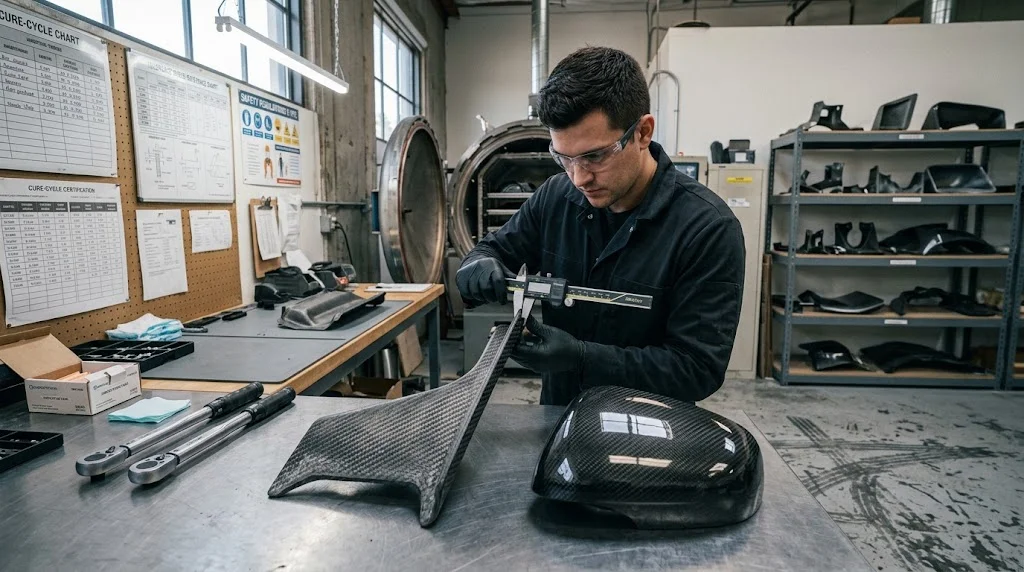
Carbon fiber car parts fall into two categories that share a raw material and almost nothing else. Structural components carry load: they are engineered against a defined load case, simulated, tested to failure and released against a durability or crash requirement. Cosmetic components exist for app
Introduction
Carbon fiber car parts fall into two categories that share a raw material and almost nothing else. Structural components carry load: they are engineered against a defined load case, simulated, tested to failure and released against a durability or crash requirement. Cosmetic components exist for appearance, styling or a modest reduction in the mass of a cover, and they are judged on surface, fit and colour rather than on strength. Confusing the two is the most common and most expensive mistake buyers make in this market.
This guide separates the two groups and explains what differs between them: where each is used, which manufacturing process makes each one, how validation works, what it costs, and how repairs are treated. It also covers how to evaluate carbon fiber car parts manufacturers when a programme moves from a single trim piece to a load-bearing component, and where the line sits between OEM carbon fiber auto parts and aftermarket styling hardware.
Structural Carbon Fiber Car Parts: What Actually Carries Load
Structural parts sit in the load path of the vehicle, and the list is longer than most buyers expect: roof panels and roof bows, driveshafts, chassis springs, suspension arms and uprights, roll hoops and roll cages, bumper beams and crash boxes, seat frames, battery enclosure lids and module structures on electric vehicles, plus aerodynamic elements such as a rear wing that generates real downforce. Each one replaces a steel or aluminium equivalent and has to prove, with data, that it does the same job at lower mass.
The material is a laminate, not a substance with a single strength number. A typical structural layup uses prepreg carbon fiber fabric or woven roving cured in an autoclave, or resin transfer moulding at higher volume, near a sixty percent fibre fraction. Density sits close to 1.6 grams per cubic centimetre against 2.7 for aluminium and 7.8 for steel, the axial modulus of a unidirectional ply runs from about 130 to 180 gigapascals, and a cured multi-directional laminate typically shows tensile strength between 600 and 1000 megapascals depending on fibre grade and layup. Because the fibre is directional, strength exists only where plies were placed, so every structural part is designed ply by ply against a load case rather than picked from a catalogue.
| Aspect | Structural carbon fiber car part | Cosmetic carbon fiber car part |
|---|---|---|
| Primary requirement | Stiffness, strength, crash energy absorption | Surface finish, fit, colour match |
| Typical process | Prepreg autoclave, RTM, bonded sandwich | Hand layup in an open mould with gel coat |
| Wall thickness | 2 to 8 mm, engineered per load case | 1.2 to 2.5 mm, set by handling and appearance |
| Validation | FEA, coupon tests, component test to failure, crash or durability sign-off | Fit check, visual inspection, UV and thermal cycle |
| Failure concern | Brittle fracture, delamination, bolt bearing crush | Cracked clear coat, warpage, poor panel gap |
| Cost driver | Tooling, analysis and destructive test | Finish quality and hand labour |
Crash and durability behaviour is where the two categories separate most sharply. Carbon fiber laminate absorbs energy well in axial crushing, with specific energy absorption for a properly triggered tube in the region of 40 to 90 kilojoules per kilogram against roughly 10 to 25 for steel, but it does not yield before it breaks. A structural part therefore has to be designed so that damage stays predictable and detectable: crash boxes crush progressively, attachment points carry local reinforcement so the joint never becomes the weakest link, and inspectors know where to look after an impact.
Cosmetic Carbon Fiber Car Parts: Trim, Panels and Appearance
Cosmetic parts are the visible half of the market: mirror caps, front splitters, side skirts, rear diffusers, boot lids and bonnet vents, roof scoops, interior trim strips, shift knobs, steering wheel spokes and engine covers. They are attached with tape, clips or a few bolts, carry little or no structural load, and are bought for the way they look. A bonnet that shows a carbon weave with no structural duty is a cosmetic part, while a rear wing producing hundreds of newtons of downforce at speed is a structural one, whatever the seller calls it.
Appearance parts are almost always made in open moulds by hand layup behind a gel coat, because tooling is cheap and volumes are low. The buyer is paying for a Class A surface: a straight 2 by 2 twill weave with no distortion in the pattern, a UV stable clear coat that will not yellow, and panel gaps that match the factory bodywork. Structural performance is irrelevant to that service, so the laminate stays thin and lightly engineered, and it is normal for such a part to delaminate under a load it was never designed to take.
- Weave and alignment: the twill pattern has to run straight across the visible face, and distorted patches or a stitched-in cheaper fabric are the tell of a low cost part.
- Clear coat: a UV stabilised automotive clear coat with a measured yellowness index after weathering, not a thin resin wipe that chalks inside one season.
- Fit: mounting holes, flanges and edges should match the body with even gaps, checked against a fixture rather than trimmed at fitment time.
- Weight claim: cosmetic parts often save under two kilograms in total, so a dramatic weight claim on trim is a marketing number rather than an engineering one.
- Safety boundary: never repurpose a cosmetic part into a load path, and never accept an untested splitter or mirror cap as a structural upgrade.
Custom Carbon Fiber Car Parts: How Manufacturers Validate a Structural Part
Moving from trim to structure changes the relationship with the supplier completely. Serious carbon fiber car parts manufacturers work from an engineering packet rather than a photograph: geometry and material definition, load cases with factors of safety, a layup schedule ply by ply, and an acceptance criterion for the delivered part. The programme then runs in stages: finite element analysis of the geometry, coupon tests of the laminate from the same cure cycle, subcomponent tests of a representative joint or section, and a full component test to the acceptance load, followed by durability cycling and, where relevant, a crash pulse test.
Quality systems matter as much as analysis in a production programme. A structural supplier should hold ISO 9001 as a minimum and preferably IATF 16949 for series automotive work, should issue first article inspection reports and production part approval paperwork, and should trace every part back to a specific fabric roll and cure batch. Non-destructive inspection, usually ultrasonic C-scan, finds porosity and delamination that a visual check will not, and a supplier that cannot show a scan of a cut-up part from your own programme is not ready for structural work. Lead times follow the same logic: a cosmetic trim piece can ship in two to three weeks from a hand mould, while a validated structural component typically needs eight to sixteen weeks once tooling and test are counted.
Cost separates the categories just as clearly. Aftermarket cosmetic pieces such as mirror caps or a splitter commonly sell for a few hundred dollars per item, because the mould is simple and the labour is finishing work. A structural programme pays for analysis, fixtures, tooling and destructive tests, so first-off cost for a load bearing bracket, arm or beam usually runs into the thousands, and the per part price only becomes attractive once volume amortises the tooling. Two quotes for what looks like the same panel are often quoting two completely different products.
Frequently Asked Questions
Are carbon fiber car parts stronger than the steel parts they replace?
Not in every sense, and the question hides the real trade. A carbon fiber laminate has far higher specific strength and stiffness, so the same part can be made lighter at equal performance, and it absorbs more energy per kilogram in axial crush. Steel yields and deforms predictably, which makes damage visible and repair straightforward. A well designed carbon fiber part matches the steel part on load capability at lower mass; a cosmetic part designed for appearance does not, and it should never be substituted into a load path.
How do I tell whether an aftermarket panel is structural or cosmetic?
Ask what evidence comes with it. A structural part arrives with a layup definition, a stated test or analysis basis, a material certificate and a repair or replace instruction. A cosmetic part arrives with a photo, a weave choice and a fit guarantee. Weight and thickness are secondary signals: a 1.5 mm open mould panel that claims a crash rating is cosmetic whatever the listing says, and a bonded beam with local reinforcement around its mounts is structural even if it is sold as an upgrade.
Can a damaged structural carbon fiber part be repaired?
Sometimes, but only under an approved procedure. Local delamination can be scarfed, re-laminated and re-cured, and bonded joints can be disassembled and re-made with proper surface preparation. Parts that carry crash or primary suspension duty are usually replaced after a significant impact, because the failure mode is brittle and internal damage can sit under an undamaged surface. Cosmetic parts are simpler: a cracked clear coat can be sanded and refinished, and a delaminated skin can often be re-bonded, since appearance rather than load is the requirement.
Conclusion
The split between structural and cosmetic carbon fiber car parts is a difference in engineering method, not in material branding. Structural parts are built from a load case outward, with a ply schedule, simulation, coupon and component tests, and a traceable cure record, while cosmetic parts are built inward from a surface, with weave, clear coat and gap as the acceptance criteria. Buying on the drawing rather than the photograph keeps both kinds honest: specify the load, the process and the evidence, and the supplier either has them or does not. YongXian supplies carbon fiber sheet, tube, rod and plate for both structural programmes and appearance work, and our engineers will review your load case, layup and acceptance criteria before quoting. Browse our carbon fiber products or contact us with your geometry, target mass and validation requirements, whether you are a tier supplier in Europe or sourcing custom carbon fiber car parts from Asia.
Part of topic
Related Articles
- Carbon Fiber Drone Kit: Choosing, Building, and Flying a Carbon Fiber Frame
- Carbon Fiber Rod Repair Kit: Field Repairs for Fishing and RC Components
- Carbon Fiber Tube Cap: End Fittings and Sealing Solutions
- Carbon Fiber Plate in Shoes: Running, Cycling and Everyday Footwear
- Carbon Fiber Control Arms: Suspension Geometry and Composite Design
- Carbon Fiber Drone Frame: Selection Guide for Racing and Industrial Drones
Interested in Our Products?
Contact our team for competitive pricing and technical specifications.
Get a QuoteRelated Products

Carbon Fiber Plate — 3K Twill T700 1.5mm
Thin 1.5mm carbon fiber plate with 3K twill weave surface. Lightweight and stiff, commonly used for covers, panels, drone bodies, and applications requiring a premium aesthetic appearance.

Carbon Fiber Plate — 3K Twill T700 3.0mm
Medium-thickness 3.0mm carbon fiber plate offering significantly higher load capacity while maintaining attractive 3K twill finish. Suitable for structural brackets, reinforcement plates, and load-bearing panels.

Square Carbon Fiber Tube — 3K Twill T700
Square cross-section carbon fiber tube manufactured with 3K twill weave for torsional strength. Preferred for structural frames, trusses, and support columns where rectangular geometry offers design flexibility.

Round Carbon Fiber Tube — 3K Plain Weave T700
Standard round carbon fiber tube manufactured from Toray T700 grade fiber with 3K plain weave. Offers balanced strength and stiffness for general industrial applications including robotics, automation, sports equipment, and aerospace structures.

Round Carbon Fiber Tube — UD Unidirectional T700
Unidirectional (UD) round tube with all fibers aligned axially for maximum longitudinal stiffness. Ideal for applications requiring high bending rigidity with minimal weight, such as shafts, struts, and structural reinforcements.