
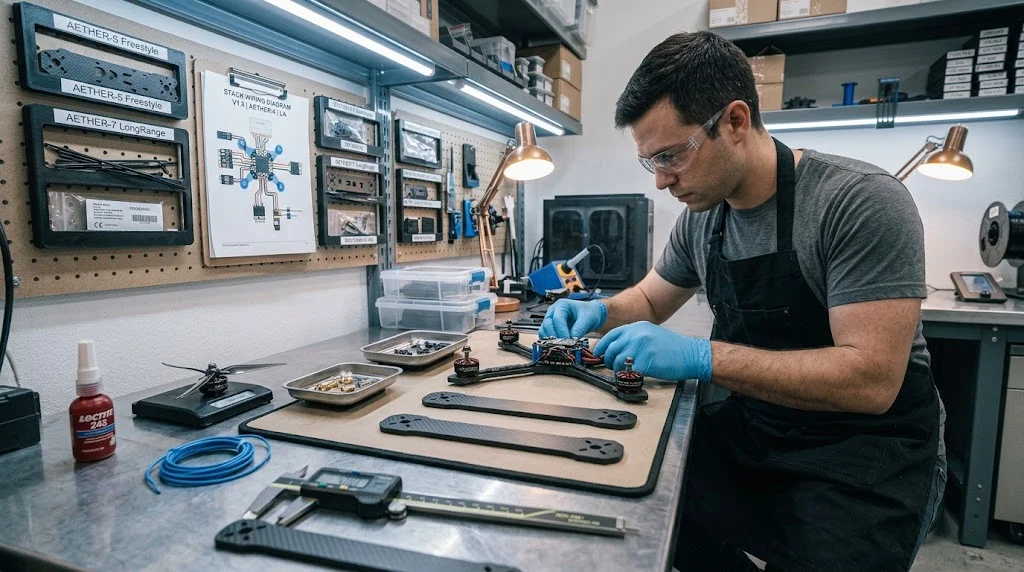
A carbon fiber fpv drone frame is the one part you cannot tune out of a bad flight. Motors, props and PIDs can be adjusted on the bench; geometry, arm stiffness and mass distribution are fixed the moment the frame is cut. This article walks through the decisions that actually separate frames: wheelb
Introduction
A carbon fiber fpv drone frame is the one part you cannot tune out of a bad flight. Motors, props and PIDs can be adjusted on the bench; geometry, arm stiffness and mass distribution are fixed the moment the frame is cut. This article walks through the decisions that actually separate frames: wheelbase and arm thickness by flying style, resin and weave choices, stack and antenna layouts, and the trade-offs of a diy carbon fiber drone frame build versus buying a proven kit.
Every gram on the frame is a gram not on the battery, and every millimeter of arm flex is gyro noise the flight controller has to fight. The right carbon fiber drone frame is not the lightest one in the cart — it is the one whose stiffness-to-weight ratio matches how you crash. Race pilots optimize for gate times and accept frequent arm swaps; freestyle pilots buy thicker arms and live with the grams; long-range pilots spend mass budget where the antenna bay and pack demand it, and nowhere else. This article keeps that hierarchy in view through geometry, materials, DIY builds and the antenna pitfalls that carbon introduces.
Carbon Fiber FPV Drone Frame Geometry Explained
Frame geometry collapses to three numbers pilots actually feel: wheelbase, arm thickness and camera angle. Wheelbase — motor post center to center across the diagonal — sets the flight envelope:
| Class | Wheelbase | Arm | Frame mass | Best for |
|---|---|---|---|---|
| 3 inch freestyle | 140-155 mm | 1.5-2 mm | 50-70 g | Parks, tight gaps, low inertia |
| 5 inch freestyle | 220-235 mm | 2-2.5 mm | 80-120 g | General freestyle, action cameras |
| 5 inch race | 220 mm | 1.5-2 mm | 60-85 g | Gates, minimum inertia |
| 7 inch long range | 270-300 mm | 2.5-3 mm | 120-180 g | Cruising, larger packs, efficiency |
Arms are the lever arm of every crash. A 2 mm arm on a 5 inch quad survives concrete ego impacts; 1.5 mm saves roughly 15 grams and snaps on the second hard landing. Unibody plates trade arm swaps for stiffness — cheaper until the day an arm dies, then you replace the whole frame. Removable arms cost a few grams in hardware and save whole weekends. Long-range pilots often land in the middle: 2.5 mm arms with aluminum standoffs, accepting the grams for span stiffness that keeps a cruising quad from flexing into the props at full throttle.
Camera angle matters more than most spec sheets admit: a fixed 30 degree mount suits cruising, while racing setups want 45 degrees and a reinforced camera cage, because the cage is the first thing that hits the gate.
Weave, Grade and What 3K Twill Actually Buys You
Almost every commercial carbon fiber drone frame panel is 3K twill weave over quasi-isotropic layup. The "3K" means 3,000 filaments per tow — the standard balance of surface finish, cutability and cost. What actually changes frame behavior is layup and resin, not the weave name:
- Twill vs plain weave: cosmetic difference on arms; twill drapes better over curves, plain weave is slightly stiffer per layer. Neither makes a frame "stronger."
- Standard tow vs T700-class fiber: T700 and similar high-strength fibers raise tensile strength roughly 15-20 percent for a small price premium — real for long-range arms loaded in bending, marginal for short freestyle arms loaded in impact.
- Resin toughness: aerospace-grade toughened epoxy resists microcracking after crashes better than cheap polyester systems. It is invisible in a listing and decisive at the third concrete kiss.
Thickness tolerance is the quiet differentiator: a genuine 2.0 mm arm cut to -0/+0.1 mm behaves very differently from a "2 mm" arm measuring 1.7 mm under the stack posts. Weigh the frame and measure three arms with calipers before the first pack.
Building a DIY Carbon Fiber Drone Frame
A diy carbon fiber drone frame makes sense when your antenna layout, GPS bay or battery position does not exist on any shelf frame — long-range builds with dual antennas and a GPS mast are the classic case. It stops making sense the moment consistency matters: CNC-cut arms from a production batch beat hand-cut plates for repeatability, and a crash-replaceable arm ecosystem is worth more than one perfect custom frame.
If you build, budget the full stack: 2-3 mm sheet, a drill guide for the 30.5 x 30.5 mm or 20 x 20 mm stack pattern, countersunk hardware, and epoxy wet-layup or vacuum bagging if you laminate your own arms. Cutting dry sheet with a diamond router bit, wet, at low speed keeps dust down and delamination away. Expect the first frame to be a lesson; the second one flies. Order enough sheet for spares in the same batch — carbon from different lots can differ in resin content enough to change arm mass between a original and its replacement.
Antennas, Vibration and the Carbon Trap
Carbon fiber is conductive, and that fact wrecks more builds than any crash. A patch or omni antenna mounted flush against a carbon plate loses pattern and range — the plate becomes a ground plane you did not design. Mount antennas on printed TPU standoffs clear of the main plate, keep the active element in free air, and route RC and video leads away from ESC current paths. The same conductivity helps elsewhere: bond a ground strap from the plate to the pack negative and the frame stops acting as an antenna for ESC noise, which cleans up video without touching your VTX power.
Vibration follows mass and stiffness: soft-mount the flight controller stack on silicone gummies, keep arms matched in thickness so resonant frequencies stay symmetrical, and check for prop wash by hovering at low throttle after a hard yaw. A frame that rings will never fly clean on stock PIDs, no matter how good the tune. Balance the rotating assembly too — a Dynamic Balancer session on props and motors isolates frame resonance from prop imbalance, and it is the cheapest flight improvement most pilots skip.
Frequently Asked Questions
Is a lighter carbon fiber fpv drone frame always better?
No. Light frames accelerate faster and wash out sooner in prop wash; heavy frames carry momentum through wind. Match mass to your flying: race gates want minimum grams, outdoor freestyle wants enough inertia to punch out of dives, and long range wants the mass budget spent on pack, not plate.
Can I drill or cut a carbon fiber drone frame at home?
Yes, with dust control — carbon dust is an irritant and stays conductive in lungs and electronics. Use a drill guide, low speed, and wet cutting where possible; seal edges with thin epoxy after cutting. Wear a P100 respirator, not a dust mask, and vacuum rather than blow out the workbench.
Why does my diy carbon fiber drone frame vibrate more than a kit?
Usually arm asymmetry or stack resonance. Measure all four arms, check motor post alignment, and soft-mount the stack. Hand-cut plates often differ by tenths of a millimeter — enough to split resonant frequencies into a gyro noise floor you cannot tune away.
Do T700 frames survive crashes better than standard fiber?
Marginally in bending, barely in impact. Crash survival is dominated by arm thickness, layup quality and whether the arm is replaceable. Spend on thickness and spare arms before spending on fiber grade for a freestyle quad.
Conclusion
Choose the carbon fiber fpv drone frame by geometry first — wheelbase and arm thickness for your class — then by layup quality and replaceable-arm design, and treat antenna clearance and stack soft-mounting as part of the frame decision, not accessories. A diy carbon fiber drone frame earns its place only for layouts that do not exist commercially, and even then, production-cut arms beat hand-cut plates. For stock plates, custom-cut sheet and full laminate specifications, browse our carbon fiber sheet and tube range. To match a layup to a frame class or a long-range antenna bay, contact our engineering team with your wheelbase and mass budget — we answer with a specification, not a catalog page.
Related Articles
- Carbon Fiber Tube Protector: Edge Guards and Damage Prevention
- Carbon Fiber RC Body: Lightweight Shells for On-Road and Off-Road Cars
- Pultruded Carbon-Fiber Leaf Springs: Composite Suspension for Commercial Vehicles
- Carbon Fibre Drone Frame: UK Buying Guide
- Filament Wound Pressure Vessel: Design, Standards and Manufacturing
- Carbon Fiber Car Parts: Structural vs Cosmetic Components Explained
Interested in Our Products?
Contact our team for competitive pricing and technical specifications.
Get a QuoteRelated Products

Round Carbon Fiber Tube — 3K Plain Weave T700
Standard round carbon fiber tube manufactured from Toray T700 grade fiber with 3K plain weave. Offers balanced strength and stiffness for general industrial applications including robotics, automation, sports equipment, and aerospace structures.
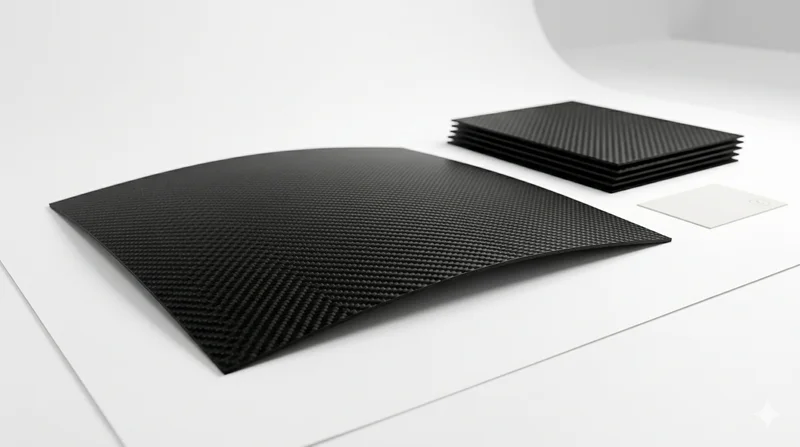
Carbon Fiber Plate — 3K Twill T700 1.5mm
Thin 1.5mm carbon fiber plate with 3K twill weave surface. Lightweight and stiff, commonly used for covers, panels, drone bodies, and applications requiring a premium aesthetic appearance.

Square Carbon Fiber Tube — 3K Twill T700
Square cross-section carbon fiber tube manufactured with 3K twill weave for torsional strength. Preferred for structural frames, trusses, and support columns where rectangular geometry offers design flexibility.

Round Carbon Fiber Tube — 3K Twill
Lightweight and ultra-stiff round tubes ideal for drone frames, robotics, and structural applications.

Round Carbon Fiber Tube — UD Unidirectional T700
Unidirectional (UD) round tube with all fibers aligned axially for maximum longitudinal stiffness. Ideal for applications requiring high bending rigidity with minimal weight, such as shafts, struts, and structural reinforcements.