
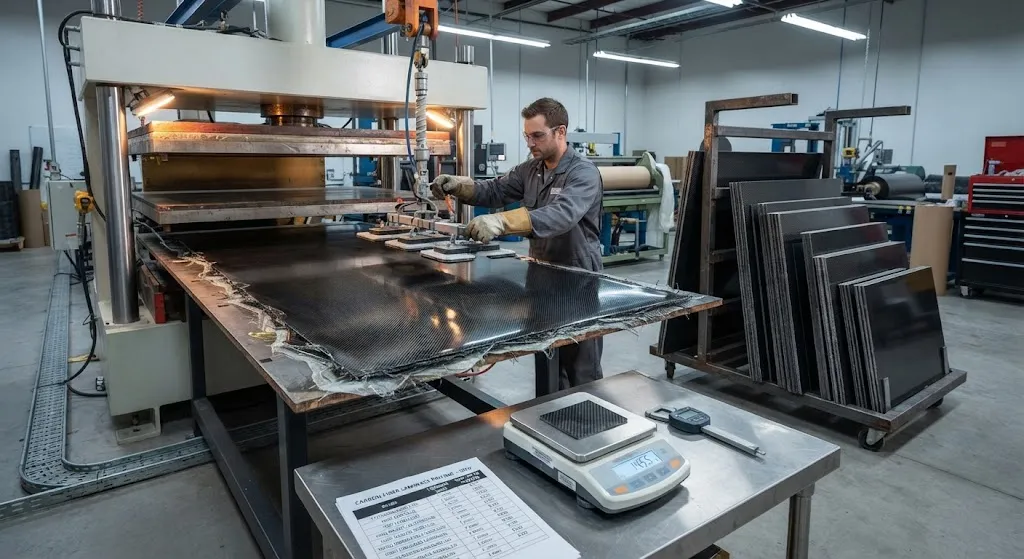
The carbon fiber sheet price on a supplier's quote depends on a chain of decisions that starts at the fiber tow and ends at the cut panel on your factory floor. A carbon fiber sheet is a flat laminate of carbon fiber layers — unidirectional, woven, or braided — bonded by an epoxy or thermoplastic ma
Introduction
The carbon fiber sheet price on a supplier's quote depends on a chain of decisions that starts at the fiber tow and ends at the cut panel on your factory floor. A carbon fiber sheet is a flat laminate of carbon fiber layers — unidirectional, woven, or braided — bonded by an epoxy or thermoplastic matrix, and the carbon fiber sheet cost per square meter can range from roughly $30 for a thin standard-modulus laminate to more than $300 for a thick aerospace-grade plate. Understanding the carbon fiber sheet price structure is not about negotiating harder; it is about knowing which variables in the quote you can control, which are dictated by the material, and how to compare CFRP plate pricing from different suppliers on an apples-to-apples basis. This article explains the cost drivers, gives worked composite sheet price examples, and lays out a comparison method that keeps budgets honest.
Carbon Fiber Sheet Price Structure: Where the Cost Goes
Every carbon fiber sheet price traces back to the same cost stack, and knowing the proportions of that stack makes supplier quotes much easier to interpret. The table below shows a representative breakdown for a 1.5 mm thick woven carbon fiber sheet (3K twill, standard modulus, epoxy matrix):
| Cost Component | Share of Price | What It Covers |
|---|---|---|
| Carbon fiber reinforcement | 40-50% | Fiber tow, weaving or stitching into fabric |
| Resin and consumables | 10-15% | Epoxy matrix, release films, bagging, peel ply |
| Labor and processing | 15-25% | Layup, curing, trimming, surface finishing |
| Scrap and yield loss | 5-10% | Offcuts, rejected panels, cure shrink |
| Testing, QC and overhead | 10-20% | Certificates, inspection, tooling amortization |
Two implications follow. First, the fiber itself is the dominant cost, so the fiber grade — standard modulus, intermediate modulus, or high modulus — and the tow size set the floor under any quote. Second, labor and scrap are where process efficiency shows up: a supplier with automated layup and tight process control can quote a lower carbon fiber sheet price at the same material quality, which is why the cheapest quote is not always the low-quality option.
Carbon Fiber Sheet Cost per Square Meter by Grade and Thickness
To translate the structure into numbers, the table below shows representative carbon fiber sheet cost per square meter ranges for common configurations. These are planning figures for standard sheet sizes and full-panel orders, not quotations for custom parts:
| Configuration | Thickness | Price per m² (USD) | Typical Use |
|---|---|---|---|
| 3K twill woven, standard modulus | 1.0 mm | 45-70 | Cosmetic panels, drone parts |
| 3K twill woven, standard modulus | 2.0 mm | 80-120 | Structural enclosures, brackets |
| Unidirectional, standard modulus | 1.5 mm | 50-80 | Stiffened plates, splice plates |
| 12K fabric, intermediate modulus | 2.0 mm | 110-170 | Automotive and industrial structures |
| Aerospace prepreg laminate (T700) | 2.0 mm | 180-280 | Flight-critical and certified parts |
| High-modulus plate (M40J class) | 1.5 mm | 250-400+ | Space and precision instruments |
The pattern is consistent: every step up in fiber grade roughly doubles the price, and thickness scales cost nearly linearly because more material and more processing are involved. Buyers comparing carbon fiber sheet price across suppliers should first normalize for grade, thickness, and fiber volume fraction — a $90 per square meter sheet at 50 percent fiber volume is not comparable to one at 65 percent, and the stronger laminate is usually the better value per unit of stiffness.
CFRP Plate Pricing: Why Quotes Vary So Widely
Beyond material grade and thickness, several factors explain why CFRP plate pricing can differ by two to three times between suppliers for apparently identical sheets. The most important are listed below:
- Manufacturing process: Autoclave-cured prepreg plates carry the highest cost; press-cured or out-of-autoclave laminates are cheaper at the price of different void content and mechanical properties.
- Fiber volume fraction: A 60-65 percent fiber volume laminate delivers more stiffness per millimeter of thickness, which justifies a higher price per square meter and often a lower price per unit of stiffness.
- Surface quality and cosmetic grade: Class-A automotive surfaces require controlled resin content and post-finishing, adding cost that a hidden structural layer does not need.
- Tolerances and machining: Plates supplied net-shape with drilled holes and edge finishing cost more than raw laminated panels that the buyer cuts in-house.
- Certification and traceability: Material certificates, batch traceability, and third-party testing add 5-15 percent to the composite sheet price but are essential for certified industries.
- Order volume: Tooling setup and minimum batch costs are amortized over the order; a 10-sheet order can cost 30-50 percent more per sheet than a 500-sheet order.
When a quote looks unusually cheap, the question is not whether the supplier made a mistake but which of these variables was traded away — usually fiber volume fraction, surface class, or certification depth.
How to Compare Composite Sheet Prices Like a Buyer
Comparing composite sheet price quotes fairly requires a standardized checklist. First, confirm the laminate specification in writing: fiber grade and tow size, fabric style, resin system, fiber volume fraction, thickness and tolerance, and surface class. Second, convert every quote to a common unit — cost per square meter at the same thickness — and additionally compute cost per unit of stiffness (price divided by laminate modulus) to catch the traps of thin, weak laminates quoted cheaply. Third, ask what the price includes: cutting, edge finish, drilling, certificates, packaging, and minimum order. Finally, request a sample panel and verify fiber volume fraction and thickness on delivery, because the composite sheet price is only meaningful if the delivered laminate matches the specification that was quoted. A disciplined comparison converts the carbon fiber sheet price from an opaque number into a decision input you can trust.
Frequently Asked Questions
How much does a carbon fiber sheet cost per square meter?
Planning figures range from roughly $45-70 per square meter for a 1 mm thick 3K twill standard-modulus sheet to $80-120 for a 2 mm version, $110-170 for intermediate-modulus fabric laminates, and $180-400+ for aerospace-grade or high-modulus plates. The final carbon fiber sheet price depends on fiber grade, thickness, fiber volume fraction, manufacturing process, surface class, certifications, and order volume, so the practical range for most industrial buyers is $50-250 per square meter. Always normalize quotes to the same thickness and grade before comparing.
Why is carbon fiber sheet price so much higher than fiberglass or aluminum?
Three reasons. The carbon fiber reinforcement itself costs roughly 5-10 times more per kilogram than E-glass fiber, because carbon fiber production involves high-temperature processing of a costly precursor. Second, carbon fiber laminates achieve much higher strength and stiffness per unit weight, so the price premium buys a genuine performance advantage — a stiffer, lighter panel. Third, production volumes for carbon fiber sheets are far smaller than for aluminum or fiberglass, so less scale benefit has been realized. When compared per unit of stiffness rather than per kilogram, the gap narrows considerably.
What is the cheapest way to buy carbon fiber sheets?
For most buyers, the lowest carbon fiber sheet cost per square meter comes from standard-modulus fiber, a simpler fabric construction such as plain or twill weave, a moderate fiber volume fraction, larger order volumes, and unfinished raw panels. Buying standard sheet sizes rather than custom dimensions, combining orders to reach volume pricing, and accepting standard surface quality are the three most effective levers. Avoid the trap of the cheapest possible laminate if your application needs stiffness and impact resistance — a slightly higher CFRP plate pricing that delivers higher fiber volume fraction is often cheaper per unit of performance.
Conclusion
The carbon fiber sheet price is a transparent structure once you know what to look at: fiber grade dominates the cost stack, thickness scales it nearly linearly, and process, fiber volume fraction, surface class, and order volume explain most of the difference between competing quotes. Working through the carbon fiber sheet cost per square meter examples and the CFRP plate pricing checklist above gives buyers a reliable way to budget, compare suppliers, and verify that the delivered laminate matches the specification. The composite sheet price is a decision input, not a mystery — when the laminate specification and the verification data are both clear, the quote stops being the risk in the project.
When you need carbon fiber sheets with transparent pricing and verified material data, review our carbon fiber sheet and panel range or contact our sales team with your required thickness, dimensions, and application, and we will provide a clear per-square-meter quote with the full laminate specification.
Part of topic
Related Articles
- Carbon Fibre for Sale: Reading Listings, Grades and Lead Times
- Carbon Fiber Near Me: Why Local Sourcing Beats Cross-Border for Prototyping
- Carbon Fiber Rod Blanks: Supply Chain and Custom Cutting Services
- Carbon Fiber Tube Shop: Selecting the Right Supplier for Custom and Standard Tubes
- Carbon Fibre Sheet Supplier UK: Sourcing Options and Specification Checklist
- Carbon Fiber Sheets Near Me Suppliers: Local Stock vs Factory Direct
Interested in Our Products?
Contact our team for competitive pricing and technical specifications.
Get a QuoteRelated Products

Carbon Fiber Fishing Rod Blank
High-quality carbon fiber fishing rod blank manufactured from multiple grades of Toray carbon fiber cloth. Available in a wide range of lengths, powers, and actions for freshwater and saltwater applications. Suitable for OEM rod building.

Carbon Fiber Plate — 3K Twill T700 3.0mm
Medium-thickness 3.0mm carbon fiber plate offering significantly higher load capacity while maintaining attractive 3K twill finish. Suitable for structural brackets, reinforcement plates, and load-bearing panels.

Carbon Fiber Plate — 3K Twill T700 1.5mm
Thin 1.5mm carbon fiber plate with 3K twill weave surface. Lightweight and stiff, commonly used for covers, panels, drone bodies, and applications requiring a premium aesthetic appearance.

Square Carbon Fiber Tube — 3K Twill T700
Square cross-section carbon fiber tube manufactured with 3K twill weave for torsional strength. Preferred for structural frames, trusses, and support columns where rectangular geometry offers design flexibility.

Carbon Fiber Trekking Pole
Lightweight carbon fiber trekking pole manufactured from high-grade carbon fiber tube. Weighs only 160g per pole while providing superior shock absorption and durability for hiking, trail running, and backpacking.