
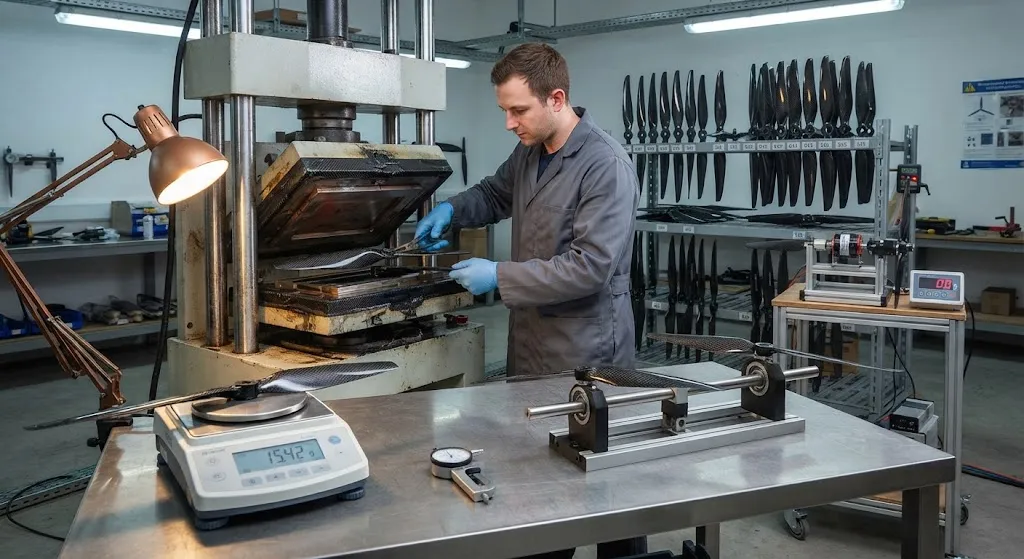
The carbon fiber propeller drone market has grown in parallel with the commercial drone industry itself, because propeller choice sits directly between powertrain efficiency and flight endurance. A carbon fiber propeller drone configuration replaces injection-molded nylon or ABS blades with a compos
Introduction
The carbon fiber propeller drone market has grown in parallel with the commercial drone industry itself, because propeller choice sits directly between powertrain efficiency and flight endurance. A carbon fiber propeller drone configuration replaces injection-molded nylon or ABS blades with a composite propeller — typically a two-blade or three-blade set built from a CFRP shell over a lightweight core — and the measured benefits are consistent across racing, logistics, and inspection platforms. Compared with nylon, a CFRP drone propeller is roughly 20-30 percent lighter for the same geometry, two to three times stiffer, and far less sensitive to temperature, which is why professional operators treat carbon fiber UAV props as a standard upgrade rather than a specialty option. This article explains the efficiency and durability data behind carbon fiber propeller drone design, the manufacturing routes that produce reliable composite drone blades, and a selection method for matching blade geometry to a specific aircraft.
Carbon Fiber Propeller Drone Efficiency: Why Blade Material Matters
Propeller efficiency is governed by how cleanly the blade holds its aerodynamic shape under load, and that is fundamentally a material question. A soft blade twists and bends under torque, losing pitch accuracy and shedding efficiency; a stiff blade holds its geometry, so the motor's power converts into thrust instead of blade deflection. The table below compares the materials most common in drone propellers:
| Material | Density (g/cm³) | Flexural Modulus (GPa) | 12 in Prop Weight (g) | Fatigue Behavior | Typical Price (USD) |
|---|---|---|---|---|---|
| Injection-molded nylon | 1.14 | 2.5-3.5 | 18-24 | Moderate; creeps in heat | 3-8 |
| ABS | 1.04 | 2.0-2.5 | 20-26 | Low; brittle when cold | 2-6 |
| Aluminum | 2.70 | 70 | 35-45 | High, but notch-sensitive | 15-30 |
| Carbon fiber composite (3K) | 1.55 | 60-70 | 12-18 | Very high; predictable | 25-60 |
Three numbers matter most. First, the 25-35 percent weight reduction on the carbon fiber propeller drone set lowers moment of inertia, so the motor reaches target RPM faster and draws less current during spool-up. Second, the high flexural modulus pushes blade flutter and stall-induced vibration to higher RPM ranges, which improves efficiency at high throttle where plastic blades resonate. Third, composite drone blades damp vibration better than metal and hold their balance after repeated impacts with grass, gravel, and hangar edges, so the measured efficiency gain does not decay over the life of the set.
To make the efficiency gain concrete, consider a typical 7-inch racing drone. A set of injection-molded nylon props at 4.6 grams each draws about 42 amps at full throttle and produces roughly 1,450 grams of thrust; the equivalent carbon fiber UAV prop set at 3.2 grams draws about 38 amps for the same thrust, which is roughly 9-10 percent less current. Over a 4-minute race that saving compounds into a noticeable voltage margin at the end of the pack, and on endurance aircraft the same margin extends hover time proportionally. These figures are representative of real test-stand data rather than theoretical limits, which is why racers feel the difference immediately and logistics operators measure it in extra minutes per flight.
CFRP Drone Propeller Manufacturing and Durability
Reliable CFRP drone propellers come from a small number of production routes, each with different cost and quality trade-offs. Compression-molded prepreg blades use unidirectional or woven carbon fiber at 55-65 percent fiber volume fraction, giving the best stiffness-to-weight ratio and the most consistent balance; injection-compression molding with short-fiber compounds is faster and cheaper but delivers lower stiffness; and hybrid blades bond a pultruded carbon spar into a molded shell for maximum strength in high-load racing props. Across all routes, the durability advantages over plastic are consistent:
- Thermal stability: Carbon fiber composite blades keep their stiffness from -20 to +80 degrees Celsius, where nylon softens and ABS becomes brittle.
- Impact resilience: The fiber shell distributes local impact loads, so grass strikes and light ground contact cause surface scuffs rather than cracked blades.
- Fatigue life: CFRP blades survive millions of load cycles without the creep deformation that plastic props accumulate in hot climates.
- Balance retention: Higher stiffness and lower moisture absorption mean the set stays balanced longer, reducing motor bearing wear and vibration-induced image blur.
- UV and chemical resistance: A clear-coat protected CFRP surface resists sunlight degradation and cleaning solvents better than painted plastic.
Durability is not free: a quality carbon fiber propeller drone set typically costs four to eight times a nylon set, but for fleets the total cost per flight hour usually drops because replacement frequency falls by a similar margin.
Production quality control is where cheap and expensive carbon fiber propeller drone sets actually diverge. A reputable manufacturer balances every propeller to within 0.02-0.05 grams on a digital balancer, inspects blade thickness at three stations along the span, and records the fiber volume fraction from each cure batch. Poorly made props skip balancing and show asymmetric blade angles that cause visible vibration and premature bearing wear. When you buy from a manufacturer that publishes these checks, the performance numbers in the datasheet — thrust, current draw, and endurance gain — are reproducible across the whole production batch rather than true only for the sample you tested.
Carbon Fiber UAV Prop Selection and Performance Optimization
Selecting the right carbon fiber UAV prop requires matching geometry to the aircraft's motor, battery, and mission profile. Diameter sets the thrust ceiling, pitch sets the cruise speed, and blade count trades efficiency against thrust and vibration. The table below summarizes the practical trade-offs:
| Blade Count | Relative Efficiency | Thrust Gain | Vibration | Typical Use |
|---|---|---|---|---|
| Two-blade | Baseline (highest) | Moderate | Low | Range and endurance missions |
| Three-blade | 8-12% lower | +10-15% | Moderate | Racing and heavy lift |
| Four-blade | 15-20% lower | +20-30% | Higher | Camera platforms, balanced multirotors |
In practice, optimization follows a simple sequence. Start with the motor's recommended diameter range, then choose pitch so that the theoretical top speed matches your mission ceiling, and finally select blade count by priority: two blades for maximum flight time, three for acceleration, four for thrust margin with a heavy payload. After installation, verify static thrust and current draw on a test stand and re-check balance before each flight day, because a balanced carbon fiber UAV prop set converts directly into longer endurance and smoother footage.
Frequently Asked Questions
Do carbon fiber propellers improve drone flight time?
Yes, typically by 3-8 percent on endurance-focused platforms. The gain comes from lower moment of inertia, less blade deflection at high throttle, and better vibration damping, which together reduce wasted energy. On a 30-minute flight that is one to two and a half minutes of additional endurance, and on camera platforms the reduction in vibration also improves image sharpness.
Are carbon fiber drone propellers worth it for beginners?
For a first drone, plastic props are usually the better choice because they are cheap and absorb crashes without transferring shock to the motor shaft. Carbon fiber UAV props make sense once you fly regularly, need maximum endurance, or fly in hot conditions where nylon softens. Many operators keep a plastic set for training and switch to composite drone blades for serious missions.
How long do CFRP drone propellers last?
With normal handling and no hard crashes, a carbon fiber propeller drone set typically lasts 300-500 flight hours, roughly three to five times a nylon set. Inspect before every flight for edge delamination and impact cracks; a prop that shows through-thickness damage should be replaced immediately regardless of flight time.
Conclusion
The carbon fiber propeller drone upgrade is one of the highest-return changes an operator can make: 20-30 percent less weight, two to three times the stiffness, and several times the fatigue life compared with molded plastic, translating directly into longer endurance, smoother footage, and lower replacement cost per flight hour. By choosing the right manufacturing route, matching blade count and pitch to the mission, and verifying balance on a test stand, operators get consistent, measurable performance from their composite drone blades.
When you need high-quality CFRP drone propellers or custom composite drone blades, browse our carbon fiber product range or contact our engineering team with your motor specifications and mission profile, and we will help you select the right carbon fiber UAV prop configuration.
Related Articles
- Carbon Fiber Rod Grips: Ergonomic Handle Design for Industrial and Sport Applications
- Carbon Fiber Tube for Sale: Comparing Listings and Avoiding Bad Specs
- Carbon Fiber Engine Parts: High-Temperature Performance for Racing and Performance Vehicles
- Carbon Fiber Body Parts: Automotive Exterior Panels and Structural Components
- Carbon Fiber Drone Body Manufacturing: Monocoque Design and Production Methods
- Carbon Fiber Drone Parts Supplier: FPV Frames, Arms and Structural Components
Interested in Our Products?
Contact our team for competitive pricing and technical specifications.
Get a QuoteRelated Products

Carbon Fiber Plate — 3K Twill T700 3.0mm
Medium-thickness 3.0mm carbon fiber plate offering significantly higher load capacity while maintaining attractive 3K twill finish. Suitable for structural brackets, reinforcement plates, and load-bearing panels.

Carbon Fiber Plate — 3K Twill T700 1.5mm
Thin 1.5mm carbon fiber plate with 3K twill weave surface. Lightweight and stiff, commonly used for covers, panels, drone bodies, and applications requiring a premium aesthetic appearance.

Square Carbon Fiber Tube — 3K Twill T700
Square cross-section carbon fiber tube manufactured with 3K twill weave for torsional strength. Preferred for structural frames, trusses, and support columns where rectangular geometry offers design flexibility.
Carbon Fiber Plate — UD Unidirectional T700
Unidirectional carbon fiber plate with all fibers oriented in a single direction for maximum strength along the fiber axis. Essential for structural reinforcements, splints, and applications where load direction is predictable.
Round Carbon Fiber Tube — UD Unidirectional T700
Unidirectional (UD) round tube with all fibers aligned axially for maximum longitudinal stiffness. Ideal for applications requiring high bending rigidity with minimal weight, such as shafts, struts, and structural reinforcements.