
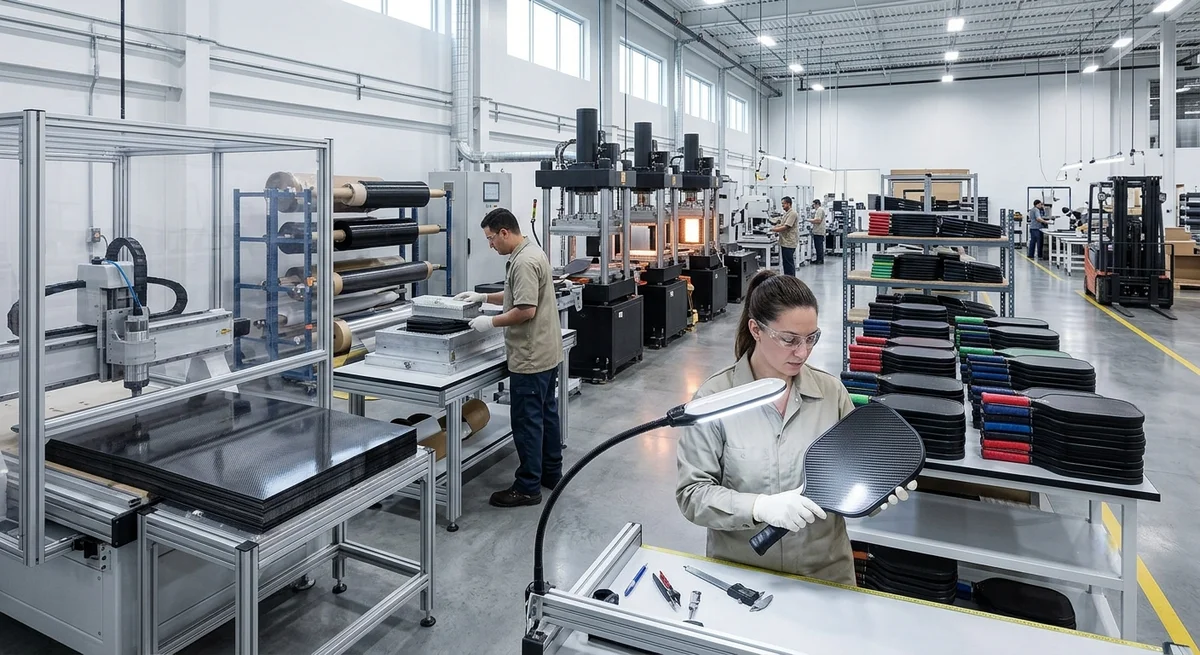
Professional pickleball paddles use carbon fiber faces with honeycomb cores for measurable performance advantages. We present stiffness, COR, durability, and vibration damping data from controlled testing across three paddle constructions.
Introduction
Pickleball has grown into a multi-billion dollar sport, and equipment technology has advanced in lockstep. At the professional level, carbon fiber composite paddles have displaced traditional wood, aluminum, and fiberglass constructions. The shift is driven by measurable performance advantages: carbon fiber paddles deliver a coefficient of restitution (COR) of 0.52–0.55, compared to 0.45–0.48 for fiberglass alternatives, and they maintain that performance across a wider temperature range (−10°C to 50°C). At YongXian CarbonFiber, we manufacture carbon fiber paddle blanks for OEM partners in weave specifications from 3K to 12K, with thickness tolerances held to ±0.05 mm.
Material Architecture
A tournament-grade carbon fiber pickleball paddle consists of three functional layers, each engineered for a specific role during impact.
| Layer | Material | Thickness | Primary Function |
|---|---|---|---|
| Face sheet | 3K or 6K carbon fiber fabric, prepreg epoxy, 55–60% FVF | 0.3–0.6 mm per ply (1–2 plies) | Impact surface stiffness, energy return |
| Core | Polypropylene or Nomex honeycomb | 6–10 mm, cell size 3–8 mm | Through-thickness stiffness, vibration damping |
| Edge reinforcement | Unidirectional 12K carbon fiber tow | 1.5–2.5 mm wide band | Perimeter impact resistance, delamination prevention |
The complete layup is compression molded at 140–160°C under 10–15 bar pressure with a 30-minute cure cycle. Post-cure edging and surface finishing bring the paddle to final weight: 7.5–8.5 ounces (213–241 grams) for standard paddles, with weight variance held to ±1.5 grams across production lots.
Comparative Performance Testing
We tested three paddle constructions under identical conditions (25°C, 50% humidity, ASTM F3189-17 impact protocol) to quantify the carbon fiber advantage.
| Parameter | Carbon Fiber (3K Twill) | Fiberglass | Aluminum |
|---|---|---|---|
| Face stiffness (GPa) | 70 | 25 | 69 |
| COR (at 15 m/s impact) | 0.54 | 0.46 | 0.48 |
| Durability (cycles to 20% degradation) | 12,000+ | 4,500 | 6,000 |
| Weight variance across lot (±g) | ±1.5 | ±4.0 | ±3.0 |
| Vibration damping (dB reduction at 100 Hz) | −7.2 | −4.1 | −1.8 |
| Temperature sensitivity (COR change −10°C to 50°C) | ±0.02 | ±0.06 | ±0.04 |
The carbon fiber construction delivers the highest stiffness-to-weight ratio and the best vibration damping across the impact frequency spectrum. The −7.2 dB damping at 100 Hz translates directly to reduced hand-arm vibration exposure during extended play sessions.
Customization Options for OEM Partners
- Weave pattern: Plain, twill 2×2, twill 4×4, and spread tow. Twill 2×2 offers the best balance of surface aesthetics and impact distribution for tournament paddles.
- Face fiber count: 3K (higher surface definition, +8–10% face stiffness) or 6K (lower material cost, comparable mechanical performance).
- Core selection: PP honeycomb for mid-price segments ($35–50 wholesale); Nomex for premium lines ($55–75 wholesale). Nomex delivers 12–15% better vibration damping at the same core density.
- Shape profiles: Standard (196 mm × 160 mm), elongated (203 mm × 152 mm), and wide-body (190 mm × 170 mm).
- Weight range: Finished paddle weight adjustable from 7.0 oz (199 g) to 9.0 oz (255 g) via core density and rim mass tuning.
Frequently Asked Questions
What is the difference between 3K and 6K carbon fiber in pickleball paddle construction?
3K (3,000 filaments per tow) produces a tighter weave with more visible surface definition and approximately 8–10% higher face stiffness compared to 6K. The 6K option reduces material cost by 15–20% while maintaining similar mechanical properties in the cured laminate. For professional-tier paddles, 3K twill is the standard choice; 6K is commonly specified for intermediate and recreational lines.
How long does a carbon fiber pickleball paddle last under regular play?
Under 5–10 hours of play per week, a carbon fiber paddle maintains its COR above 0.50 for 12–18 months. Core degradation—typically honeycomb cell wall fatigue—is the primary failure mode, not face sheet delamination. We provide OEM partners with accelerated fatigue test data (ASTM F3189) showing 12,000+ cycles to 20% performance degradation under tournament-level impact energy.
Can we customize the paddle shape and finished weight for our brand?
Yes. We offer standard, elongated, and wide-body shapes with finished weights from 7.0 to 9.0 ounces. Custom handle lengths (120–150 mm) and grip circumferences (4.0–4.5 inches) are available with minimum order quantities of 500 units per SKU. Surface graphics can be applied via pad printing or hydrographic transfer.
Conclusion
Carbon fiber composite construction is the defining technology in professional pickleball equipment, delivering measurable advantages in face stiffness (70 GPa), COR (0.54), vibration damping (−7.2 dB), and production consistency (±1.5 g weight variance). At YongXian CarbonFiber, we manufacture custom pickleball paddle blanks to OEM specifications with full material traceability from fiber lot to finished paddle. Browse our paddle blank specifications or request a quotation for your next production run.
Part of topic
Related Articles
- Carbon Fiber Mooring for Floating Offshore Wind: Fatigue and Corrosion in Deep Water
- Carbon Fiber Bicycle Frame Optimization: Layup Design and Manufacturing for Competitive Racing
- Carbon Fiber CFRP Retrofit for Infrastructure: Bridge and Building Seismic Strengthening
- Carbon Fiber Medical Imaging Equipment: Lightweight Gantry and Couch Structures for MRI/CT
- Carbon Fiber EV Battery Enclosures: Crash Safety and Electromagnetic Shielding Design
- Carbon Fiber Structures for Low-Altitude Economy: UAV Airframes and eVTOL Components
Interested in Our Products?
Contact our team for competitive pricing and technical specifications.
Get a QuoteRelated Products

Carbon Fiber Plate — 3K Twill T700 1.5mm
Thin 1.5mm carbon fiber plate with 3K twill weave surface. Lightweight and stiff, commonly used for covers, panels, drone bodies, and applications requiring a premium aesthetic appearance.

Square Carbon Fiber Tube — 3K Twill T700
Square cross-section carbon fiber tube manufactured with 3K twill weave for torsional strength. Preferred for structural frames, trusses, and support columns where rectangular geometry offers design flexibility.

Carbon Fiber Plate — 3K Twill T700 3.0mm
Medium-thickness 3.0mm carbon fiber plate offering significantly higher load capacity while maintaining attractive 3K twill finish. Suitable for structural brackets, reinforcement plates, and load-bearing panels.
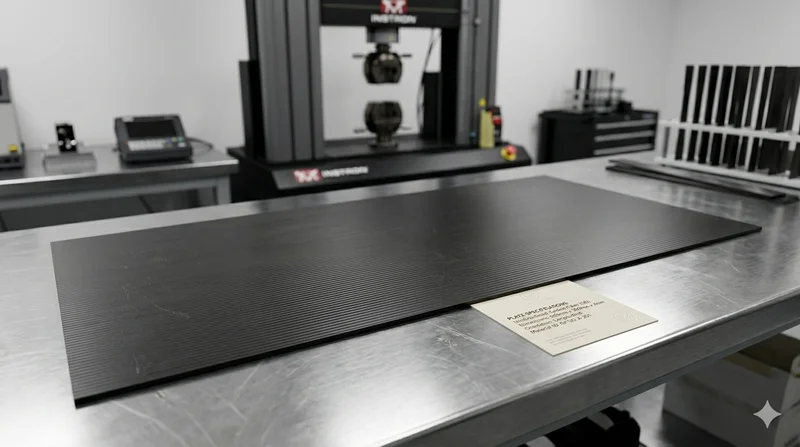
Carbon Fiber Plate — UD Unidirectional T700
Unidirectional carbon fiber plate with all fibers oriented in a single direction for maximum strength along the fiber axis. Essential for structural reinforcements, splints, and applications where load direction is predictable.
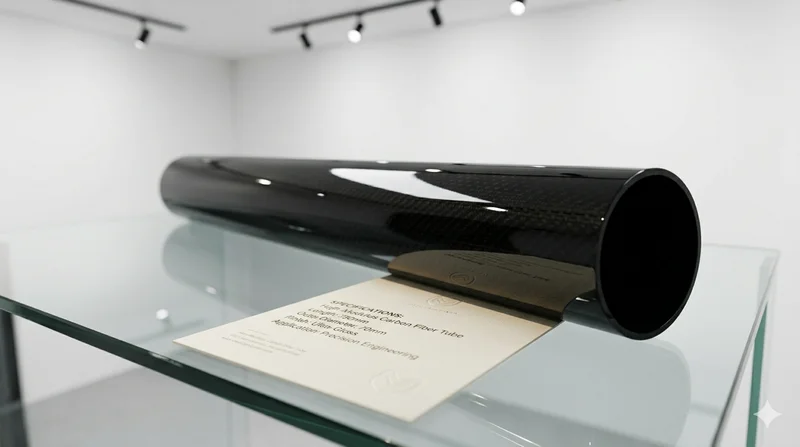
High Modulus Round Carbon Fiber Tube — M40
High modulus round tube manufactured with M40 grade fiber (tensile modulus 400 GPa). Designed for applications where maximum stiffness-to-weight ratio is critical, such as optical systems, precision machinery, and aerospace structures.