
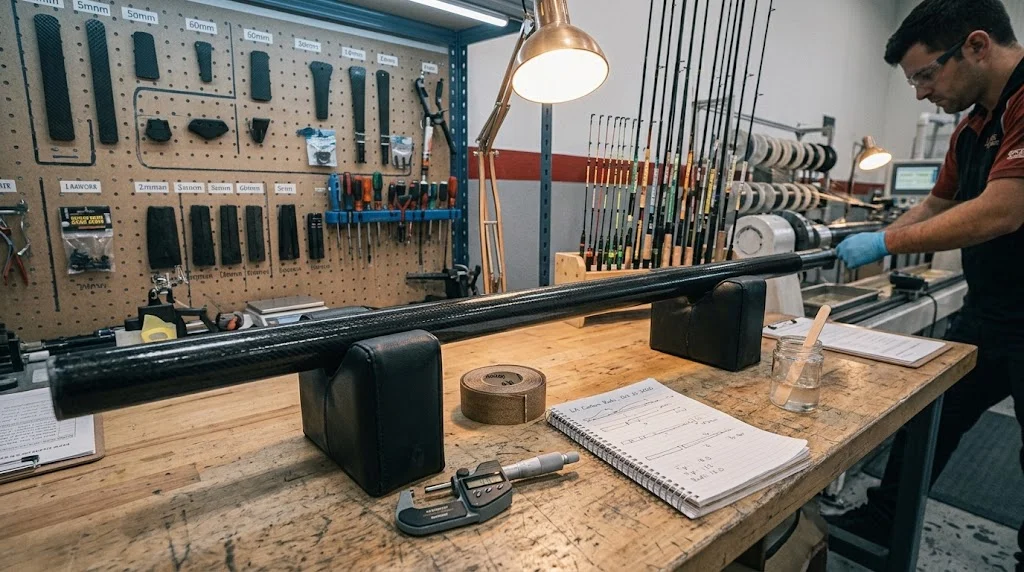
Introduction Carbon fiber rod fishing has moved from niche curiosity to the default choice for serious anglers across freshwater and saltwater disciplines. Modern carbon blanks deliver sensitivity that glass and composites cannot match, weight savings that reduce fatigue over long sessions, and lift
Introduction
Carbon fiber rod fishing has moved from niche curiosity to the default choice for serious anglers across freshwater and saltwater disciplines. Modern carbon blanks deliver sensitivity that glass and composites cannot match, weight savings that reduce fatigue over long sessions, and lifting power that belies their slim profiles. Yet the market is crowded with specs, marketing terms, and grade labels that obscure what actually determines performance. This guide breaks down the two variables that matter most — fiber grade and action curve — so you can read a blank's specification sheet and understand exactly how it will cast and fight before it ever touches water.
Whether you are buying a production carbon fiber fishing rod or commissioning a custom blank, the same engineering principles apply. Fiber modulus, tensile strength, resin content, and layup angle all interact to produce the action curve you feel in your hand. Understanding these relationships lets you compare blanks on equal footing and avoid paying for numbers that do not translate to real-world results.
Fiber Grades in Carbon Fiber Rod Fishing Blanks
Carbon fiber grades used in fishing blanks fall into three broad categories, distinguished by their modulus (stiffness) and tensile strength. Each grade produces a different feel and casting profile:
- Standard-modulus carbon (230-260 GPa): The workhorse of production fishing rods. Offers an excellent balance of strength, flexibility, and cost. Most freshwater spinning and casting blanks in the $100-300 range use standard-modulus fiber. Durability is high — these blanks tolerate harder use and minor impacts better than high-modulus alternatives.
- Intermediate-modulus carbon (290-320 GPa): A step up in stiffness and sensitivity. Intermediate-modulus blanks transmit vibration more efficiently, making subtle bites easier to detect. Popular in premium bass rods, trout rods, and inshore saltwater applications where sensitivity drives hook-set success. Weight savings of 10-15% versus standard modulus at equivalent length and power.
- High-modulus carbon (350-450 GPa):** Maximum stiffness-to-weight. High-modulus blanks cast with exceptional accuracy and recover quickly from flex, but trade impact resistance for performance. Best suited to finesse techniques, surf casting blanks, and custom builds where the angler prioritizes casting distance and precision over raw toughness.
Grade selection is not simply "higher is better." A high-modulus blank optimized for long-distance surf casting may feel brittle around rocks or boat gunwales, while a standard-modulus blank for musky or pike fishing accepts weight penalties in exchange for survive-the-fight resilience. The best carbon fiber rod fishing blanks for a given application match the modulus to the load profile and abuse the blank will actually see.
Action Curves: Fast, Moderate, and Slow Explained
The action curve describes where and how a blank bends under load. It is determined by the layup schedule — the orientation and placement of carbon plies along the blank's length — and governs casting distance, accuracy, and fish-fighting leverage:
| Action Type | Bend Location | Best For | Trade-off |
|---|---|---|---|
| Fast | Upper 25-30% (tip) | Jigging, drop-shot, single-hook techniques | Shorter casting stroke; less forgiveness on hard strikes |
| Moderate-Fast | Upper 40-50% | All-purpose bass, trout, inshore | Balanced but not specialized |
| Moderate | Middle 50-60% | Crankbaits, treble-hook lures, floating flies | Reduced distance on light lures |
| Slow / Full Flex | Through the entire blank | Ultralight, panfish, traditional fly | Poor with heavy lures; wind sensitivity |
Fast-action blanks load energy near the tip and release it quickly, generating high line speed and distance with heavier lures. They excel when the technique requires a sharp hook-set — vertical jigging, worm fishing, and many saltwater applications. Moderate-action blanks distribute the load deeper into the blank, keeping treble hooks pinned during a fish's surge and forgiving casting errors with moving baits. Slow-action blanks bend through the butt, protecting light tippets in fly fishing and providing the classic "bent rod" fun of ultralight spinning.
For custom builders, action is tuned by adjusting the carbon ply schedule: more tip-orientated layers with stiffer butt sections produce fast actions, while continuous taper layups with balanced tip and butt modulus create moderate curves. Prepreg roll-wrapping on tapered mandrels remains the dominant manufacturing method, with autoclave or oven cure cycles determining final resin content and void fraction.
Matching Blank Grade and Action to Your Fishing
The wrong combination of grade and action produces a blank that fights you. A high-modulus fast blank thrown at lightweight crankbaits loads awkwardly and casts short; a slow-action standard-modulus blank swung at deep jigging weights simply will not recover. Use this matching logic as a starting point:
- Finesse plastics, drop-shot, light jigging: Intermediate-modulus or high-modulus, fast action. Sensitivity and quick hook-set are primary.
- Crankbaits, jerkbaits, topwater with trebles: Standard or intermediate modulus, moderate to moderate-fast action. The softer bend keeps hooks pinned.
- Heavy cover flipping, punch fishing: Standard-modulus, extra-fast to fast with a powerful butt. Strength and lifting power dominate.
- Surf casting, long-distance: High-modulus, moderate-fast with a long tip section. Casting distance and accuracy are the goals.
- Ultralight freshwater, panfish: Standard or intermediate modulus, slow to moderate action. Play and tippet protection matter most.
Saltwater anglers should also verify resin systems — epoxy novolac resins offer better UV and corrosion resistance than standard epoxy systems, extending blank life in marine environments.
Frequently Asked Questions
Is a higher-modulus carbon fiber fishing rod always better?
No. Higher modulus means stiffer, lighter, and more sensitive — but also more brittle under impact and more expensive. A standard-modulus blank often delivers better real-world durability for techniques involving rocks, boat edges, or hard-fighting fish. Match modulus to your technique and fishing environment rather than chasing the highest number on the spec sheet.
How do I know what action a blank has without bending it?
Read the manufacturer's description for terms like "fast tip," "moderate flex," or "full flex" — these indicate action type. For custom blanks, ask the builder for the ply schedule or a bend profile diagram. A blank labeled "extra-fast" will load in the top 20-25% of its length; "moderate" loads near the midpoint. If those details are missing, treat the marketing copy as vague and request technical data before purchasing.
What resin system is standard in quality carbon fiber blanks?
Most production blanks use heat-cured epoxy resin systems, typically cured at 120-150°C for 1-3 hours. Premium and marine-grade blanks may specify novolac-modified epoxy or cyanate ester for improved moisture and UV resistance. Avoid blanks with unidentified resin systems — cheap polyester resins produce blanks that embrittle and delaminate within a few seasons.
Conclusion
Carbon fiber rod fishing performance comes down to two engineering decisions: the fiber grade that determines stiffness and sensitivity, and the action curve that governs casting and fish-fighting behavior. Standard-modulus blanks offer durability and value; intermediate and high-modulus blanks trade some toughness for precision and feel. Fast actions excel with single-hook techniques, while moderate and slow actions keep treble hooks pinned and protect light tippets. Matching grade and action to your target species and technique — not to marketing superlatives — is what separates a blank that feels right from one that ends up unused in the garage.
For anglers and custom rod builders seeking consistent, high-quality carbon blanks with full technical data sheets, explore our carbon fiber rod and tube product range, or contact our engineering team to discuss modulus selection, layup schedules, and custom blank specifications for your application.
Part of topic
Related Articles
- Carbon Fiber Drone: When Composite Airframes Make Sense
- Carbon Fiber Tubes for RC Planes: Spars, Booms and Frame Components
- Carbon Fiber Tube Protector: Edge Guards and Damage Prevention
- Carbon Fiber RC Body: Lightweight Shells for On-Road and Off-Road Cars
- Carbon Fiber FPV Drone Frame: Geometry, Materials and DIY Builds
- Pultruded Carbon-Fiber Leaf Springs: Composite Suspension for Commercial Vehicles
Interested in Our Products?
Contact our team for competitive pricing and technical specifications.
Get a QuoteRelated Products

Round Carbon Fiber Tube — 3K Plain Weave T700
Standard round carbon fiber tube manufactured from Toray T700 grade fiber with 3K plain weave. Offers balanced strength and stiffness for general industrial applications including robotics, automation, sports equipment, and aerospace structures.

Square Carbon Fiber Tube — 3K Twill T700
Square cross-section carbon fiber tube manufactured with 3K twill weave for torsional strength. Preferred for structural frames, trusses, and support columns where rectangular geometry offers design flexibility.

Round Carbon Fiber Tube — 3K Twill
Lightweight and ultra-stiff round tubes ideal for drone frames, robotics, and structural applications.

Round Carbon Fiber Tube — UD Unidirectional T700
Unidirectional (UD) round tube with all fibers aligned axially for maximum longitudinal stiffness. Ideal for applications requiring high bending rigidity with minimal weight, such as shafts, struts, and structural reinforcements.

Carbon Fiber Plate — 3K Twill T700 3.0mm
Medium-thickness 3.0mm carbon fiber plate offering significantly higher load capacity while maintaining attractive 3K twill finish. Suitable for structural brackets, reinforcement plates, and load-bearing panels.