
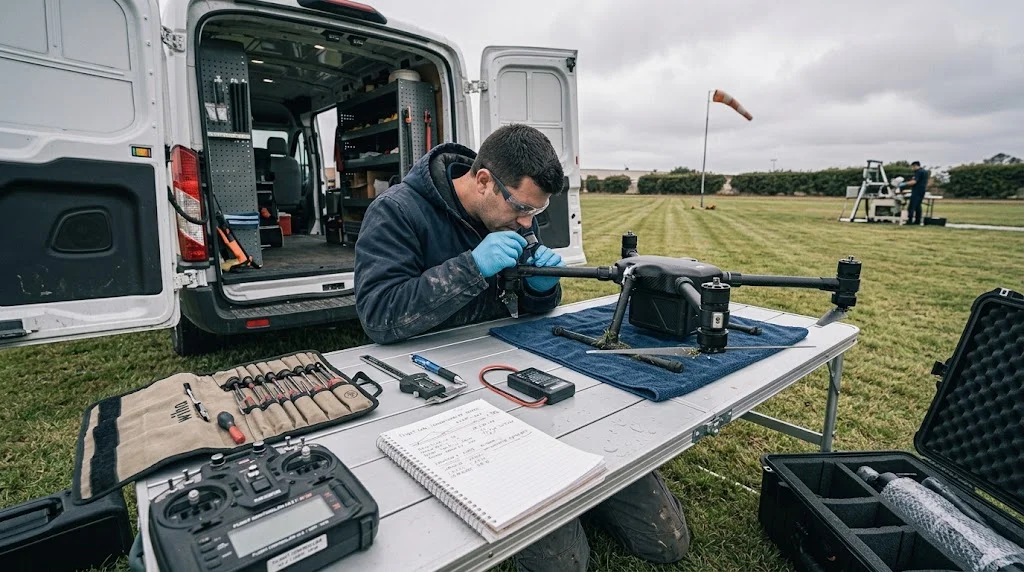
A carbon fiber drone airframe is not automatically the better airframe; it is the better answer only when the weight you remove pays you back faster than the money you spend and the repair risk you accept. Composite frames shine where every gram comes out of the hover power budget, where stiffness k
Introduction
A carbon fiber drone airframe is not automatically the better airframe; it is the better answer only when the weight you remove pays you back faster than the money you spend and the repair risk you accept. Composite frames shine where every gram comes out of the hover power budget, where stiffness keeps camera gimbals and flight controllers away from frame resonances, and where the airframe must stay true after hundreds of flight hours. They lose where crashes are frequent, where field repair must happen with a knife and tape, or where aluminum plates can be cut on a bench for a tenth of the price.
This article works through the actual decision: what a frame job asks of the material, how composite compares against aluminum and wood on the numbers, when a carbon fiber drone kit beats a scratch build, which carbon fiber drone parts fail first, and the inspection routine that tells you whether a crashed frame is finished or flyable.
Carbon Fiber Drone Frames: What the Load Case Actually Asks
Frame design for a multirotor is dominated by three loads: motor thrust acting at the arm tips, landing impact going up through the legs, and the vibration spectrum the props write into the plate where the flight controller sits. Carbon fiber plate and tube answer all three well when the layup is right. Bending stiffness per gram beats 6061 aluminum by roughly three to one, so arms deflect less under thrust for the same mass, and the higher natural frequency pushes frame resonances above the prop band that would otherwise smear gyro readings. The catch is anisotropy: in-plane properties are excellent, through-thickness and interlaminar properties are not, and almost every real field failure of a composite frame starts at a drilled hole, a stack of press nuts or a machined edge that was never sealed.
Where the load case is dominated by impact tolerance instead of stiffness, the calculus flips. A drilled aluminum arm bends in a hard landing and can be straightened with a vise; a carbon arm that bends has already yielded its fibers and will fail at a lower load next time. Frequency-limited machines that fly indoors and hit walls weekly usually come out cheaper on aluminum or reinforced nylon, while long-range and heavy-lift platforms that fly hundreds of hours between incidents are the natural home for composite.
Carbon Fiber Drone Kit versus Scratch Build
A kit answers a different question than a parts list. What you buy in a reputable kit is the iteration: holes that line up with the stack, arms whose length and stiffness have already been tuned against the flight controller firmware, and hardware specified to the loads rather than to a bin price. What you pay for is that supplier's choices — motor layout, plate thickness, arm cross-section — and for the fact that every spare you will ever need carries their part numbers. A scratch build wins when the geometry is unusual, when you already hold a stock of hardware, or when the machine is a one-off testbed whose requirements will change next month.
The economics split cleanly with volume. For a single machine, a kit typically costs 20 to 40 percent more than the same parts bought separately only if you would have chosen the same parts anyway; against a first attempt at sourcing everything, the kit is usually cheaper once mistakes are counted. For the third and fourth machine, the reverse holds: once the cut list and hole pattern are proven, buying plate and tube by the meter undercuts the kit every time. Decide which side of that line you are on before reading any product page, because the marketing will not draw it for you.
Carbon Fiber, Aluminum and Wood: The Numbers Side by Side
The table below compares the three frame materials on the properties a frame actually consumes. Values are typical for quasi-isotropic carbon laminate, 6061-T6 aluminum and aircraft-grade birch ply, and they are comparison bands rather than guaranteed specifications; your layup, temper and grain direction will move them.
| Property | Carbon fiber laminate | 6061-T6 aluminum | Birch plywood |
|---|---|---|---|
| Density | 1.55 to 1.60 g/cm³ | 2.70 g/cm³ | 0.65 to 0.75 g/cm³ |
| Tensile modulus | 45 to 70 GPa quasi-iso | 69 GPa | 9 to 12 GPa |
| Bending stiffness at equal mass | Highest | Mid | Lowest |
| Impact damage tolerance | Low, delaminates | High, bends then yields | Mid, splinters at screws |
| Field repair | Patch or replace | Straighten, drill, splice | Screw and glue |
| Relative cost per frame | High | Mid | Low |
Read the third row first: it is the reason composite exists. A carbon arm with the same bending stiffness as an aluminum arm can be materially thinner and lighter, and those grams come straight out of hover current, extending flight time or paying for a bigger battery. Read the fourth row right after it: it is the reason the material has not simply replaced everything else. A frame that dies on the first hard week of training is not cheaper at any price.
Carbon Fiber Drone Parts: Where Frames Actually Fail
Composite frames do not usually fail in the middle of an arm. They fail at the hardware: arm-to-body joints where press nuts crush the laminate, motor mounts where bolt holes elongate under thrust reversal, and leg mounts where landing shock concentrates into a small pad. Each of those is a through-thickness load on a material that is weakest in exactly that direction, and each is fixable at design time with larger pads, shoulder bolts, captive nuts in a bonded boss, or a replaceable aluminum insert taking the crush while the carbon carries the bending.
- Motor mounts: check for elongation at the bolt holes and for fine cracks radiating from them after every prop strike.
- Arm joints: look for compression set under washers and for any shift in arm angle under hand torque.
- Landing legs: inspect the bond line where the leg meets the plate; impact energy hides as a delamination you can tap for.
- Battery tray: watch strap slots for edge chipping, the most common slow-growth crack on a working machine.
None of those inspections needs instruments. A bright light, a fingernail and ten minutes after any hard landing will find the damage that matters; the mistake is doing the inspection only after a crash so violent that the answer is obvious anyway. Frames that get looked at weekly survive months of incidents that would end an uninspected one.
Frequently Asked Questions
Is a carbon fiber drone frame worth it for a beginner?
Usually not. Beginners crash often, repair badly and cannot yet feel the stiffness benefit that justifies the cost, so a glass-fiber or nylon frame that can be replaced cheaply teaches the same lessons for less money. The exception is a builder who values flight time from the first machine, for example a long-range platform where every gram is battery; there the composite frame pays for itself even while the pilot is learning. Buy the cheap frame first and the carbon frame once your landings stop being events.
Can I drill or trim a carbon fiber drone frame safely?
Yes, with a sharp bit at moderate speed, a backing block, and dust control, because carbon dust is an irritant and must not be breathed or wiped around the workshop. Use carbide or diamond tooling rather than HSS, keep the feed gentle to avoid breakout on the exit face, and seal any freshly cut edge with thin epoxy so the laminate cannot wick moisture or start delaminating at the cut. Tape both faces before drilling to protect the surface finish, and deburr by hand rather than with a rotary tool that can catch.
How do I repair a cracked carbon fiber drone arm?
For a hairline crack that has not shifted, clean the area, drill a stop hole at the crack tip, and bond an over-length patch of the same fiber orientation on both faces with structural epoxy, then peel-ply the surface flat. For an arm that has delaminated, shifted or lost more than a third of its section, replace it; a bonded repair restores stiffness but not the original fatigue life, and a failed arm costs more than the arm it saved. Always pair the repair with the cause hunt: cracks at the same location on two frames mean the mount design, not the pilot, is the problem.
Does paint or a clear coat protect a carbon fiber drone frame?
A clear coat seals the surface against UV and moisture, which matters more on stored machines than on machines flown weekly, and it makes edge damage easier to see. Paint hides the weave, which is fine structurally but removes a visual cue inspectors use for surface cracks. Whatever you choose, keep the coat thin at bolt holes and joints, because a thick film under a washer crushes into the laminate and starts the very compression failure it was meant to prevent.
Conclusion
A carbon fiber drone airframe earns its price where stiffness per gram and dimensional stability translate directly into flight time or footage quality, and loses it where crashes and field repairs dominate the ownership picture. Kit or scratch, the same test applies: buy composite when the load case rewards stiffness, and stay with aluminum or nylon when the load case rewards survivability.
Start from your real duty cycle — hours between incidents, weight budget, and how the machine will be repaired — then choose the material that answers it. Browse our carbon fiber plate and tube range or contact our engineering team with your frame drawing, and we will tell you honestly when aluminum is the better answer.
Related Articles
- Carbon Fiber Tubes for RC Planes: Spars, Booms and Frame Components
- Carbon Fiber Rod Fishing: Blank Grades and Action Curves Explained
- Carbon Fiber Tube Protector: Edge Guards and Damage Prevention
- Carbon Fiber RC Body: Lightweight Shells for On-Road and Off-Road Cars
- Carbon Fiber FPV Drone Frame: Geometry, Materials and DIY Builds
- Pultruded Carbon-Fiber Leaf Springs: Composite Suspension for Commercial Vehicles
Interested in Our Products?
Contact our team for competitive pricing and technical specifications.
Get a QuoteRelated Products

Round Carbon Fiber Tube — 3K Plain Weave T700
Standard round carbon fiber tube manufactured from Toray T700 grade fiber with 3K plain weave. Offers balanced strength and stiffness for general industrial applications including robotics, automation, sports equipment, and aerospace structures.

Square Carbon Fiber Tube — 3K Twill T700
Square cross-section carbon fiber tube manufactured with 3K twill weave for torsional strength. Preferred for structural frames, trusses, and support columns where rectangular geometry offers design flexibility.

Round Carbon Fiber Tube — 3K Twill
Lightweight and ultra-stiff round tubes ideal for drone frames, robotics, and structural applications.
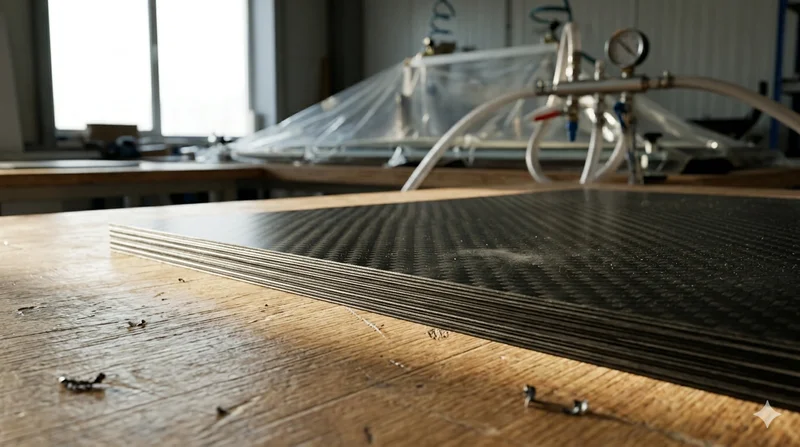
Carbon Fiber Plate — 3K Twill T700 3.0mm
Medium-thickness 3.0mm carbon fiber plate offering significantly higher load capacity while maintaining attractive 3K twill finish. Suitable for structural brackets, reinforcement plates, and load-bearing panels.
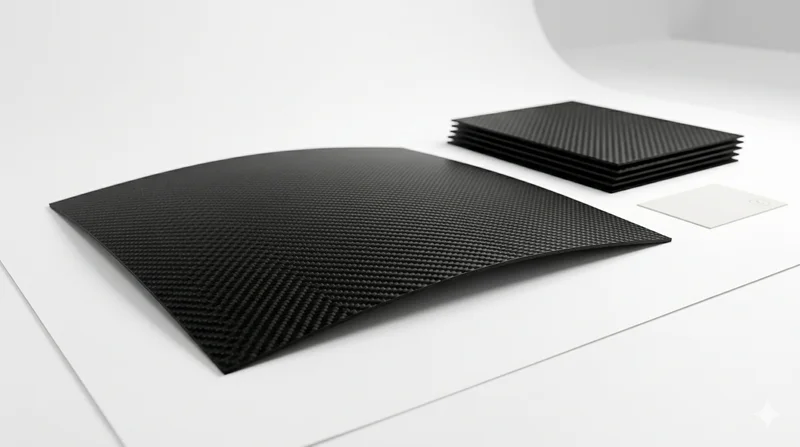
Carbon Fiber Plate — 3K Twill T700 1.5mm
Thin 1.5mm carbon fiber plate with 3K twill weave surface. Lightweight and stiff, commonly used for covers, panels, drone bodies, and applications requiring a premium aesthetic appearance.