
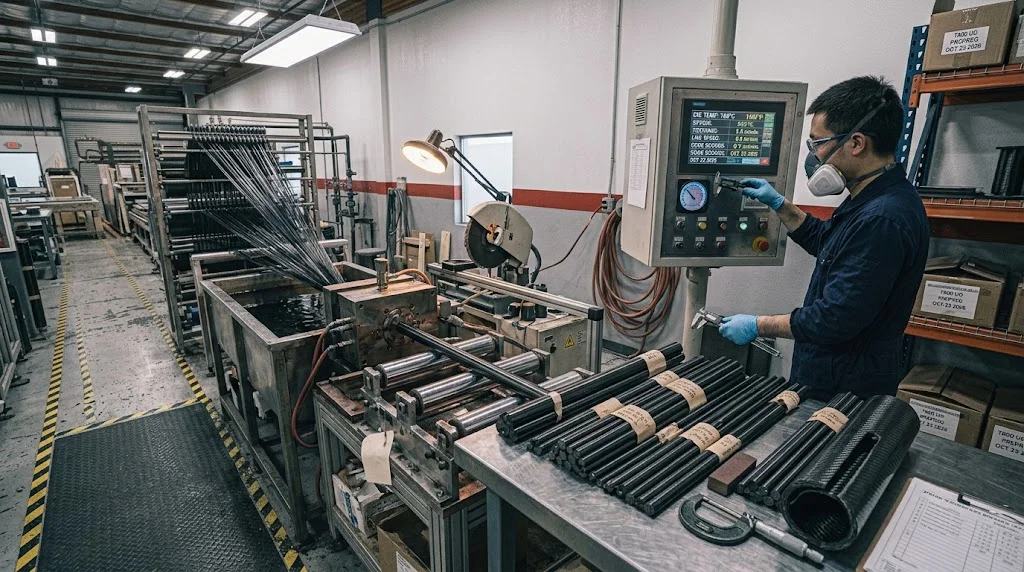
Sourcing a carbon fiber custom rod is a process decision before it is a price decision. The same 8 mm outside diameter rod can be pultruded or roll-wrapped, solid or tubular, sanded or painted, and those choices change axial stiffness, hoop strength, bend radius and unit cost by factors of two or mo
Introduction
Sourcing a carbon fiber custom rod is a process decision before it is a price decision. The same 8 mm outside diameter rod can be pultruded or roll-wrapped, solid or tubular, sanded or painted, and those choices change axial stiffness, hoop strength, bend radius and unit cost by factors of two or more. Buyers who only compare price per meter usually discover the mismatch at first assembly, when the rod will not seat in its socket or snaps at the intended bend.
This guide covers the two production families that matter for custom work, the tolerances each can actually hold, where custom carbon fiber rod grips and surface finishes enter the picture, a carbon fiber rod vs steel comparison for designers switching from metal, and the practical limits of how to bend carbon fiber rod without damaging it.
Carbon Fiber Custom Rod: Pultruded vs Roll-Wrapped Fundamentals
Pultrusion is a continuous process: fiber is pulled from creels through a resin bath, then through a heated steel die that cures the section as it passes. The result is a constant cross-section rod or tube at high line speed and low unit cost. Because the fibers run almost entirely axially, pultruded rod is stiffest per gram along its length — but weak in torsion and hoop direction, which is why pultruded tube crushes more easily than a roll-wrapped equivalent.
Roll-wrapping is a batch process: pre-pregged or resin-wetted ply is wrapped around a steel mandrel, cured (often under heat-shrink or in an autoclave), then stripped and cut. It lets you place plies at ±45° for torsional stiffness, run a solid laminate for dent resistance, and hold tighter outside diameter because the OD is finished against a cured surface rather than a die.
| Attribute | Pultruded rod / tube | Roll-wrapped tube | What it means for a custom order |
|---|---|---|---|
| Fiber direction | ~95-100% axial | Axial + ±45° / hoop layers available | Pultrusion for pure bending stiffness, roll-wrap when torsion or crushing matters |
| Typical OD tolerance | ±0.1-0.2 mm | ±0.05-0.1 mm | Press-fit sockets and gimbal bearings need the tighter band |
| Straightness (per 300 mm) | 0.2-0.5 mm | 0.05-0.2 mm | Straightness dominates optical and antenna applications |
| Minimum practical wall | 0.5-0.8 mm (tube) | 0.4-0.6 mm (tube) | Very thin walls are roll-wrap territory; pultrusion die limits apply |
| Relative unit cost at volume | 1x | 2-4x | Pultrusion amortizes tooling over continuous production |
| Length availability | Continuous (cut to order) | Mandrel limited, typically ≤ 2-3 m | Long single-piece rods almost always point to pultrusion |
Solid pultruded rod is the default for short pins, shafts and grips; hollow roll-wrapped tube is the default for anything that must stay light while carrying bending and torsion together — camera booms, drone arms and antenna whips all land there. A hybrid worth asking about: pultruded tube over-wrapped with a thin roll-wrapped skin.
Custom Carbon Fiber Rod Grips: Tolerance, Finish and Surface
Grip applications — tool handles, sports grips, machine handles — add two requirements bare rod does not face: a controlled outside diameter for the sleeve or overmold, and a surface the adhesive or overmold can actually bond to. Custom carbon fiber rod grips therefore specify finish as carefully as diameter:
- Sanded finish (P240-P400): the standard for bonding. A consistent scratch pattern gives the epoxy or rubber overmold a mechanical key; a glossy as-cured surface will delaminate under torque.
- Painted or printed sleeve: a thin paint or heat-shrink sleeve carries color and branding but adds 0.1-0.3 mm to finished OD — budget this into the grip fit.
- End machining: chamfers and counterbores at the grip ends prevent the rod from slicing into the sleeve, and a knurled section can be turned into the laminate for mechanical retention.
- Concentricity: for spinning grips, specify runout — typically ≤ 0.1 mm TIR on roll-wrapped rod, harder to guarantee on pultrusion where the fiber pack can wander inside the die-set OD.
A common failure in grip programs is specifying diameter tolerance while leaving finish unspecified, then receiving rods that look perfect and slip under load. Always name the finish grit, maximum gloss, and whether the rod arrives with protective film.
Carbon Fiber Rod vs Steel: Weight, Stiffness and Cost
Designers replacing steel rod with carbon often underweight the stiffness difference, because the headline number is density and the design number is the second moment of area. A fair comparison holds either diameter or mass constant — not both:
| Property | Carbon fiber rod (standard modulus) | 304 stainless rod | Mild steel rod |
|---|---|---|---|
| Density | 1.55-1.65 g/cm³ | 8.0 g/cm³ | 7.85 g/cm³ |
| Tensile modulus | 130-150 GPa (laminate, axial) | 193 GPa | 200-210 GPa |
| Specific stiffness (modulus / density) | ~85-95 kNm/kg | ~24 kNm/kg | ~26 kNm/kg |
| Mass of 8 mm x 500 mm rod | ~39-41 g | ~200 g | ~195 g |
| Bending behavior | Elastic then brittle fracture | Elastic then yield then ductile | Elastic then yield then ductile |
| Galvanic risk against aluminum | High (carbon is cathodic) | Low | Low-moderate |
At equal diameter, a carbon rod is roughly as stiff as steel in bending — the payoff is the 5x mass reduction, which shows up as lower inertia in moving assemblies and less sag over unsupported spans. At equal mass you can upsize the carbon section dramatically, because specific stiffness is 3.5-4x better. The trade is failure mode: steel yields and warns you, carbon breaks without warning, so carbon rod structures need conservative stress limits or a design that catches a failed spar before it drops a load.
Cost is the second trade. Carbon rod material costs several times steel per meter, and new tooling adds a one-time charge that only makes sense above a few hundred pieces. For prototypes, buy standard diameters and cut; for series, the tooling pays back quickly once volume is real.
How to Bend Carbon Fiber Rod: Cold Forming and Mandrel Limits
The short version of how to bend carbon fiber rod: cold-form it around a mandrel whose radius is generous, and never exceed roughly 10x the outside diameter for a pultruded solid rod or 15-20x for a roll-wrapped tube. Below those radii the outer ply goes into tension beyond its resin's strain limit and the rod opens a longitudinal crack, usually invisible until it propagates.
- Mandrel technique: wrap the rod over a polished mandrel with a release film and apply slow, even force — never jerk. A strap or cloth pad distributes load; clamping directly point-loads the rod and dents the resin.
- Heat assist: for tight-but-legal radii, warming the rod to 60-80 °C (heat gun, not flame) softens the matrix and reduces springback. Above roughly 120 °C for standard epoxy you begin permanently degrading it.
- Solid vs tube: solid rod tolerates tighter radii than tube of the same OD, because there is no inner surface to wrinkle. Tube bending should always use an internal mandrel or filler to support the wall.
- Springback: carbon rod springs back 2-5° after forming; overshoot deliberately and check against a template — re-bending back and forth fatigues the matrix at the bend zone.
- When not to bend: tight hooks, S-bends under 30 mm radius, or bends carrying cyclic load should be ordered pre-shaped on a curved mandrel. Bent-in-service rods are the most common source of field failures in spar applications.
Frequently Asked Questions
What is the minimum order quantity for a carbon fiber custom rod?
For standard pultruded diameters cut to length, MOQs are often 50-100 pieces because the line is already set up. A new pultrusion die or mandrel set usually needs 300-500 pieces to absorb tooling, though some suppliers will run a 100-piece first article at a premium. Roll-wrapped custom sections typically start at 50-200 pieces.
Can carbon fiber custom rod be threaded, drilled or notched?
All three are possible but each weakens the rod. Drill with sharp bits at low speed and back the exit with a sacrificial block; thread only into solid rod with thread depth ≤ 1.5x diameter, or use a metal insert; avoid notches entirely in bending-critical spans — a notch cuts the outer plies that carry almost all the bending load.
How do I stop a carbon fiber rod from galvanically corroding an aluminum mount?
Isolate the joint with nylon or PEEK washers, a thin plastic sleeve at the interface, or a painted band where the rod contacts metal. Then use fasteners compatible with the aluminum (300-series stainless or aluminum itself) rather than plain steel. Isolation layer plus compatible fastener is what keeps the joint alive in wet or salted environments.
Conclusion
Sourcing a carbon fiber custom rod comes down to choosing a process family against your load case: pultrusion when you need low cost, long lengths and pure axial stiffness; roll-wrapping when tolerance, straightness or torsional strength matter. Add the surface and grip specification early, size the section honestly against a carbon fiber rod vs steel comparison, and keep bend radii inside the practical limits — do those things and the rod will behave exactly as the drawing promised.
YongXian supplies pultruded and roll-wrapped carbon fiber rod to custom diameter, wall thickness, length and finish. Browse our carbon fiber tube and rod range or contact our engineering team with your drawing and target quantity.
Part of topic
Related Articles
- Price of Carbon Fibre 2026: Global Carbon Fiber Price Benchmarks
- Carbon Fiber Tube Price in Pakistan: Import Costs and Local Market
- How to Choose a Carbon Fiber Drone Manufacturer
- Carbon Fiber Plate Custom: CNC Cutting, Nesting and Thickness Selection
- How to Read a Carbon Fiber Supplier Pricing Sheet
- Carbon Fiber Tube Custom Orders: OD, Wall Thickness and Tolerance Buying Guide
Interested in Our Products?
Contact our team for competitive pricing and technical specifications.
Get a QuoteRelated Products

Round Carbon Fiber Tube — 3K Plain Weave T700
Standard round carbon fiber tube manufactured from Toray T700 grade fiber with 3K plain weave. Offers balanced strength and stiffness for general industrial applications including robotics, automation, sports equipment, and aerospace structures.

Carbon Fiber Pickleball Paddle
High-performance pickleball paddle with Toray T700 carbon fiber face and polypropylene honeycomb core. Delivers excellent power-to-weight ratio, spin generation, and vibration dampening for competitive play.

Square Carbon Fiber Tube — 3K Twill T700
Square cross-section carbon fiber tube manufactured with 3K twill weave for torsional strength. Preferred for structural frames, trusses, and support columns where rectangular geometry offers design flexibility.
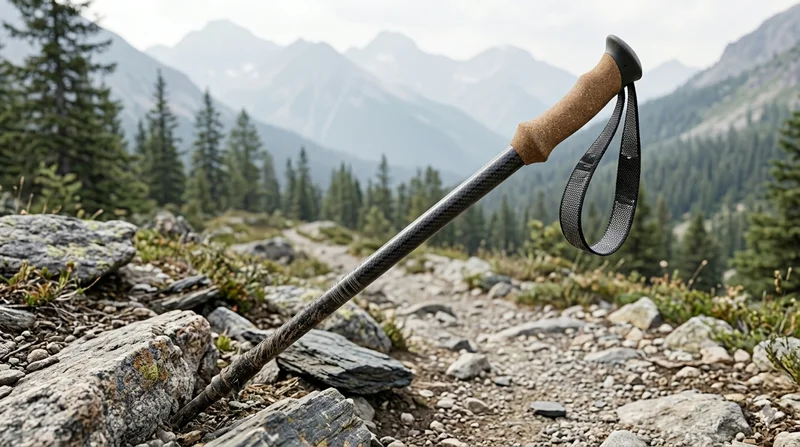
Carbon Fiber Trekking Pole
Lightweight carbon fiber trekking pole manufactured from high-grade carbon fiber tube. Weighs only 160g per pole while providing superior shock absorption and durability for hiking, trail running, and backpacking.

Carbon Fiber Plate — 3K Twill T700 3.0mm
Medium-thickness 3.0mm carbon fiber plate offering significantly higher load capacity while maintaining attractive 3K twill finish. Suitable for structural brackets, reinforcement plates, and load-bearing panels.