
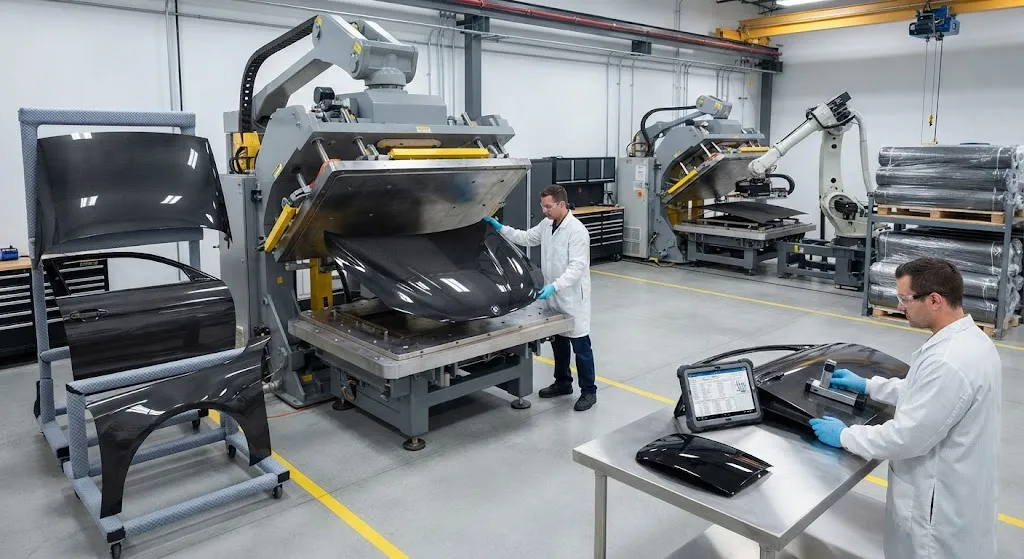
Carbon fiber body parts have become a mainstream engineering choice in automotive programs that need to cut mass without cutting structure. A hood, roof, or door panel made from carbon fiber saves 40-60% of the weight of a steel equivalent while offering similar or higher stiffness, and the saving a
Introduction
Carbon fiber body parts have become a mainstream engineering choice in automotive programs that need to cut mass without cutting structure. A hood, roof, or door panel made from carbon fiber saves 40-60% of the weight of a steel equivalent while offering similar or higher stiffness, and the saving at the top of the vehicle lowers the center of gravity and improves handling. Carbon fiber body parts are no longer limited to supercars: high-volume platforms now use them for hoods, roofs, and decklids where the weight target and the production volume justify composite tooling.
This article covers the types of carbon fiber body parts used in automotive exterior and structural applications, the CFRP body panel construction options, the manufacturing routes for carbon fiber car body parts, and the cost and quality factors that determine whether a composite exterior panel is the right choice for a given program.
Carbon Fiber Body Parts: What They Are and What They Achieve
The term carbon fiber body parts covers two families: exterior panels, which replace visible skin components, and structural components, which carry load and manage crash energy. Exterior panels — hoods, roof panels, doors, fenders, and trunk lids — are where the weight saving is most visible. Structural components — front-end carriers, floor reinforcements, and roof bows — integrate carbon fiber where its stiffness and fatigue resistance change the behavior of the body in white.
| Body Part | Typical Weight Saving vs Steel | Primary Benefit |
|---|---|---|
| Hood | 45-60% | Lower front axle load, pedestrian-friendly structure |
| Roof panel | 40-55% | Lower center of gravity, improved roll response |
| Door outer panel | 40-55% | Mass reduction, dent resistance of composite |
| Fender | 40-60% | Unsprung-adjacent mass saving, styling freedom |
| Front-end carrier | 30-50% | Stiffness integration, part consolidation |
The weight numbers matter because every kilogram saved in the body is multiplied through the rest of the vehicle: smaller brakes, smaller battery in an EV, and a lighter suspension can all follow a single panel decision. That is why a carbon fiber body part is rarely evaluated in isolation — it is evaluated as the starting point of a mass-reduction chain.
CFRP Body Panel Types: Construction and Material Choices
A CFRP body panel is built from a laminate that must balance stiffness, surface quality, impact behavior, and cost. The construction choices are the same across panel types, and each one shifts the balance:
- Prepreg autoclave: The highest quality Class A surface and the highest strength-to-weight ratio, at the cost of long cycles and high capital — used for supercar panels.
- Resin transfer molding (RTM): Shorter cycles with a two-sided mold, good surface on both sides, and a high fiber volume fraction — the workhorse for medium-volume carbon fiber body parts.
- Compression molding with sheet molding compound: The fastest cycles and lowest cost, but with a shorter fiber length that reduces strength — suited to structural components and high-volume panels.
- Sandwich construction: A foam or honeycomb core between carbon skins multiplies bending stiffness — used in roofs and hoods where buckling stiffness dominates.
The fiber choice is equally important. Standard-modulus carbon fiber at 230-250 GPa covers most body panels; intermediate-modulus fiber at 290-300 GPa appears where stiffness must be maximized per gram, such as roof bows and doors. The weave pattern matters for appearance — 2x2 twill is the classic visible weave for exterior carbon fiber car body parts — while unidirectional plies hidden under the surface layer provide the engineering stiffness.
Manufacturing Routes for Carbon Fiber Car Body Parts
The manufacturing route for carbon fiber car body parts is chosen by volume and cycle time, and the economics are dominated by tooling and cycle:
| Process | Cycle Time | Volume Fit | Class A Surface |
|---|---|---|---|
| Prepreg autoclave | 60-180 min | Low (supercars, motorsport) | Yes, with paint-ready finish |
| RTM / HP-RTM | 5-20 min | Medium (thousands per year) | Yes, with in-mold coating |
| Compression SMC | 2-5 min | High (tens of thousands) | Yes, with primer |
High-pressure RTM (HP-RTM) has become the preferred route for carbon fiber body parts at meaningful volume because it combines a two-sided tool that controls both surfaces, a cycle under 20 minutes, and a fiber volume fraction above 55%. The resin is injected at pressure into a closed mold containing the dry carbon preform, and the part demolds with a surface that needs only light preparation before paint. For truly high volume, compression molding of carbon sheet molding compound cuts cycle time to minutes, trading some strength for the low cost and throughput that a mass-market platform demands.
Composite Exterior Panel: Cost, Quality, and Program Fit
The decision to adopt a composite exterior panel rests on four factors that engineering teams must quantify before committing: the mass budget, the Class A surface requirement, the production volume, and the total cost including tooling amortization. A carbon fiber body part is always more expensive per part than steel or aluminum, so the business case depends on the value of the mass saving — longer EV range, better performance metrics, or a distinctive appearance that supports a premium price.
Quality control for carbon fiber body parts is demanding because the parts are visible. Porosity control, surface waviness, and paint adhesion must be verified on every panel, and the thermal expansion mismatch between carbon and the surrounding metal structure must be managed with flexible bonding and slip planes. A supplier that can deliver a Class A surface panel with batch traceability and dimensional reports is a supplier that can carry a production program, not just a prototype.
Frequently Asked Questions
How much weight do carbon fiber body parts actually save?
Compared with a steel equivalent, a carbon fiber exterior panel typically saves 40-60% of its weight; compared with aluminum, the saving is typically 20-35%. A full carbon hood on a midsize car, for example, weighs roughly 7-9 kg versus 14-18 kg for a steel hood with the same structure. The savings compound through the vehicle because a lighter body allows smaller brakes, suspension, and powertrain components, which saves additional mass downstream.
Are carbon fiber body parts strong enough for everyday road use?
Yes, when designed and manufactured correctly. The stiffness of a well-laid carbon panel is comparable to steel at a fraction of the weight, and the composite has excellent fatigue resistance — it does not rust, and it absorbs repeated vibration without the microcrack growth that eventually fails a metal panel. The practical requirements are a proper laminate design, impact resistance in the skin and core, and UV-stable clear coats or paint systems that protect the resin from sunlight. Certification for road use follows the same structural standards as any body panel.
Why are carbon fiber body parts still expensive?
The cost is dominated by three inputs: the raw material, the tooling, and the cycle time. Carbon fiber prepreg or fabric is an order of magnitude more expensive per kilogram than steel or aluminum sheet. The molds — steel tools for RTM or autoclave tooling — cost hundreds of thousands of dollars and must be amortized over the production run. And the cycle time, even at 5-20 minutes in HP-RTM, is longer than a metal stamping line. The price falls with volume and with newer processes, but for most programs a carbon fiber body part remains a premium choice justified by mass targets, performance, or brand image.
Conclusion
Carbon fiber body parts have earned a permanent place in automotive engineering because the physics is unambiguous: a carbon fiber body part is 40-60% lighter than steel at equal stiffness, and the saving propagates through the entire vehicle. CFRP body panels built by prepreg autoclave, RTM, or compression molding cover everything from supercar skins to high-volume structural components, and the composite exterior panel decision comes down to quantified mass value, surface requirements, and volume. For programs that make the numbers work, carbon fiber body parts deliver a measurable improvement in range, handling, and product identity.
If you are evaluating carbon fiber body parts for a production program, review our automotive composite capabilities or contact our engineering team with your mass targets, panel geometry, and volume, and we will recommend the CFRP body panel construction and manufacturing route that fits.
Part of topic
Related Articles
- Carbon Fiber Tube for Sale: Comparing Listings and Avoiding Bad Specs
- Carbon Fiber Engine Parts: High-Temperature Performance for Racing and Performance Vehicles
- Carbon Fiber Drone Body Manufacturing: Monocoque Design and Production Methods
- Carbon Fiber Drone Parts Supplier: FPV Frames, Arms and Structural Components
- Filament Wound Epoxy Tubes: Industrial Applications from Oil and Gas to Aerospace
- Carbon Fiber Rod Near Me: Stock Sizes, Tolerances and Local Availability
Interested in Our Products?
Contact our team for competitive pricing and technical specifications.
Get a QuoteRelated Products

Carbon Fiber Plate — 3K Twill T700 3.0mm
Medium-thickness 3.0mm carbon fiber plate offering significantly higher load capacity while maintaining attractive 3K twill finish. Suitable for structural brackets, reinforcement plates, and load-bearing panels.

Carbon Fiber Plate — 3K Twill T700 1.5mm
Thin 1.5mm carbon fiber plate with 3K twill weave surface. Lightweight and stiff, commonly used for covers, panels, drone bodies, and applications requiring a premium aesthetic appearance.

Square Carbon Fiber Tube — 3K Twill T700
Square cross-section carbon fiber tube manufactured with 3K twill weave for torsional strength. Preferred for structural frames, trusses, and support columns where rectangular geometry offers design flexibility.
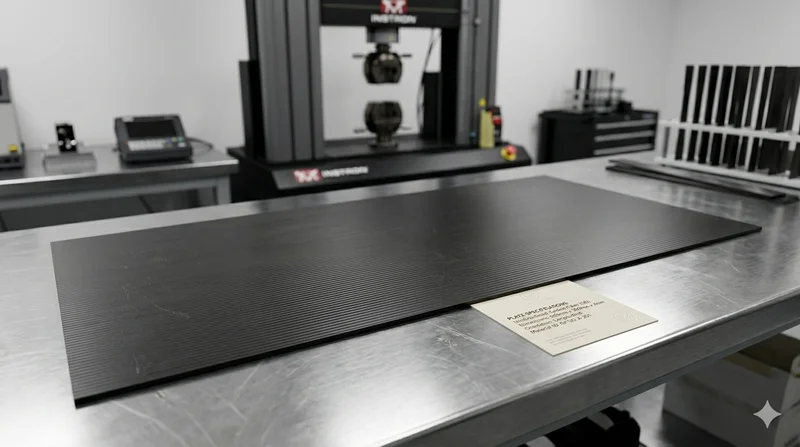
Carbon Fiber Plate — UD Unidirectional T700
Unidirectional carbon fiber plate with all fibers oriented in a single direction for maximum strength along the fiber axis. Essential for structural reinforcements, splints, and applications where load direction is predictable.
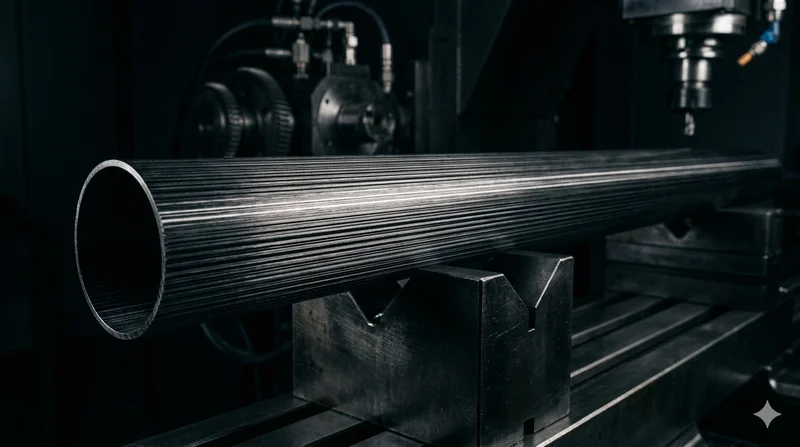
Round Carbon Fiber Tube — UD Unidirectional T700
Unidirectional (UD) round tube with all fibers aligned axially for maximum longitudinal stiffness. Ideal for applications requiring high bending rigidity with minimal weight, such as shafts, struts, and structural reinforcements.