
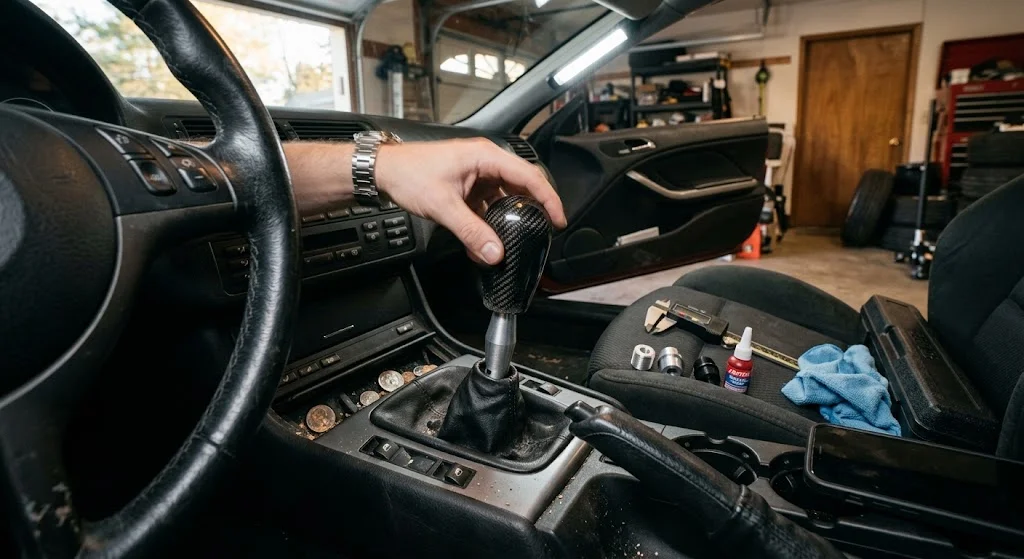
A car carbon fiber gear knob is one of the few interior parts a driver touches on every journey, so it sells well but also generates more returns than most interior trim. Those returns are rarely about looks: thread mismatch, a knob that rattles after a month, or a clear coat that yellows in a sun-e
Introduction
A car carbon fiber gear knob is one of the few interior parts a driver touches on every journey, so it sells well but also generates more returns than most interior trim. Those returns are rarely about looks: thread mismatch, a knob that rattles after a month, or a clear coat that yellows in a sun-exposed cabin.
Real Carbon Versus Carbon Wrap
Two products share the phrase "carbon fiber" and behave differently. Separating them is the first commercial decision: the price gap is roughly three to one, and the sample stage is where a buyer finds out which one is on the quote.
- Genuine carbon fiber laminate: layers of 3K or 12K tow in an epoxy matrix, cured under vacuum or autoclave and then clear coated. Fibre volume fraction is typically 55 to 62 percent, and the weave is the structural fibre.
- Carbon fiber wrap (skinning): a thin carbon fabric laid over an ABS, aluminium, or polyurethane core and flooded with resin. The core carries the load; the carbon is a cosmetic skin of tens of microns to about 0.5 mm.
The practical difference is weight and repeatability. A solid laminate has a density of 1.5 to 1.6 g/cm³, so a 45 mm sphere-machined knob lands near 90 to 140 g, while one with a carbon skin can be built at 40 to 70 g. Both sell, but a skin can lift at a cut edge if the resin did not wet out.
Car Carbon Fiber Gear Knob Thread and Clamp Fitment
Fitment is where returns originate. The pitch is what must match, so measure the gear lever, not the original knob, since a supplied adapter insert may be masking a mismatch.
| Thread specification | Engagement depth | Notes for specification |
|---|---|---|
| M12 × 1.25 | 18–25 mm | The most common size across European and Japanese manual gearboxes |
| M12 × 1.50 | 18–25 mm | Threads onto 1.25 then binds, a cross-threading cause |
| M10 × 1.25 | 15–22 mm | Often supplied as a reducer insert inside an M12 knob |
| M10 × 1.50 | 15–22 mm | Check with a thread gauge, not a sample knob |
| M8 × 1.25 | 12–18 mm | Thin wall section, so limit set-screw torque |
| 8–15 mm plain shaft | Clamp band 10–15 mm | Two or three M4/M5 set screws with nylon tips |
| Reverse-lockout collar | n/a | A plain threaded knob will not work; collar geometry must be reproduced |
Three rules follow. Engagement should reach at least 1.5 times the nominal diameter. Reverse lockout is a hard constraint: if the vehicle needs a lift collar, the knob must be designed around it. Adapter inserts should be steel rather than moulded plastic, which creeps under torque.
Weight, Hand Feel and Ergonomics
Knob mass changes shift feel more than buyers expect, because it damps the linkage. Mass bands below are realistic for production parts.
| Construction | Mass | Feel and price (USD) |
|---|---|---|
| Carbon skin over ABS core | 40–70 g | Light, mechanical; 25–70 |
| Carbon skin over aluminium core | 90–150 g | Balanced; 45–120 |
| Solid carbon laminate, CNC finished | 90–140 g | Light but dense; 60–180 |
| Machined aluminium with carbon inlay | 180–320 g | Heavy, deliberate throw; 80–260 |
| Stainless or titanium core | 250–400 g | Heaviest, for weighted shifters; 120–350 |
Ergonomics matter more than mass in daily use. A 45 to 50 mm sphere suits most hands; below 40 mm the knob tires the hand on long drives, and above 55 mm it begins to foul centre consoles. A spherical knob suits a slick gate, while a tapered shape is friendlier to a stiff linkage. Sourcing carbon fiber sheets for cars alongside the knob keeps weave and gloss consistent across a private-label interior kit.
Surface Finish and Wear Resistance
The finish, not the laminate, decides how the knob looks after two years. Carbon fiber is hard and abrasion resistant; the resin and clear coat on top are what wear, yellow, and pick up hand oils.
- 2K polyurethane clear coat, 25–40 µm: the standard for gloss and satin, and the best balance of clarity, hand feel, and UV stability.
- UV stability: request the test method and hours. ISO 4892-2 at 1000 hours is defensible for an interior part.
- Hand oil and abrasion: add an artificial-sweat check for hot climates and a 500-cycle abrasion check on high-touch surfaces.
- Heat: a dark knob on a dashboard reaches 70 to 90 °C in summer sun, so confirm the softening point of the coating.
Edges matter as much as faces. A cut edge exposes fibre ends and lets moisture wick into the laminate, so edges on a knob or inlay plate should be radiused or sealed. In carbon fiber sheet cutting, a clean waterjet edge is normal, while a CNC-routed edge with fibre pull-out is worth rejecting.
Car Carbon Fiber Gear Knob Installation Notes
Installation is short but unforgiving; most failures trace to four mistakes.
- Clean the lever thread first. Degrease with isopropyl alcohol and run a thread chaser if the lever carries old thread-locker residue.
- Use thread locker sparingly. One drop of medium-strength removable compound is enough; never use permanent compound.
- Torque sensibly. Hand-tight plus a light nip is enough, roughly 15 to 25 N·m on an M12 knob. Composite can crack at the thread root below what steel tolerates.
- Tighten set screws evenly. Take two or three M4/M5 screws up in small increments, about 1.5 to 2.5 N·m each, so the knob seats square. Recheck after 200 to 300 km.
Check clearance before the final tighten, since a knob that looks fine at rest can foul the gear boot at the extreme of a shift.
Frequently Asked Questions
How do I tell genuine carbon fiber from a wrap or printed film?
Look at a compound curve. A genuine laminate carries a continuous weave through the radius with slight distortion of the tow, and its cut edges show layered fibre rather than a skin over a hollow core. A wrap often shows a seam where the fabric ends, and printed film has a regular pattern with no depth change under raking light.
Will a heavier carbon knob really change shift feel?
Yes, predictably. Mass at the end of the lever damps the linkage, so a 250 g knob makes a notchy gearbox feel smoother and more deliberate, while a 50 g knob transmits more mechanical feedback. On a light, precise shifter a heavy knob can feel vague.
Can one knob fit several cars in my product line?
Usually with adapter inserts. An M12 knob plus M10 and M8 reducers covers most manual gearboxes, and a clamp variant covers plain-shaft applications. The exception is reverse-lockout levers, which need dedicated geometry.
Conclusion
Specify a car carbon fiber gear knob as an engineered assembly, not a cosmetic part. Fix four numbers before requesting samples: thread and pitch, minimum engagement depth, knob mass, and a clear-coat system with a stated UV test. Those four decide fitment, feel, and appearance after two summers, and they are the four that generic quotations leave blank. Buyers building a private-label programme often source the knob and flat trim from one laminate specification so that weave and gloss read as a set. For laminate sheet or a knob programme quoted against your drawing, contact our team with the thread specification, target mass, and finish.
Related Articles
- Carbon Fiber Intake Tube: Engine Air Induction Systems
- Carbon Fiber Arrow Shafts: Spine Selection and Performance
- Carbon Fiber Road Glide Fairing: Lightweight Upgrade Options
- Carbon Fiber Road Glide Fender: Aftermarket Options
- Carbon Fiber Bike Parts: Frame and Component Upgrade Guide
- Carbon Fiber Sheets for Cars: Interior, Exterior and Structural Uses
Interested in Our Products?
Contact our team for competitive pricing and technical specifications.
Get a QuoteRelated Products

Carbon Fiber Plate — 3K Twill T700 1.5mm
Thin 1.5mm carbon fiber plate with 3K twill weave surface. Lightweight and stiff, commonly used for covers, panels, drone bodies, and applications requiring a premium aesthetic appearance.
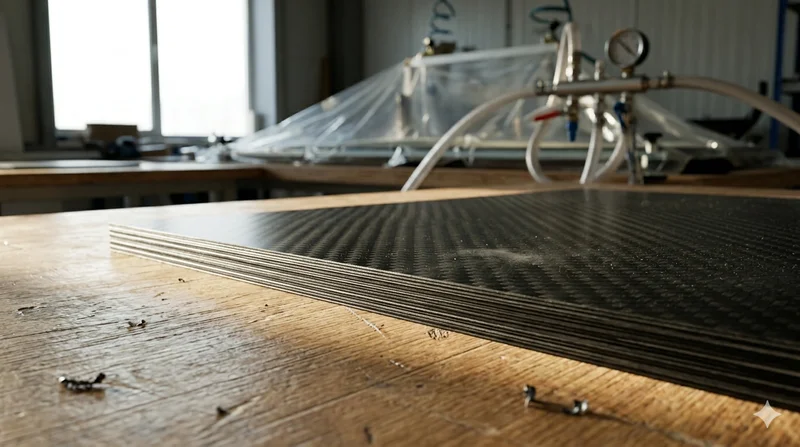
Carbon Fiber Plate — 3K Twill T700 3.0mm
Medium-thickness 3.0mm carbon fiber plate offering significantly higher load capacity while maintaining attractive 3K twill finish. Suitable for structural brackets, reinforcement plates, and load-bearing panels.
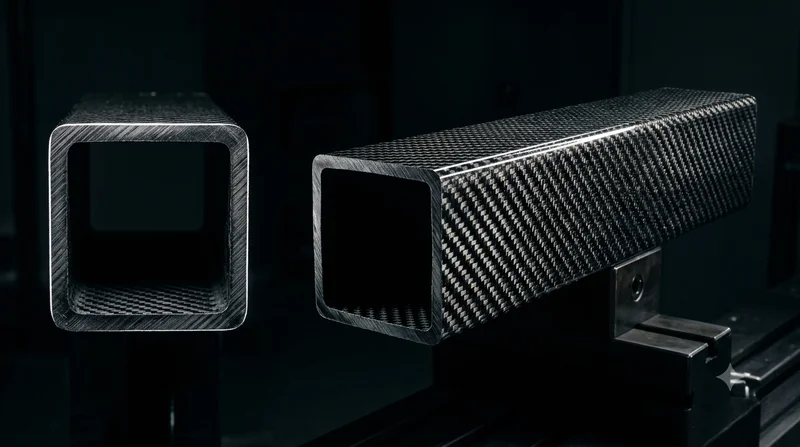
Square Carbon Fiber Tube — 3K Twill T700
Square cross-section carbon fiber tube manufactured with 3K twill weave for torsional strength. Preferred for structural frames, trusses, and support columns where rectangular geometry offers design flexibility.
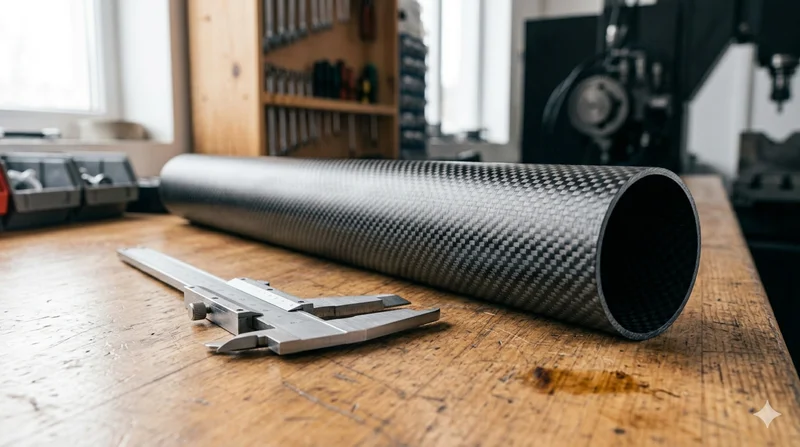
Round Carbon Fiber Tube — 3K Plain Weave T700
Standard round carbon fiber tube manufactured from Toray T700 grade fiber with 3K plain weave. Offers balanced strength and stiffness for general industrial applications including robotics, automation, sports equipment, and aerospace structures.
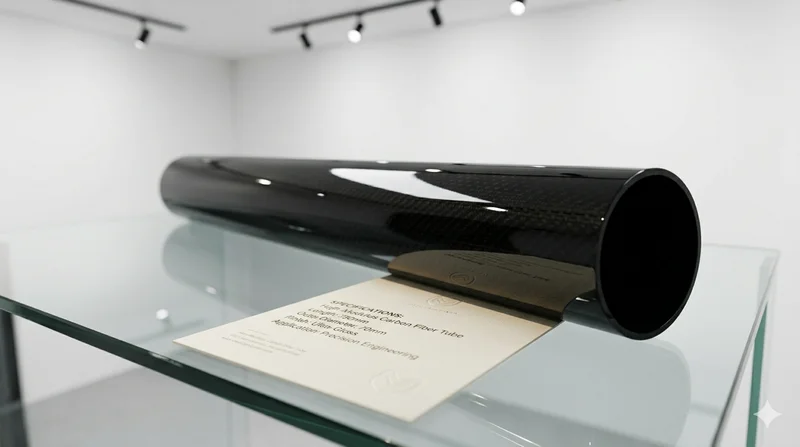
High Modulus Round Carbon Fiber Tube — M40
High modulus round tube manufactured with M40 grade fiber (tensile modulus 400 GPa). Designed for applications where maximum stiffness-to-weight ratio is critical, such as optical systems, precision machinery, and aerospace structures.