
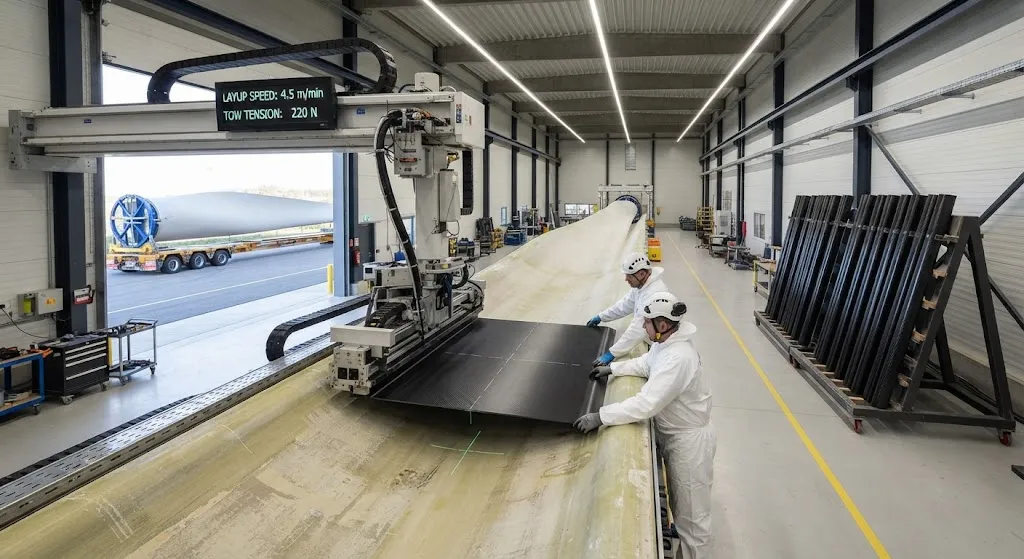
Wind energy became the largest single market for carbon fiber in 2025. According to the ATA 2025 annual carbon fiber market report, wind turbine manufacturing consumed 100,000 tonnes of carbon fiber during the year — the first time the segment has crossed six figures, a 127.3% jump over
Introduction
Wind energy became the largest single market for carbon fiber in 2025. According to the ATA 2025 annual carbon fiber market report, wind turbine manufacturing consumed 100,000 tonnes of carbon fiber during the year — the first time the segment has crossed six figures, a 127.3% jump over the prior year, and fully 44.5% of total global demand of roughly 225,000 tonnes. In a single year, wind absorbed more carbon fiber than aerospace, the segment that had defined the industry for four decades.
The milestone matters far beyond its own statistics. Blade manufacturing is now the volume engine that pulls commodity-grade fiber production, which explains why large-tow lines from China and elsewhere are sized for wind first and everything else second. This article breaks down why demand jumped, how the supply base is responding, and what the trajectory to 2030 looks like for blade makers, fiber producers, and the procurement teams caught between them.
The 100,000-Tonne Milestone
The jump from roughly 44,000 tonnes in 2024 to 100,000 tonnes in 2025 was not a single event but the convergence of three waves: record onshore and offshore installations in China, the mainstreaming of carbon spar caps in blades beyond 100 meters, and build-ahead purchasing by manufacturers securing long-lead fiber. The table below shows wind's position within total 2025 demand.
| Demand segment, 2025 | Consumption (t) | Share of total | Growth character |
|---|---|---|---|
| Wind energy | 100,000 | 44.5% | Up 127.3% year on year, first time above 100,000 t |
| Aerospace and defense | 52,000 (approx.) | 23% | Recovering with production rates, stable structure |
| Industrial (pressure vessels, automotive, construction) | 45,000 (approx.) | 20% | Steady growth, hydrogen tank and mobility drivers |
| Sports and leisure | 28,000 (approx.) | 12.5% | Mature, slow-growing premium segment |
Wind has passed aerospace in absolute tonnage while aerospace retains the higher value per kilogram. The commercial consequence is that capacity decisions, new line investments, and feedstock planning at the producers are now driven primarily by wind's volume requirements rather than aerospace margins.
Why Wind Demand Jumped
Three technical and commercial shifts explain the surge. First, blade length crossed the threshold where carbon becomes a structural necessity rather than a weight-saving luxury. At rotor diameters beyond roughly 180 meters, all-glass spar caps reach practical mass limits, and manufacturers adopt carbon pultruded spar caps to cut blade weight by 20-30% while keeping stiffness. Second, pultrusion matured as a manufacturing route: continuous pultruded carbon spar caps can be produced at high speed from large-tow fiber, converting wind turbines into a genuine volume consumer of industrial-grade carbon rather than a niche user of premium grades. Third, the build-ahead effect amplified demand in 2025 as manufacturers placed orders for two seasons at once to lock capacity and hedge delivery risk.
- Blade length economics: Carbon spar caps pay back their material cost through lighter blades, smaller drive trains, and reduced tower loads beyond the 100-meter blade class.
- Hybrid layups: Increasingly, blades combine carbon spar caps with glass reinforcement in shells and webs, matching material cost to local load paths.
- Large-tow pull: 48K and 60K fiber, previously limited to niche industrial use, is now the workhorse of spar cap pultrusion.
How Supply Responded
The supply base responded to wind's demand jump along three lines. Chinese producers redirected capacity toward large-tow pultrusion feedstock, since domestic wind installations are the largest single demand pool in the world and the logistics of serving them favor local supply. Producers elsewhere retained aerospace orientation but began qualifying large-tow grades for wind, widening the eligible supply pool beyond China. And the nominal-versus-effective capacity gap became visible: the 127.3% demand jump was absorbed partly by underutilized lines flexing upward and partly by inventory drawdown, not by new greenfield capacity, because a near-doubling of demand in one year cannot be met by lines that take 18-24 months to install.
This creates a structural tension for 2026-2027. Wind demand at record levels, holding above 100,000 tonnes, competes with aerospace and other industrial users for the same upstream PAN precursor. If wind sustains its trajectory, feedstock rather than carbonization capacity becomes the binding constraint, shifting competition upstream and re-pricing precursor contracts industry-wide.
The 2030 Trajectory
Market research firm Mordor Intelligence projects wind carbon fiber demand beyond 159,000 tonnes by 2030, roughly a 60% increase over the 2025 record. That trajectory assumes continued blade growth, sustained installation volumes, and carbon content per blade rising as larger turbines enter the mix. The table below summarizes the demand path.
| Year | Wind carbon fiber demand | Notable driver |
|---|---|---|
| 2024 | About 44,000 t | Pre-jump baseline |
| 2025 | 100,000 t (+127.3% YoY) | Record installations, carbon spar cap mainstreaming, build-ahead |
| 2030 (projection) | 159,000+ t | Larger rotors, deeper carbon adoption, offshore growth |
Two judgments shape how credible the trajectory is. On the supportive side, blade technology has room to grow: the majority of turbines installed today still use glass spar caps, and each rotor size class that crosses into carbon territory adds tens of thousands of tonnes of new demand. On the cautionary side, blade supply chains are cyclical and installation financing can slow, and the 2025 figure includes some build-ahead purchasing that will not repeat at the same intensity every year.
What the Numbers Mean for Buyers and Producers
The wind-driven demand structure changes how both sides of the market plan. Producers must treat wind as the anchor customer whose volume requirements set line sizing and feedstock contracts; buyers in aerospace and other premium segments must accept that they now negotiate against wind's pull on the same upstream inputs. For procurement teams, three practices follow.
- Lock annual volume early: Wind installations cluster in identifiable seasons; committing volumes before peak demand periods secures allocation over buyers who order late.
- Qualify large-tow suppliers in advance: With eligible wind-grade supply still concentrated, a second qualified source is leverage against the tight feedstock segment.
- Plan precursor-linked pricing: As feedstock becomes the binding layer, contracts should reference PAN precursor cost indices rather than finished fiber averages.
Frequently Asked Questions
Why did wind carbon fiber demand grow by 127.3% in a single year?
The jump combines three effects: record turbine installations, particularly in China; the mainstreaming of carbon pultruded spar caps in blades beyond the 100-meter class, where all-glass designs hit practical weight limits; and build-ahead purchasing, as manufacturers placed multi-season orders to lock capacity and hedge delivery risk. The 2025 figure therefore includes both structural growth and some demand pulled forward, which is why annualized growth in 2026-2027 is expected to moderate even as total demand stays at record levels.
Will carbon replace glass fiber in most wind turbine blades by 2030?
Not in most blades, but in the large blades. Glass remains cost-appropriate in rotors below roughly 180 meters in diameter, where its lower price outweighs the weight penalty. Carbon spar caps are becoming standard above that size class, and hybrid layups — carbon spar caps with glass shells and webs — are spreading the material into mid-range blades. The 2030 projection of 159,000+ tonnes assumes growth driven mainly by larger rotor sizes and offshore projects, not by full replacement of glass across the market.
Is carbon fiber supply sufficient for record wind demand, or will there be shortages?
Carbonization capacity itself is sufficient on paper — the industry carries large-tow lines that were underutilized before the 2025 jump. The real constraint is upstream: PAN precursor availability and the grade mix needed for spar cap pultrusion. Rapid demand growth was absorbed by utilization gains and inventory, but if wind demand holds above 100,000 tonnes while aerospace and industrial segments also grow, precursor feedstock rather than carbonization becomes the binding layer, and buyers should expect tightening lead times and precursor-linked pricing.
Conclusion
Wind energy is now the defining demand engine of the carbon fiber industry. At 100,000 tonnes in 2025 — up 127.3% year on year and 44.5% of total demand — the segment has overtaken aerospace to become the largest single market, reshaping how producers size lines, how feedstock is contracted, and how every other buyer negotiates. The road to 2030 points to 159,000+ tonnes if rotor growth and carbon adoption continue on their current course.
For manufacturers and buyers, the strategic response is to align with wind's volume rhythm: commit early, qualify large-tow sources ahead of need, and price against precursor cost rather than finished-fiber averages. Explore our carbon fiber tow and fabric range for wind applications, or contact our team to discuss large-tow supply and spar cap feedstock for your blade program.
Part of topic
Related Articles
- Recycled Carbon Fiber Market Forecast 2030: Technology Maturity and Commercialization Path
- South Korea Carbon Fiber Market 2026: Hydrogen Economy and Shipbuilding Innovation
- Wind Turbine Blade Leading Edge Protection 2026: Polyurethane, Tape, and Metallic Shield Solutions
- China Carbon Fiber Overcapacity 2026: Price War Impact and Industry Consolidation
- India Carbon Fiber Market 2026: Wind Energy, Aerospace, and Defense Expansion
- PAN Precursor Market 2026: Acrylonitrile Supply and Carbon Fiber Cost Structure
Interested in Our Products?
Contact our team for competitive pricing and technical specifications.
Get a QuoteRelated Products

Carbon Fiber Fishing Rod Blank
High-quality carbon fiber fishing rod blank manufactured from multiple grades of Toray carbon fiber cloth. Available in a wide range of lengths, powers, and actions for freshwater and saltwater applications. Suitable for OEM rod building.

Carbon Fiber Plate — 3K Twill T700 3.0mm
Medium-thickness 3.0mm carbon fiber plate offering significantly higher load capacity while maintaining attractive 3K twill finish. Suitable for structural brackets, reinforcement plates, and load-bearing panels.

Carbon Fiber Plate — 3K Twill T700 1.5mm
Thin 1.5mm carbon fiber plate with 3K twill weave surface. Lightweight and stiff, commonly used for covers, panels, drone bodies, and applications requiring a premium aesthetic appearance.

Square Carbon Fiber Tube — 3K Twill T700
Square cross-section carbon fiber tube manufactured with 3K twill weave for torsional strength. Preferred for structural frames, trusses, and support columns where rectangular geometry offers design flexibility.

Carbon Fiber Drone Arm
Precision-molded carbon fiber drone arm combining unidirectional fiber for stiffness and woven layers for torsional strength. Designed for FPV, photography, and industrial drone platforms. Each arm is CNC-machined to exact specifications.