
Ukraine does not appear in most classic maps of European composite demand, but it now supports one of the fastest-moving composite procurement environments on the continent. The country combines three demand streams that are normally found in separate industries: a wartime drone sector
Introduction
Ukraine does not appear in most classic maps of European composite demand, but it now supports one of the fastest-moving composite procurement environments on the continent. The country combines three demand streams that are normally found in separate industries: a wartime drone sector that consumes lightweight carbon structures at a pace resembling consumer electronics production, a defense localization program that is pushing armor and protection manufacturing onshore, and a reconstruction pipeline that is specifying FRP reinforcement for bridges, housing and industrial buildings. Together they make Ukraine a volume market with unusual speed requirements and a strong tolerance for practical, field-proven materials over exotic ones.
For composite suppliers, the market is best understood as three parallel procurement chains with different buyers, different material grades and different expectations. This article maps each stream, summarizes the material demand behind it, and closes with what exporters should prepare before engaging Ukrainian customers.
Drone Mass Production
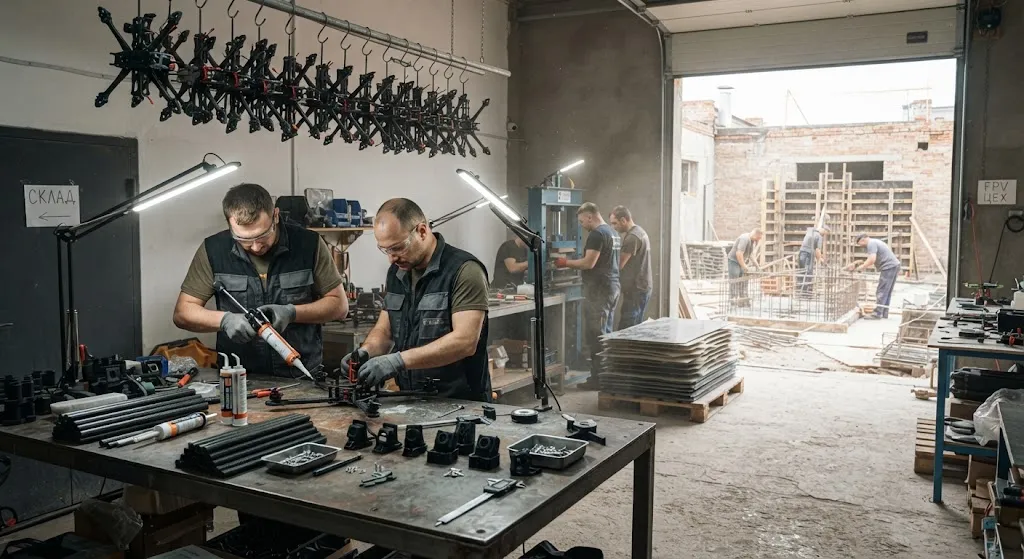
The first and most visible stream is unmanned systems. Ukraine's drone industry scaled from workshop assembly to industrial output lines within two years, and reported annualized production of FPV systems now runs into the hundreds of thousands of units. The composite content is small per unit but enormous in aggregate: carbon fiber tubes for arms and booms, molded shells for fuselages, and lightweight camera and payload mounts are consumed by the hundreds of thousands of pieces per year. Delivery cycles are measured in days, and the supply chain values consistent, machine-usable tow and tube stock over premium certification.
| Unmanned category | Typical airframe materials | Volume profile | Key buyer requirements |
|---|---|---|---|
| FPV strike systems | Carbon tubes, molded shells, 3D-printed mounts | Very high, continuous | Low cost, consistent tolerance, fast delivery |
| Long-range ISR drones | Carbon laminate wings, epoxy prepreg | Medium, batch | Light weight, fatigue reliability, documentation |
| Naval unmanned surface vehicles | Glass/carbon hybrid hulls, radomes | Growing batches | Corrosion resistance, repairability in field |
What distinguishes this stream from classic aerospace demand is tolerance: airframes are expected to survive short service lives, be repaired locally, and be replaced quickly. Suppliers that can deliver clean, consistent reinforcement at scale without burdensome certification overhead match the market's operating reality best.
Armor and Protection Localization
The second stream is ballistic protection, and it is undergoing localization. Body armor plates, vehicle spall liners, demining suits and shelter panels are increasingly manufactured in Ukraine from imported fiber and locally produced resin systems. The policy driver is straightforward: protection is a consumable in high-turnover operations, and import dependency on finished panels is slower and more expensive than importing reinforcement and laying panels onshore. Composite armor programs therefore import carbon and aramid reinforcement, adhesive systems and tooling, then operate their own pressing and curing capacity.
Demand here is less about exotic high-end armor and more about repeatable, certifiable protection that can be produced in batches: soft armor from aramid and hybrid weaves, hard inserts using composite and ceramic combinations, and vehicle liners from glass-reinforced systems with predictable ballistic and fragmentation performance. Buyers run standardized test procedures and expect traceable material documentation with every shipment.
Reinforcement supply into this stream has shorter qualification cycles than aerospace but stricter traceability than commodity trade. Buyers sample and test each delivered lot against a defined ballistic standard, and they expect certificate-of-conformance documentation to travel with every shipment. Margins are set by repeatability: the producers who win tenders deliver identical panels batch after batch, which makes process control at the layup and curing stage the competitive differentiator rather than material novelty.
Reconstruction-Driven Demand
The third stream is the one with the longest horizon: reconstruction. Bridges, housing blocks, schools, hospitals and industrial facilities are being repaired or rebuilt across the country, and the reconstruction pipeline is expected to run for years. Two composite product families feature prominently. The first is FRP rebar — glass and carbon reinforcement rods used in concrete decks, retaining walls and foundations, chosen for corrosion resistance in chloride-rich environments and for speed of logistics over traditional steel. The second is CFRP strengthening — adhesive-bonded carbon sheets and plates applied to damaged concrete columns, beams and slabs to restore load capacity without demolition.
Reconstruction demand behaves like a sovereign procurement market: standards must be met, delivery schedules are tied to funding tranches, and competitive tenders favor materials with existing track records. Because the work is spread across hundreds of individual sites rather than concentrated in factory programs, the supply chain prizes standardization, availability of small-batch deliveries and technical support that can reach site engineers.
The economics of FRP rebar in reconstruction are driven as much by logistics as by material cost. Reinforcing bar must reach hundreds of dispersed construction sites, each with its own schedule; composite rebar is lighter per meter than steel, easier to transport in mixed loads, and does not corrode while waiting on site in damp storage. For owners funding repairs through fixed tranches, the corrosion argument converts into a maintenance-budget argument: a chloride-exposed structure reinforced once with FRP postpones the next repair cycle by decades.
How Suppliers Should Engage
The three streams reward different commercial behaviors, but a common preparation checklist applies to suppliers entering the market:
- Pre-qualify documentation: Ukrainian defense and reconstruction buyers run standardized material tests; prepare tensile, ballistic and durability data sheets in advance rather than compiling them per tender.
- Plan for mixed order sizes: drone buyers want continuous small-lot supply, armor buyers want batch runs, and reconstruction buyers want project-sized deliveries — a flexible logistics setup matters more than a single large capacity.
- Accept tighter payment structures: public reconstruction funding and defense procurement both favor staged payment and bankable contractual documentation.
- Partner with EU frameworks: several reconstruction programs are funded or co-delivered through European channels, so EU-framework registration amplifies access.
- Offer field support: installation training for FRP rebar and strengthening systems reduces site errors and builds long-term customer loyalty in a market that values practical reliability.
Suppliers that combine consistent material quality with flexible logistics and local technical support will find the Ukrainian market reserved for them; those that treat it as a conventional export territory will spend most of their time reconciling expectations.
Frequently Asked Questions
What composite components does Ukraine actually need now?
Current demand concentrates in three areas: drone airframes and mounts (carbon tubes, molded shells, lightweight camera and payload structures consumed at very high volume), ballistic protection (aramid and hybrid soft armor, composite hard inserts, glass-reinforced vehicle liners produced through localization programs), and reconstruction materials (FRP rebar for concrete, CFRP strengthening sheets and plates for damaged structures). The first stream is continuous and fast-moving, the second is batch-oriented with certification requirements, and the third follows sovereign procurement cycles tied to funding tranches.
How does reconstruction demand differ from drone demand?
Reconstruction demand behaves like a sovereign procurement market: it follows standards, ties delivery to funding tranches, and favors materials with existing track records across hundreds of individual sites rather than factory programs. Drone demand, by contrast, is continuous, fast-moving and values consistent, machine-usable reinforcement with minimal certification overhead and delivery cycles measured in days. The two streams need different logistics, different documentation and different commercial terms, which is why suppliers should treat them as separate accounts rather than a single Ukrainian market.
What should a composites exporter prepare before serving the Ukrainian market?
Three preparations matter most. First, pre-qualify material documentation — tensile, ballistic and durability data aligned with the standardized test procedures local buyers run. Second, build a logistics setup that tolerates mixed order sizes, from small continuous drone lots to project-sized reconstruction deliveries. Third, establish flexible payment structures and, where possible, EU-framework registration, since much reconstruction funding is co-delivered through European channels. Field support — installation training for FRP systems — additionally differentiates suppliers in a market that prizes practical reliability.
Conclusion
Ukraine has become a distinct and fast-moving node in the European composite landscape, pulling carbon and glass fiber through three parallel demand streams. Drone mass production consumes lightweight airframes at volume and at speed; armor localization moves ballistic protection manufacturing onshore around imported reinforcement; and reconstruction programs specify FRP rebar and CFRP strengthening across a multi-year pipeline. Each stream has its own buyers, materials and commercial rhythms, and each rewards suppliers who bring clean documentation, flexible logistics and field-ready technical support.
To discuss material programs for drone production, armor localization or reconstruction projects, review our carbon fiber and FRP product range or contact our engineering team for specification support and supply planning.
Part of topic
Related Articles
- Recycled Carbon Fiber Market Forecast 2030: Technology Maturity and Commercialization Path
- South Korea Carbon Fiber Market 2026: Hydrogen Economy and Shipbuilding Innovation
- Wind Turbine Blade Leading Edge Protection 2026: Polyurethane, Tape, and Metallic Shield Solutions
- China Carbon Fiber Overcapacity 2026: Price War Impact and Industry Consolidation
- India Carbon Fiber Market 2026: Wind Energy, Aerospace, and Defense Expansion
- PAN Precursor Market 2026: Acrylonitrile Supply and Carbon Fiber Cost Structure
Interested in Our Products?
Contact our team for competitive pricing and technical specifications.
Get a QuoteRelated Products

Carbon Fiber Plate — 3K Twill T700 1.5mm
Thin 1.5mm carbon fiber plate with 3K twill weave surface. Lightweight and stiff, commonly used for covers, panels, drone bodies, and applications requiring a premium aesthetic appearance.
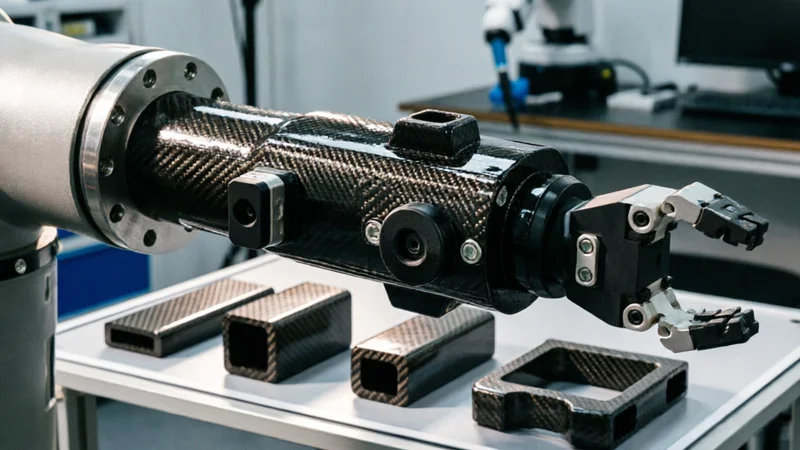
Carbon Fiber Robot End Effector Link — Custom Shape & Sensor Integration
Custom-shaped carbon fiber end effector links for robotic arms. Designed for automation integrators and research labs requiring lightweight, rigid connections between the robot wrist and gripper/tool. Can incorporate sensor mounting bosses, cable routing channels, and quick-change interfaces.

Custom Carbon Fiber Musical Instrument Parts
Carbon fiber components for musical instrument manufacturing offering superior dimensional stability, low weight, and consistent acoustic properties. We produce carbon fiber bows, guitar necks, violin chin rests, drum shells, and wind instrument bodies. Carbon fiber instruments are immune to humidity changes and temperature fluctuations that affect wooden instruments.

Carbon Fiber Tablet Case — Ultra-Light Protective Shell
Lightweight carbon fiber protective case for tablets and iPads. Molded from T700 3K prepreg with reinforced corner protection. Adds minimal weight while providing superior rigidity and drop protection compared to polycarbonate or silicone cases. Ideal for field workers, enterprise deployments, and professionals requiring durable tablet protection.
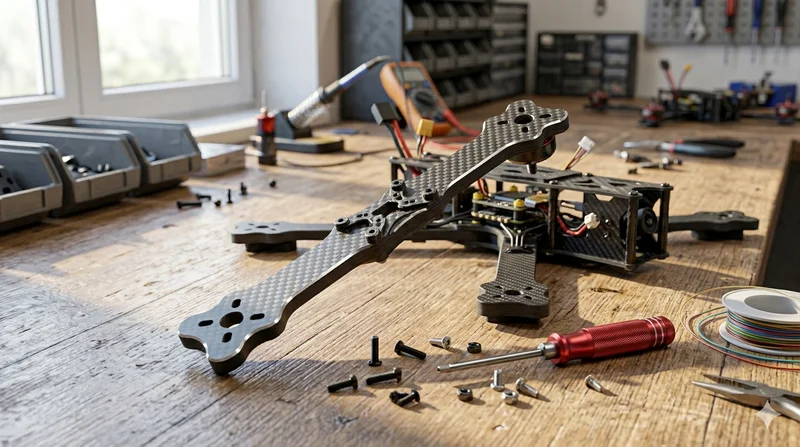
Carbon Fiber Drone Arm
Precision-molded carbon fiber drone arm combining unidirectional fiber for stiffness and woven layers for torsional strength. Designed for FPV, photography, and industrial drone platforms. Each arm is CNC-machined to exact specifications.