
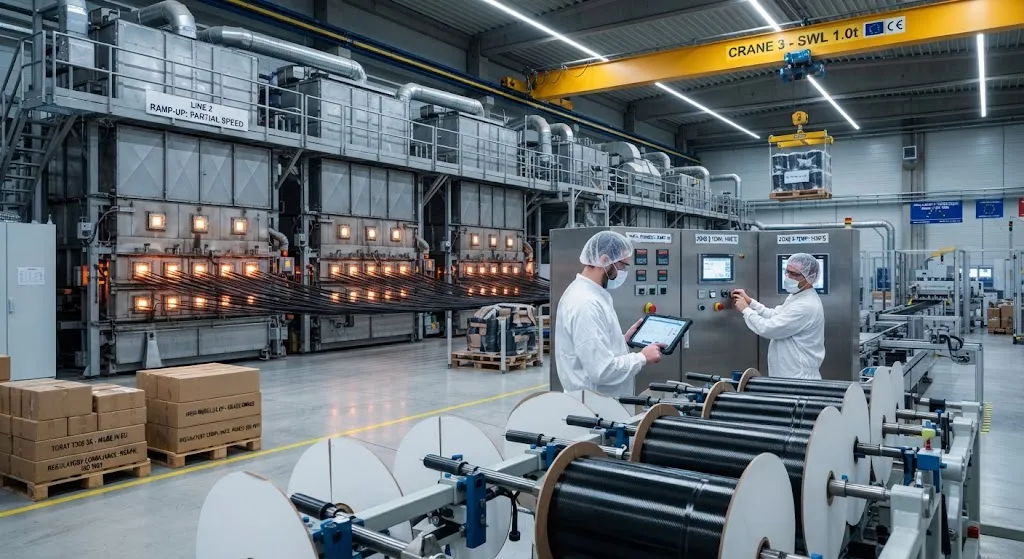
Toray Carbon Fibers Europe is completing one of the most significant capacity developments on the continent in recent years: the expansion of its Abidos, France, plant from 5,000 to 6,000 tonnes of annual carbon fiber output, backed by a new production line covering T300 standard-modulu
Introduction
Toray Carbon Fibers Europe is completing one of the most significant capacity developments on the continent in recent years: the expansion of its Abidos, France, plant from 5,000 to 6,000 tonnes of annual carbon fiber output, backed by a new production line covering T300 standard-modulus and high-modulus grades. The line is scheduled to reach full production in the second half of 2026. For European composite buyers, the development matters beyond the tonnage figure — it reshapes lead times for aerospace-grade tow, strengthens localized supply security, and widens the range of high-modulus products available from a domestic source.
This article examines what the Abidos expansion actually delivers, why regional capacity has become a strategic purchasing consideration, and how the T300 and high-modulus ramp-up changes the sourcing landscape for manufacturers across aerospace, industrial, and sporting goods applications.
The Abidos Facility and Its Role in European Supply
The Abidos plant, located in the Adour valley of southwestern France, began operations in the early 1980s as the continent's first dedicated carbon fiber production site, producing T300 tow for aerospace and industrial customers. Over four decades it has become the anchor of European carbon fiber manufacturing, supplying consumers across the aerospace supply chain, wind energy, pressure vessels, and specialty sports equipment. The facility operates precursor conversion, carbonization, and surface treatment in one integrated complex, which keeps quality control and traceability within a single site.
The plant's European location is itself a commercial asset. Carbon fiber is classified as a strategic material in most industrial economies, and a production site inside the European Union avoids the freight, customs, and compliance friction that accompanies transoceanic sourcing. For aerospace programs with stringent material traceability requirements, a domestic manufacturer shortens the documentation chain and simplifies audits by customers and certification bodies.
What the 6,000-Ton Expansion Adds
The expansion adds a new production line that raises nameplate capacity from 5,000 to 6,000 tonnes per year. The line is configured around two grade families with distinct technical profiles:
- T300 standard-modulus tow: the workhorse grade for primary aerospace structure, industrial rollers, and general composite use, offering 3,530 MPa tensile strength and 230 GPa modulus at a density of 1.76 g/cm³. Its long qualification history in aerospace programs makes it the default choice where proven allowables matter more than ultimate performance.
- High-modulus grades: higher-stiffness fibers with moduli in the 290-395 GPa range, used where stiffness-to-weight ratio drives design — satellite structures, aerospace control surfaces, wind turbine spar caps, and high-performance sporting goods.
| Parameter | Current Abidos Capacity | After Expansion | Change |
|---|---|---|---|
| Annual nameplate capacity (t/yr) | 5,000 | 6,000 | +1,000 |
| Grade families on site | T300 and selected standard grades | T300 + high-modulus family | Expanded |
| Full production target | Baseline | H2 2026 | Ramp-up phase |
| Typical tow sizes available | 1K, 3K, 6K, 12K | 1K, 3K, 6K, 12K, 24K | Wider range |
| Primary served industries | Aerospace, industrial | Aerospace, industrial, wind, sporting goods | Broadened |
The composition of the added line matters as much as its size. By pairing the mature T300 platform with high-modulus capability on European soil, the expansion reduces the continent's historical dependence on Asian and North American sources for stiffness-critical grades — a segment where buyers previously accepted long cross-continental lead times.
Why European Capacity Matters for Buyers
Regional capacity changes several variables in the purchasing equation. The most tangible is lead time. A European buyer sourcing T300 from an Asian plant typically plans on 6-10 weeks of transit and port handling on top of production scheduling; a domestic line compresses that to days of trucking after the fiber leaves the plant. For manufacturers running just-in-time composite operations, this shortens the raw material pipeline from months to weeks and reduces the working capital locked in inventory.
| Sourcing Variable | Imported Tow (Asia to Europe) | Domestic Abidos Supply |
|---|---|---|
| Typical order-to-dock lead time | 6-10 weeks | 1-2 weeks |
| Freight and customs exposure | Ocean freight, duties, port handling | Minimal |
| Currency and trade-policy risk | Higher | Lower |
| Traceability and audit convenience | Longer documentation chain | Short, single-site chain |
| CO2 footprint of logistics | Higher | Lower |
The second benefit is resilience. Disruptions — port congestion, freight cost spikes, trade policy shifts, or supplier-side production issues — affect imported fiber first. A European anchor capacity gives buyers a hedge that does not appear on a price sheet but protects the continuity of production. For industries with regulated supply chains, such as aerospace and defense, this resilience argument increasingly outweighs small price differences.
High-Modulus Grades and Where They Fit
The high-modulus portion of the line addresses a specific market gap. Intermediate and high-modulus fibers — those above roughly 290 GPa — historically came from a handful of Asian suppliers, and European buyers faced an uncomfortable choice between premium lead times and performance compromises. The Abidos expansion changes the calculus for several application groups:
- Satellite and space structures: high-stiffness, low-distortion panels and optical benches where modulus drives dimensional stability under thermal cycling.
- Aerospace control surfaces: trailing-edge and aileron components where deflection limits, rather than strength, dictate the laminate design.
- Wind turbine spar caps: blades growing toward 100 meters and beyond, where spar stiffness translates directly into annual energy production.
- High-performance sporting goods: premium golf shafts, bicycle frames, and rackets where buyers pay for stiffness-gradient architectures.
For each of these, the availability of a domestic high-modulus source shortens development cycles — prototype tow can be obtained in days rather than months, and production qualification can proceed against a supplier whose audit trail is within the same regulatory zone as the manufacturer.
European demand for high-modulus fiber is compounding from several directions at once. Satellite constellations operating under European licenses require stiff, dimensionally stable panels; wind turbine designers specify higher-modulus spar caps for blades beyond 100 meters; and premium sporting goods brands continue to migrate stiffness-critical frames to the highest available grades. Squeezed against a limited number of qualified suppliers, this demand has kept high-modulus lead times long and prices firm — the gap the Abidos line is positioned to close.
What Buyers Should Do Now
For purchasing teams, the ramp-up justifies a structured response rather than a wait-and-see approach. First, requalify the grade portfolio: review which current specifications are met by T300 and high-modulus grades available from Abidos, and initiate supplier qualification early, since aerospace material qualification typically spans 6-12 months. Second, re-run total cost models with the new lead-time and resilience assumptions — inventory carrying cost and disruption risk belong in the comparison, not just unit price. Third, if high-modulus demand is in your medium-term roadmap, engage the supplier on allocation now, because initial ramp-up output will favor established aerospace contracts before spot buyers.
Frequently Asked Questions
When will the new Abidos carbon fiber line reach full capacity?
According to the announced schedule, the new line reaches full production during the second half of 2026, raising the plant's nameplate capacity from 5,000 to 6,000 tonnes per year. Ramp-up output typically starts flowing to qualified customers before the official full-capacity date, so buyers with existing qualification standing the supplier may secure early allocation.
Which carbon fiber grades will be produced on the new line?
The line is configured around two grade families: T300 standard-modulus tow — the aerospace workhorse at 3,530 MPa strength and 230 GPa modulus — and high-modulus grades up to roughly 395 GPa. The high-modulus segment is the strategically significant addition, since stiffness-critical fibers were previously sourced mostly from Asia.
How much will the expansion reduce European order lead times?
For domestic supply, order-to-dock lead time typically compresses from 6-10 weeks for imported tow to 1-2 weeks for fiber delivered from the Abidos plant. The practical benefit extends further: shorter planning horizons reduce safety stock, cut working capital, and make just-in-time composite operations feasible for a wider range of manufacturers.
Conclusion
The Abidos expansion to 6,000 tonnes per year, with its T300 and high-modulus line reaching full production in the second half of 2026, strengthens European carbon fiber supply at exactly the point where buyers feel it most: shorter lead times, a domestic source for stiffness-critical grades, and a more resilient purchasing position. For composite manufacturers, the window to qualify and reallocate is open now — aerospace-grade qualification takes months, and early ramp-up output will be committed first.
Whether your program runs on T300-class tow or demands the stiffness of high-modulus fiber, a capable domestic partner shortens the path from design to production. Review our carbon fiber and composite product range, or contact our engineering team to discuss grade selection, qualification support, and supply planning for your next program.
Part of topic
Related Articles
- Recycled Carbon Fiber Market Forecast 2030: Technology Maturity and Commercialization Path
- South Korea Carbon Fiber Market 2026: Hydrogen Economy and Shipbuilding Innovation
- Wind Turbine Blade Leading Edge Protection 2026: Polyurethane, Tape, and Metallic Shield Solutions
- China Carbon Fiber Overcapacity 2026: Price War Impact and Industry Consolidation
- India Carbon Fiber Market 2026: Wind Energy, Aerospace, and Defense Expansion
- PAN Precursor Market 2026: Acrylonitrile Supply and Carbon Fiber Cost Structure
Interested in Our Products?
Contact our team for competitive pricing and technical specifications.
Get a QuoteRelated Products
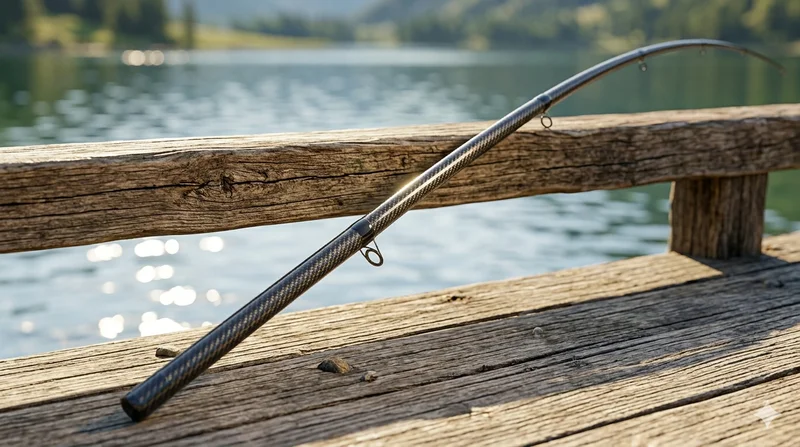
Carbon Fiber Fishing Rod Blank
High-quality carbon fiber fishing rod blank manufactured from multiple grades of Toray carbon fiber cloth. Available in a wide range of lengths, powers, and actions for freshwater and saltwater applications. Suitable for OEM rod building.
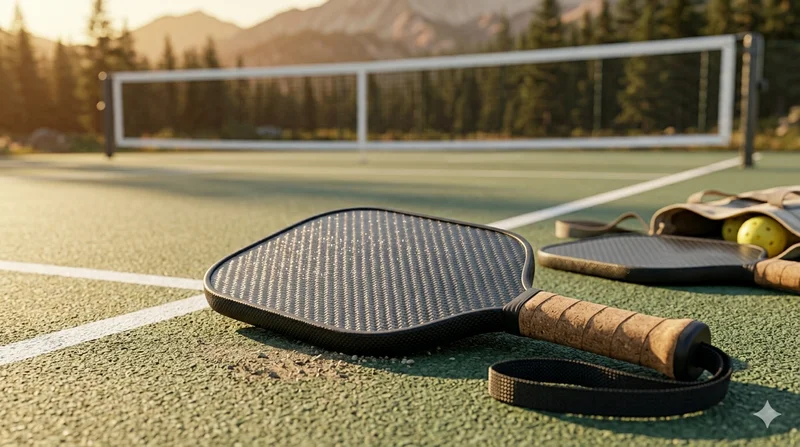
Carbon Fiber Pickleball Paddle
High-performance pickleball paddle with Toray T700 carbon fiber face and polypropylene honeycomb core. Delivers excellent power-to-weight ratio, spin generation, and vibration dampening for competitive play.
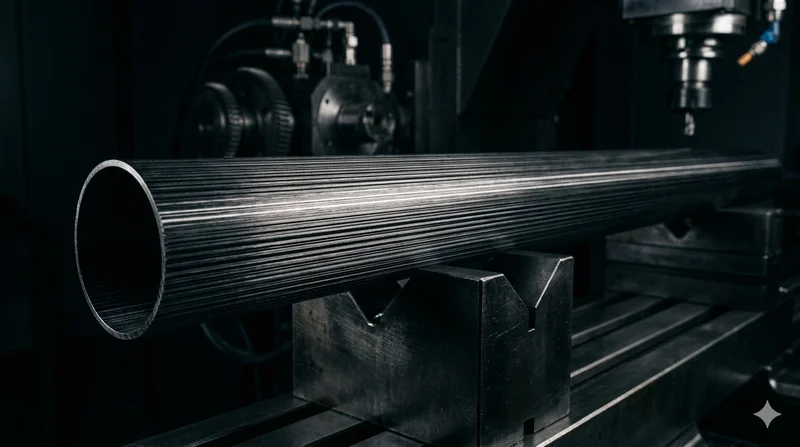
Round Carbon Fiber Tube — UD Unidirectional T700
Unidirectional (UD) round tube with all fibers aligned axially for maximum longitudinal stiffness. Ideal for applications requiring high bending rigidity with minimal weight, such as shafts, struts, and structural reinforcements.
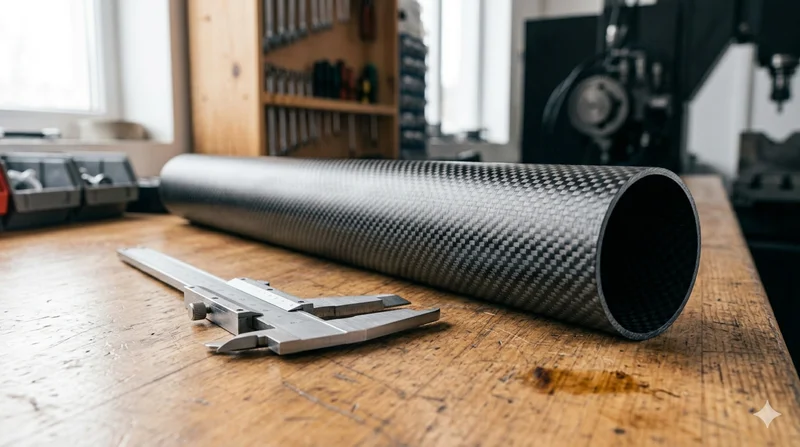
Round Carbon Fiber Tube — 3K Plain Weave T700
Standard round carbon fiber tube manufactured from Toray T700 grade fiber with 3K plain weave. Offers balanced strength and stiffness for general industrial applications including robotics, automation, sports equipment, and aerospace structures.
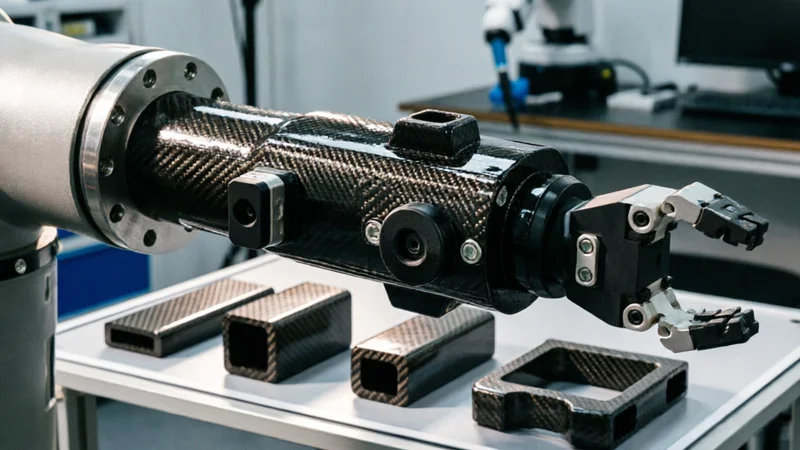
Carbon Fiber Robot End Effector Link — Custom Shape & Sensor Integration
Custom-shaped carbon fiber end effector links for robotic arms. Designed for automation integrators and research labs requiring lightweight, rigid connections between the robot wrist and gripper/tool. Can incorporate sensor mounting bosses, cable routing channels, and quick-change interfaces.