
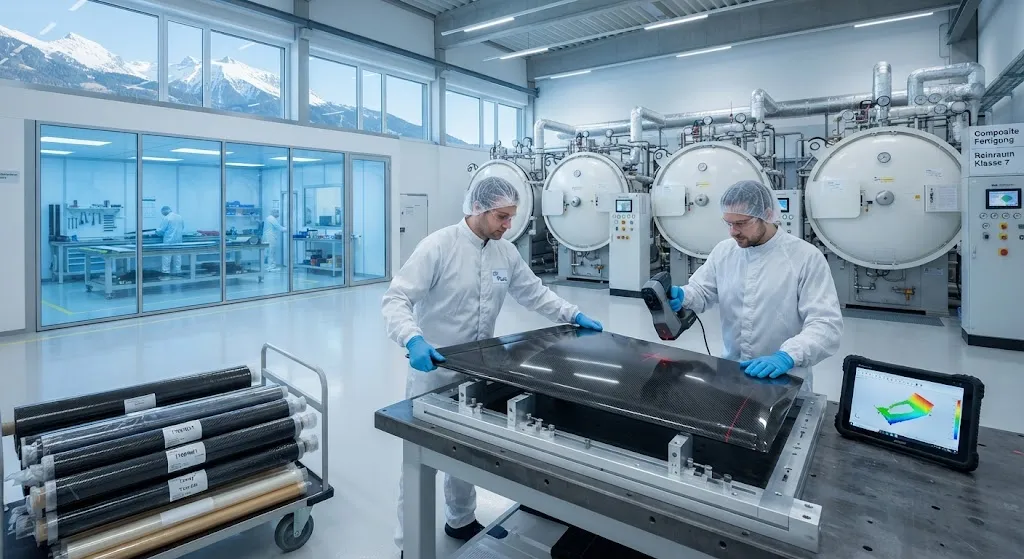
In mid-2026 Pilatus Aircraft commissioned a new composite production center at its Stans headquarters in Switzerland — a CHF 100 million facility, roughly USD 123 million, named Schwarzhorn after the peak of the Bernese Oberland that overlooks the factory floor. The investment is one of
Introduction
In mid-2026 Pilatus Aircraft commissioned a new composite production center at its Stans headquarters in Switzerland — a CHF 100 million facility, roughly USD 123 million, named Schwarzhorn after the peak of the Bernese Oberland that overlooks the factory floor. The investment is one of the largest single commitments to carbon fiber airframe production ever made by a business-jet manufacturer, and it arrives at a moment when the company's order books for the PC-24 light jet and the PC-12 turboprop are at record levels.
This article explains what the Schwarzhorn center contains, why Pilatus is making primary structural parts from composites rather than metals, and what the facility's design — including its LEED Platinum certification — says about the future direction of aerospace composite manufacturing.
Why Pilatus Is Expanding Composite Capacity
Pilatus has used composites for decades, but historically for secondary structures: fairings, radomes, cabin interiors, and control surfaces that carry lower load levels. The PC-24, which entered service in 2018, changed the equation because its design pushed composite parts into primary structural territory — control surfaces and empennage elements that carry flight loads and must meet certification evidence standards comparable to metal parts.
Three pressures drove the expansion:
- Order backlog: the PC-24's short-field performance and cargo-door configuration have made it a best-seller in the light-jet segment, and the PC-12 remains the best-selling single-engine turboprop of its class; both need parts now at higher rates.
- Weight economics: every kilogram saved on structural parts returns as payload or range, and for short-field operators both are the competitive argument Pilatus sells.
- Vertical integration: bringing composite fabrication in-house gives Pilatus control over quality, schedule, and cost that subcontracting could not match at forecast volumes.
The result is a dedicated plant sized not for prototypes but for serial production — a deliberate move from research-scale composites to industrial-scale ones.
Inside the Schwarzhorn Composite Center
The Schwarzhorn center is a production facility organized around the full composite process chain. Layup takes place in temperature- and humidity-controlled cleanrooms, where prepreg is cut, kitted, and stacked under documented conditions. Curing happens in large autoclaves sized to accept complete control-surface assemblies, supported by trimming, drilling, and non-destructive testing cells downstream. The building also houses engineering offices and process-laboratory space, so that manufacturing engineers sit beside the production lines they support.
| Capability | Legacy Production (before Schwarzhorn) | Schwarzhorn Center |
|---|---|---|
| Facility scale | Dispersed composite cells inside aircraft halls | Dedicated 15,000+ square meter composite plant |
| Cleanroom layup | Controlled but shared environment | Purpose-built, climate-conditioned layup halls |
| Curing capacity | Small autoclaves for secondary parts | Large autoclaves for full control-surface assemblies |
| Workforce | Composite team shared across programs | Roughly 300 staff dedicated to composite manufacturing |
| Certification target | Secondary structure evidence | Primary structural part qualification |
The scale difference matters commercially. A control surface that previously queued behind other programs for autoclave time now has dedicated capacity, which shortens lead times and lets Pilatus absorb new orders without displacing existing production.
Primary Structural Control Surfaces on the PC-24
The technical centerpiece of the program is the use of carbon fiber for primary structural control surfaces on the PC-24 — the elevators, rudder, and related empennage elements that transmit flight loads into the fuselage. These parts sit in a different certification class than fairings: a failure affects the aircraft's controllability, so the material and process evidence must match the proof required of metal parts, including strength allowables, fatigue behavior, and damage tolerance.
Composites earn that qualification on the PC-24 for two reasons. First, the stiffness-to-weight ratio of carbon fiber laminates lets designers tune the mass balance of control surfaces precisely — important for flutter margins and for minimizing the weight that must be carried on the tail. Second, the ability to co-cure and bond sub-elements into a single part removes dozens of fasteners and brackets, cutting both weight and assembly labor. The result is a control surface that is lighter, has fewer parts, and is produced with less touch time than the metallic or hybrid versions it replaced.
For operators, the practical benefit is range and payload on short fields; for the factory, it is a qualification template that Pilatus can apply to the next program rather than starting from scratch.
Sustainability and the LEED Platinum Design
One detail of the Schwarzhorn announcement drew attention beyond the composite industry: the facility is designed and certified to LEED Platinum, the highest rating in the green-building standard. For an energy-intensive process like autoclave curing, this is not cosmetic. The building recovers process heat, manages compressed-air and ventilation loads, and uses the Swiss alpine climate to reduce cooling demand, so that the facility's carbon footprint per kilogram of part is measurably lower than a conventional plant's.
LEED Platinum also carries a commercial message. Aerospace OEMs are increasingly asked by airlines, lessors, and governments for environmental credentials, and a composite manufacturer that can document its own manufacturing footprint is better positioned in procurement conversations. Pilatus is sending a signal that composite airframes are not just a weight play but a lifecycle-sustainability play — the lighter aircraft burns less fuel, and the plant that builds it runs cleaner as well.
What It Means for the Composite Supply Chain
For suppliers of prepreg, honeycomb, films, and tooling, the Schwarzhorn center represents a durable new volume and a demanding one. A facility with hundreds of staff and dedicated autoclaves consumes material at a steady rate, which supports long-term supply agreements; equally, its certification regime demands material batch consistency and documented quality evidence that only qualified suppliers can provide. Companies that can hold aerospace-grade traceability and rock-steady batch quality will find themselves aligned with Pilatus's expansion, while those that cannot will be screened out by qualification.
The broader lesson is about the direction of the industry. When a conservative, cash-disciplined private manufacturer like Pilatus invests nine figures in in-house carbon fiber primary structure, it confirms that composite airframe technology has crossed from niche to mainstream in business aviation. That shift pulls the whole supply chain — materials, automation, tooling, NDT — toward higher volumes and industrial methods.
Frequently Asked Questions
What is the Schwarzhorn composite center?
It is Pilatus Aircraft's new CHF 100 million composite production facility at its Stans, Switzerland headquarters, named after a peak in the Bernese Oberland. The center houses cleanroom layup halls, large autoclaves, trimming and non-destructive testing cells, and engineering support space, with roughly 300 staff dedicated to composite manufacturing. It produces primary structural composite parts for the PC-24 and supports PC-12 production in a plant certified to LEED Platinum.
Are the PC-24 control surfaces really primary structure?
Yes. The elevators and rudder on the PC-24 are flight-load-carrying elements whose failure would affect controllability, which places them in the primary-structure certification class. They are built from carbon fiber laminates with co-cured or bonded sub-elements, and they carry the same strength, fatigue, and damage-tolerance evidence requirements as equivalent metal parts — which is precisely why the qualification work done at Schwarzhorn is reusable across future programs.
Why is LEED Platinum significant for a composite factory?
Because autoclave curing and cleanroom air handling are energy-intensive, a LEED Platinum plant is engineered to recover process heat, balance ventilation and compressed-air loads, and minimize cooling demand — measurably lowering the carbon footprint per kilogram of part. Beyond the engineering, the certification is a commercial credential: airlines, lessors, and governments increasingly ask OEMs for environmental documentation, and Pilatus can now point to its own manufacturing footprint, not just the fuel savings of its aircraft.
Conclusion
The Schwarzhorn composite center is a statement of where Pilatus believes airframe manufacturing is heading. By committing CHF 100 million to dedicated, clean, high-volume carbon fiber production for primary structure, the company is betting that composites are not an option for business aviation but the baseline. The facility's qualification work on PC-24 control surfaces becomes a reusable template, and its LEED Platinum design makes sustainability part of the manufacturing case rather than an afterthought.
For composite material suppliers and engineering partners, the expansion signals long-term demand for consistent, certified aerospace-grade materials and process support. Explore our carbon fiber prepreg and composite material range or contact our technical team to discuss material systems and qualification support for primary aerospace structures.
Related Articles
- Recycled Carbon Fiber Market Forecast 2030: Technology Maturity and Commercialization Path
- South Korea Carbon Fiber Market 2026: Hydrogen Economy and Shipbuilding Innovation
- Wind Turbine Blade Leading Edge Protection 2026: Polyurethane, Tape, and Metallic Shield Solutions
- China Carbon Fiber Overcapacity 2026: Price War Impact and Industry Consolidation
- India Carbon Fiber Market 2026: Wind Energy, Aerospace, and Defense Expansion
- PAN Precursor Market 2026: Acrylonitrile Supply and Carbon Fiber Cost Structure
Interested in Our Products?
Contact our team for competitive pricing and technical specifications.
Get a QuoteRelated Products
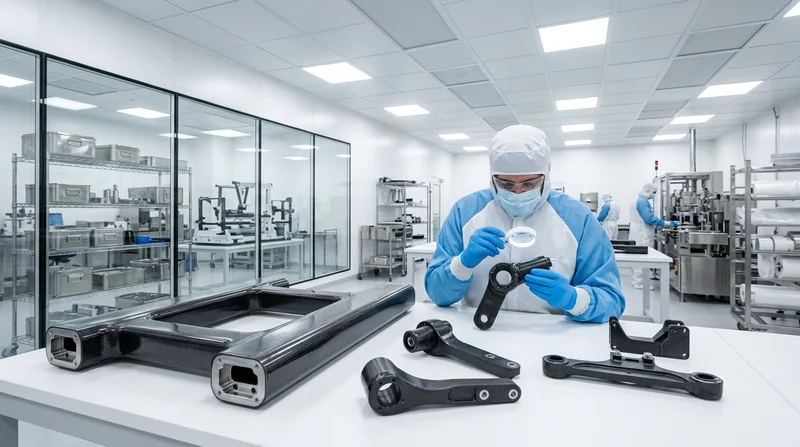
Custom Carbon Fiber Medical Device Components
Medical-grade carbon fiber components manufactured for imaging equipment, surgical instruments, and patient support systems. Carbon fiber's radiolucency (X-ray transparency) and high strength-to-weight ratio make it ideal for CT scanner beds, wheelchair frames, surgical robot arms, and MRI-compatible accessories. Biocompatible resin systems available.
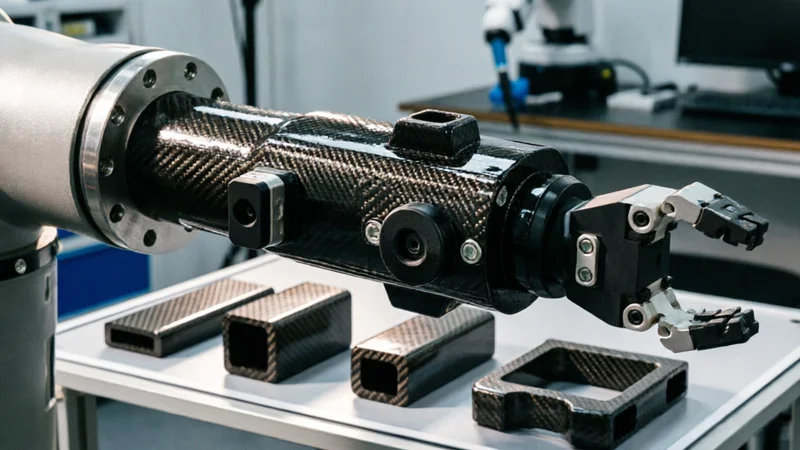
Carbon Fiber Robot End Effector Link — Custom Shape & Sensor Integration
Custom-shaped carbon fiber end effector links for robotic arms. Designed for automation integrators and research labs requiring lightweight, rigid connections between the robot wrist and gripper/tool. Can incorporate sensor mounting bosses, cable routing channels, and quick-change interfaces.
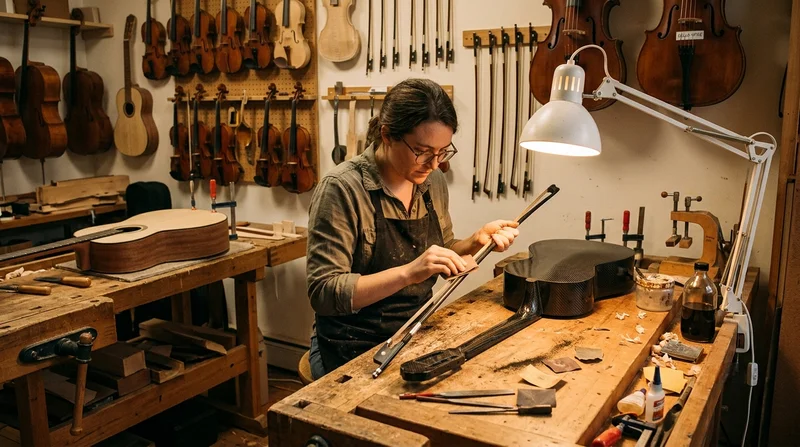
Custom Carbon Fiber Musical Instrument Parts
Carbon fiber components for musical instrument manufacturing offering superior dimensional stability, low weight, and consistent acoustic properties. We produce carbon fiber bows, guitar necks, violin chin rests, drum shells, and wind instrument bodies. Carbon fiber instruments are immune to humidity changes and temperature fluctuations that affect wooden instruments.
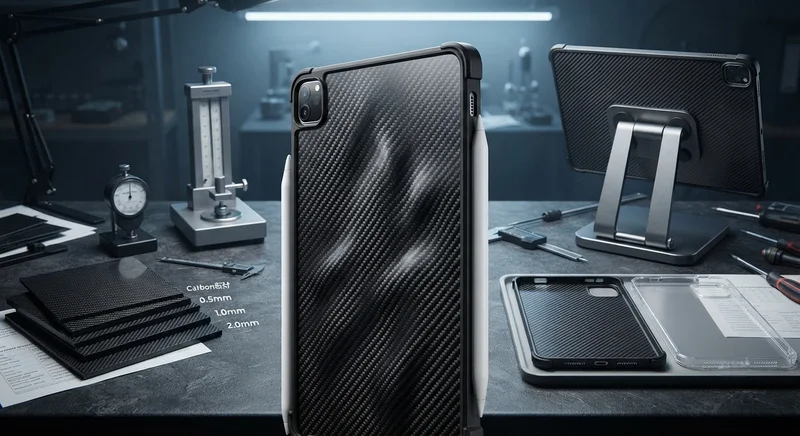
Carbon Fiber Tablet Case — Ultra-Light Protective Shell
Lightweight carbon fiber protective case for tablets and iPads. Molded from T700 3K prepreg with reinforced corner protection. Adds minimal weight while providing superior rigidity and drop protection compared to polycarbonate or silicone cases. Ideal for field workers, enterprise deployments, and professionals requiring durable tablet protection.
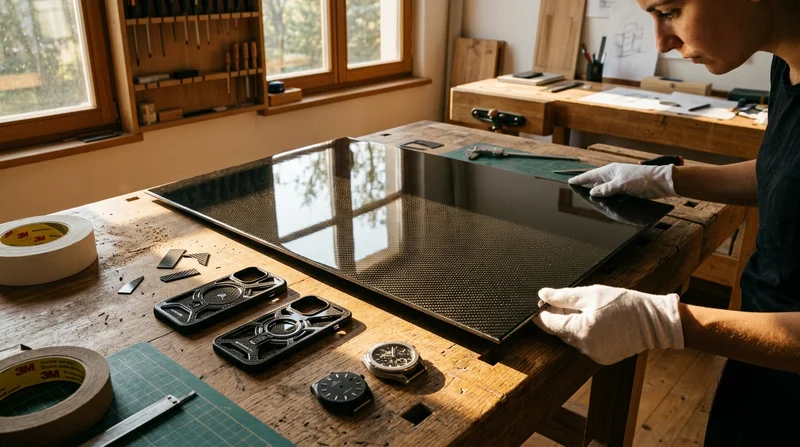
Carbon Fiber Plate — High-Gloss Decorative
High-gloss decorative carbon fiber plate with a mirror-like surface finish. The glossy coating enhances the visible 3K twill weave, creating a premium aesthetic for consumer-facing applications. Lightweight yet stiff, available in thin gauges for easy cutting and forming.