
Mexico has become the Americas' most active destination for nearshored manufacturing, and its carbon fiber market is growing on the back of that shift. Aerospace investment has concentrated around Querétaro, where multinational OEMs and their Tier 1 suppliers now assemble wing structure
Introduction
Mexico has become the Americas' most active destination for nearshored manufacturing, and its carbon fiber market is growing on the back of that shift. Aerospace investment has concentrated around Querétaro, where multinational OEMs and their Tier 1 suppliers now assemble wing structures, helicopter fuselages, and engine components that increasingly specify carbon fiber. The automotive sector, producing well over three million light vehicles a year for the North American market, is layering composite lightweighting onto a mature Tier-1 parts industry. And the United States-Mexico-Canada Agreement, USMCA, is quietly reshaping sourcing decisions by making regional content a condition of tariff-free access.
For carbon fiber suppliers, Mexico offers proximity to the largest aerospace and automotive markets in the world combined with labor and infrastructure advantages that keep processing costs competitive. Imports supply nearly all domestic fiber demand, because Mexico's own production base is still developing, which creates a stable channel for foreign producers who can serve the country's clusters with reliable logistics and technical support. This article breaks down the demand structure, the content-rule dynamics, and what suppliers need to know to serve Mexican customers.
Aerospace Nearshoring: The Querétaro Cluster
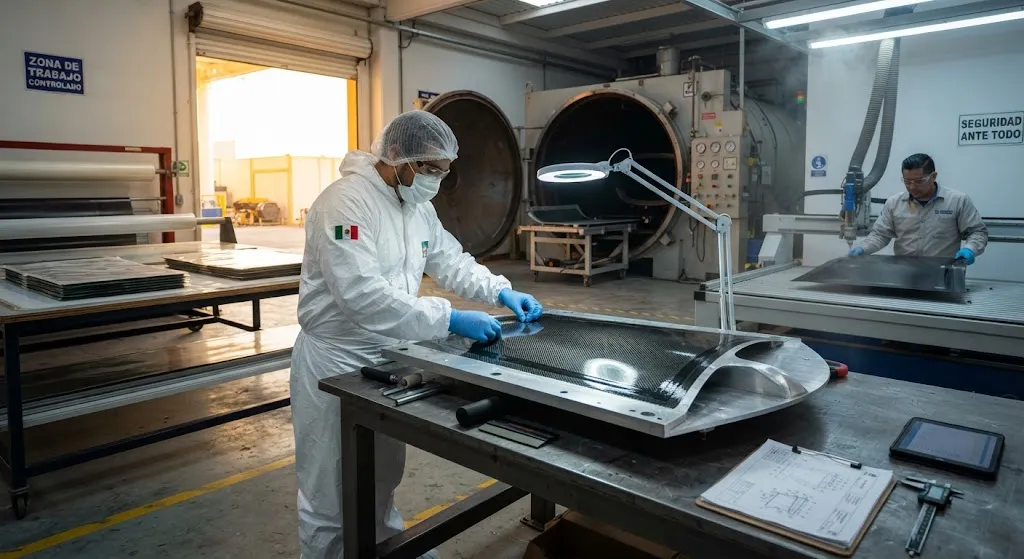
Querétaro has grown into one of the most important aerospace manufacturing hubs in the world, hosting more than one hundred aerospace companies in a single industrial corridor. Bombardier produces aircraft components there, Safran operates engine nacelle and wiring facilities, Airbus maintains helicopter work, and a dense web of Tier 2 and Tier 3 suppliers provides machining, surface treatment, and composite processing. The presence of dedicated composite shops has made the cluster a practical entry point for carbon fiber consumption: prepreg layup, autoclave curing, and CNC machining of composite details all operate within a few kilometers of each other.
| Metric | 2019 | 2025 | 2030 Estimate |
|---|---|---|---|
| Mexico aerospace exports (USD billion) | 9.5 | 11-12 | 15-16 |
| Companies in the Querétaro cluster | 80+ | 100+ | 120+ |
| Share of new programs specifying carbon fiber | 40-50% | 60-70% | 75-85% |
| Domestic carbon fiber demand (t/year) | 600-800 | 1,300-1,500 | 2,200-2,600 |
Beyond Querétaro, aerospace activity extends to Mexicali and Chihuahua in the north, Monterrey in the northeast, and Hermosillo in Sonora. What these clusters share is a workforce trained in aerospace quality culture and a growing appetite for qualified composite materials. For suppliers, the practical consequence is that Mexico is no longer only a low-cost assembly location; it is becoming a certified processing base where qualified prepreg, honeycomb, and adhesive systems command premium pricing.
Automotive Tier-1: Lightweighting Under USMCA Discipline
Mexico's automotive industry produces more than three million light vehicles annually, and its Tier-1 parts sector feeds every major assembly plant in North America. The lightweighting trend that started with luxury vehicles is now reaching the mid-market: pickup trucks, SUVs, and commercial vehicles built in Mexico increasingly use composite components for bed boxes, hoods, roof panels, and structural reinforcements. Electric vehicle programs, which are being established at several Mexican plants, add further pressure because battery weight must be offset with body and chassis mass savings.
Most current Mexican automotive composite consumption is glass fiber, but carbon fiber is entering where performance requirements are highest — premium performance pickups, luxury SUV variants, and motorsport components for the growing regional racing scene. Tier-1 suppliers in Monterrey, Saltillo, and Puebla have installed compression molding and resin transfer molding capacity that can switch between glass and carbon systems, and they are the natural intermediaries for foreign fiber producers: they hold the process know-how, the OEM relationships, and the quality standards, while upstream fiber supply remains imported.
USMCA Content Rules: Reshaping North American Supply
The USMCA rule of origin for light vehicles requires 75% regional value content, and automotive parts face escalating origin requirements over time. For carbon fiber, the practical effect is a growing incentive to localize the entire value chain inside North America: North American fiber production, North American fabric conversion, and North American part manufacturing all count toward regional content, while imported fiber from Asia does not fully qualify. This is reshaping purchasing decisions in ways that favor suppliers with processing presence in the region, such as prepreg or fabric plants in either the United States or Mexico that can certify North American origin.
The aerospace sector has no equivalent rigid content formula under USMCA, but the same nearshoring logic applies through procurement behavior: OEMs and Tier-1s increasingly prefer suppliers inside the hemisphere for security of supply, shorter lead times, and easier collaboration on qualification. The aggregate effect is that Mexico's role in the carbon fiber value chain is shifting from a low-cost assembly spot to an integrated node, where regional content and local processing capability determine supplier selection as much as price.
Supply Chain Dynamics and Sourcing Considerations
Several factors define how carbon fiber supply works in the Mexican market:
- Tariff-free access: Finished composite parts made in Mexico enter the United States and Canada duty-free under USMCA, which makes Mexican processing attractive even when the fiber itself is imported.
- Logistics advantage: Overland logistics on the US-Mexico highway network connect Mexican clusters to the American market in 2-5 days, versus 4-8 weeks for ocean freight from Asia; suppliers who hold regional stock win on responsiveness.
- Quality and certification culture: Aerospace buyers expect NADCAP-style accreditation and AS9100 systems; automotive programs require IATF 16949-aligned process control; documentation matters as much as material price.
- Skilled processing base: Mexico's combination of engineering talent and competitive labor keeps conversion costs low, making the country a profitable processing location for foreign fiber producers seeking to serve North America.
The outlook is strongly positive. Aerospace nearshoring continues to expand as new aircraft programs ramp, automotive lightweighting is spreading from premium models into high-volume vehicles, and USMCA keeps pushing content decisions northward. Industry analysts project mid-single-digit annual growth for Mexican carbon fiber consumption through 2030, with the aerospace cluster contributing the highest-value demand and automotive the largest incremental volume.
Frequently Asked Questions
What is driving carbon fiber demand in Mexico?
Three forces. Aerospace nearshoring concentrates demand around Querétaro and other clusters, where multinational OEMs and Tier-1 suppliers increasingly specify carbon fiber for wing structures, nacelles, and helicopter composite parts. Automotive lightweighting adds volume as Tier-1 suppliers in Monterrey, Saltillo, and Puebla adopt composite hoods, bed boxes, and structural reinforcements for pickup trucks, SUVs, and electric vehicles. And USMCA content rules push supply-chain localization inside North America, rewarding suppliers who can certify regional content and process material locally.
What certifications do suppliers need to serve Mexican customers?
The aerospace cluster is the strictest channel: customers expect AS9100 quality systems, NADCAP-accredited processes where applicable, and full material traceability with qualification cycles of 12-24 months. Automotive Tier-1 suppliers require IATF 16949-aligned process control, PPAP documentation, and consistent batch-to-batch material data. Wind and industrial segments are less demanding but still expect ISO 9001 and complete technical datasheets. Most Mexican customers also value suppliers who can provide bilingual technical support and application engineering, given the proximity to US engineering teams.
How does the Mexican market compare with Brazil and other Latin American markets?
Mexico and Brazil are the two heavyweight markets, but with different profiles. Brazil has the larger wind-driven volume demand and a stronger domestically anchored aerospace OEM network around Embraer, while Mexico has deeper integration with the North American market through USMCA, a larger automotive Tier-1 base, and a nearshoring-driven aerospace cluster that continues to attract new programs. Mexico's logistics to the United States are measured in days, versus weeks for Brazil's ocean routes, which makes Mexican processing particularly attractive for North American buyers. For suppliers, Mexico offers faster market access and more automotive volume, while Brazil offers wind tonnage and a self-contained aerospace ecosystem.
Conclusion
Mexico's carbon fiber market in 2026 is defined by aerospace nearshoring around Querétaro, a mature automotive Tier-1 base under USMCA discipline, and content rules that increasingly reward regional supply. The country has transformed from a low-cost assembly location into an integrated processing node, where qualified fiber, fabric, and prepreg all command premium value when they can be certified as North American content. For suppliers, the winning formula combines competitive pricing with regional stock, USMCA-compliant documentation, and the processing partnerships that connect foreign fiber to North American OEMs.
Whether you are supplying carbon fiber to aerospace clusters, automotive Tier-1 processors, or industrial customers in Mexico, the opportunity is built on regional integration. Explore our carbon fiber product range for aerospace, automotive, and industrial applications, or contact our team to discuss sourcing and North American content strategies for your Mexican program.
Part of topic
Related Articles
- Recycled Carbon Fiber Market Forecast 2030: Technology Maturity and Commercialization Path
- South Korea Carbon Fiber Market 2026: Hydrogen Economy and Shipbuilding Innovation
- Wind Turbine Blade Leading Edge Protection 2026: Polyurethane, Tape, and Metallic Shield Solutions
- China Carbon Fiber Overcapacity 2026: Price War Impact and Industry Consolidation
- India Carbon Fiber Market 2026: Wind Energy, Aerospace, and Defense Expansion
- PAN Precursor Market 2026: Acrylonitrile Supply and Carbon Fiber Cost Structure
Interested in Our Products?
Contact our team for competitive pricing and technical specifications.
Get a QuoteRelated Products

Carbon Fiber Fishing Rod Blank
High-quality carbon fiber fishing rod blank manufactured from multiple grades of Toray carbon fiber cloth. Available in a wide range of lengths, powers, and actions for freshwater and saltwater applications. Suitable for OEM rod building.

Carbon Fiber Plate — 3K Twill T700 3.0mm
Medium-thickness 3.0mm carbon fiber plate offering significantly higher load capacity while maintaining attractive 3K twill finish. Suitable for structural brackets, reinforcement plates, and load-bearing panels.

Carbon Fiber Plate — 3K Twill T700 1.5mm
Thin 1.5mm carbon fiber plate with 3K twill weave surface. Lightweight and stiff, commonly used for covers, panels, drone bodies, and applications requiring a premium aesthetic appearance.

Square Carbon Fiber Tube — 3K Twill T700
Square cross-section carbon fiber tube manufactured with 3K twill weave for torsional strength. Preferred for structural frames, trusses, and support columns where rectangular geometry offers design flexibility.

Carbon Fiber Drone Arm
Precision-molded carbon fiber drone arm combining unidirectional fiber for stiffness and woven layers for torsional strength. Designed for FPV, photography, and industrial drone platforms. Each arm is CNC-machined to exact specifications.