
European composite producers face a regulatory shift that has been years in the making but is arriving quickly. Regulation (EU) 2026/718 sets escalating recycling and recovery requirements for end-of-life composite products, and with it comes a blunt administrative fact: waste cannot be
Introduction
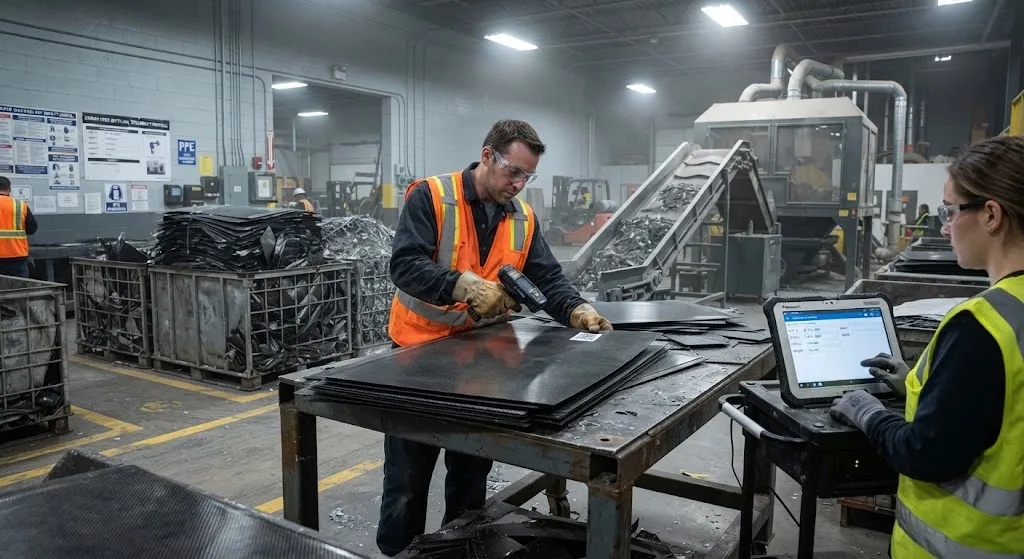
European composite producers face a regulatory shift that has been years in the making but is arriving quickly. Regulation (EU) 2026/718 sets escalating recycling and recovery requirements for end-of-life composite products, and with it comes a blunt administrative fact: waste cannot be recycled at scale if it cannot be classified and traced. A recycling operator cannot plan capacity, buyers cannot contract for feedstock, and regulators cannot verify compliance when a batch of composite waste arrives with no reliable statement of what it contains.
That gap is what EuCIA, the European Composites Industry Association, is working to close. Its initiative pairs EN ISO 1043 material marking with dedicated EU waste codes for composites, creating a classification language that producers, waste operators, and recyclers can share. This article explains the regulatory backdrop, why composites are so hard to classify, how the marking and waste-code system works, and what it means for producers and recyclers.
The Regulatory Context: 2026/718 and the Recycling Mandate
Regulation (EU) 2026/718 is part of a broader European effort to keep materials in use rather than sending them to landfill. For composites, the mandate takes the form of rising recovery-rate targets: a growing share of composite waste — from production offcuts and end-of-life parts alike — must be recovered or recycled rather than disposed of, with the targets phasing up over the coming years and applying across member states through linked waste and product legislation.
- Recovery targets: producers must document the share of their composite waste that is reused, recycled, or recovered, against rising annual thresholds.
- Extended producer responsibility: in several member states, producer-financed schemes are being extended to composite products, which requires waste volumes and destinations to be reported.
- Landfill restrictions: member states are tightening the acceptance criteria for composite waste at landfill, pushing thermoset and fiber-reinforced materials toward recovery routes.
The common thread is data. Every one of these obligations requires a producer to say what the waste is, how much there is, and where it went — which is precisely the information the current system does not reliably capture.
Why Composites Are Hard to Classify
The difficulty is material identity. A steel scrap stream is nearly uniform: the composition is declared by grade and verified by analysis. A composite waste stream can contain carbon fiber in epoxy, polyester, or vinyl ester matrices, with glass or hybrid reinforcement, filled or unfilled, painted or unpainted, cured or semi-cured. Two visually identical panels can have completely different recycling value — one may be carbon-reinforced epoxy worth recovering, the other glass-reinforced polyester with no viable recycling route today.
| Waste Characteristic | Metal Scrap | Composite Waste |
|---|---|---|
| Composition declaration | Grade and chemistry, analytically verified | Matrix and fiber type often unrecorded at part level |
| Sorting feasibility | Easy by magnet, density, and analysis | Visual sorting unreliable; requires part-level documentation |
| Recycling value | Uniform value per tonne | Highly variable by fiber type, grade, and matrix |
| Regulatory tracking | Long-established waste codes | No dedicated codes; forced into generic categories |
| Digital handoff | Standard certificates and lot data | Often a paper trail or none at all |
The consequences are economic. Waste that cannot be confidently classified moves to the cheapest disposal route, which today is usually landfill or incineration, and recyclers are left without the dependable feedstock they need to justify capital investment. Classification is therefore not a paperwork exercise; it is the prerequisite that determines whether recycling markets can form.
EN ISO 1043 Marking and Dedicated Waste Codes
EuCIA's approach has two parts. The first is material marking under EN ISO 1043, the standard series that assigns code numbers to plastics and composites — the same coding language already used for packaging and molded plastic parts. For composites, the coding captures the polymer family (epoxy, polyester, vinyl ester, and others) and the reinforcement, so that a part can carry a machine-readable identity statement such as a reinforced epoxy with carbon fiber and a defined filler level.
The second part is dedicated waste classification. EuCIA is pressing for composite-specific entries in the European Waste Catalogue, so that a stream of carbon-fiber-reinforced thermoset waste is recorded under its own code rather than folded into broad "other plastics" or mixed-fraction categories. A dedicated code does two things at once:
- It makes volume visible: for the first time, the amount of composite waste flowing through European waste systems can be counted, which underpins both policy and investment decisions.
- It creates a market signal: recyclers can see where feedstock exists, set quality expectations, and contract for it, instead of relying on ad-hoc deals.
Marking and waste codes work together: the EN ISO 1043 marking on the part tells the waste operator what the stream contains, and the dedicated waste code lets that information travel through the administrative system in a standardized way.
Digital Traceability and the Road to Recycling Markets
Material marking is only useful if the information survives the journey from part to shredder, which is where digital traceability enters. The EU's Digital Product Passport, being phased in across regulated product categories, is the natural carrier: it can hold the EN ISO 1043 identity, production data, and the material composition that a recycler needs to value a batch. Linked production records, batch identifiers, and waste-handover documents complete the chain.
The economics of traceability are straightforward once markets exist. A recycler who receives a digitally documented batch of carbon-fiber-reinforced epoxy knows its value and can plan the recovery process; one who receives an undocumented pile must treat it as low-grade mixed waste. Traceability therefore changes the price a producer can expect, and it changes the investment case for pyrolysis, solvolysis, and grinding facilities that turn composite waste into usable fiber, fillers, and energy.
What Producers Should Do Now
For composite manufacturers — molders, fabricators, and OEMs generating production offcuts and managing end-of-life returns — the practical steps follow the regulation's logic:
- Inventory what you generate: classify current scrap streams by matrix and reinforcement type, and quantify them by volume and weight.
- Adopt EN ISO 1043 marking: start coding parts and batches so every stream carries a machine-readable material identity.
- Prepare waste-handover data: record batch identifiers, compositions, and destinations in the format emerging for digital certificates and product passports.
- Qualify recycling partners: identify recovery operators who accept documented composite streams and can process your specific matrix and fiber combination.
- Review EPR obligations: map which member-state extended producer responsibility schemes cover your products and what reporting they require.
Producers who build classification and traceability into their processes now will be the ones able to sell their waste streams at recycling value rather than paying disposal costs — and they will be ready when the phased targets tighten.
Frequently Asked Questions
What does Regulation (EU) 2026/718 require of composite producers?
It sets rising recovery and recycling targets for end-of-life composite products, requiring producers to document the share of their composite waste that is reused, recycled, or recovered. The targets phase up over coming years and interact with extended producer responsibility schemes and tighter landfill rules in member states. The practical effect is that producers must be able to state what their waste is, how much there is, and where it ends up.
Why can't composite waste be sorted like metal scrap?
Because composition is invisible. Metal scrap is analytically verified by grade and is nearly uniform within a stream, while composites vary by matrix type, fiber type, fiber grade, fillers, and surface coatings — two visually identical panels can have completely different recycling value. Without part-level documentation, composite waste can only be treated as low-grade mixed material, which is why marking and traceability are prerequisites for recycling markets.
What is the Digital Product Passport's role in waste traceability?
The Digital Product Passport is the EU's standard carrier for product data, being phased in across regulated categories. For composites it can hold the EN ISO 1043 material identity, composition, and production records that recycling operators need to value a batch. When linked with batch identifiers and waste-handover documents, it creates a continuous chain from part to recycler — turning undocumented waste into a valued, contractable feedstock.
Conclusion
Classification and traceability are the unglamorous foundation of every recycling ambition in the European composite industry. Regulation (EU) 2026/718 raises the targets, EuCIA's EN ISO 1043 marking and dedicated waste codes provide the language, and digital traceability carries the information across the chain. Together they convert composite waste from an amorphous disposal problem into a countable, classifiable, and ultimately marketable material stream.
For producers, the window to build this capability is now, while volumes are manageable and partners can still be qualified. Explore our carbon fiber and composite material range or contact our technical team to discuss material documentation, batch traceability, and compliance support for European recycling regulations.
Related Articles
- Recycled Carbon Fiber Market Forecast 2030: Technology Maturity and Commercialization Path
- South Korea Carbon Fiber Market 2026: Hydrogen Economy and Shipbuilding Innovation
- Wind Turbine Blade Leading Edge Protection 2026: Polyurethane, Tape, and Metallic Shield Solutions
- China Carbon Fiber Overcapacity 2026: Price War Impact and Industry Consolidation
- India Carbon Fiber Market 2026: Wind Energy, Aerospace, and Defense Expansion
- PAN Precursor Market 2026: Acrylonitrile Supply and Carbon Fiber Cost Structure
Interested in Custom Carbon Fiber Products?
Contact our team for competitive pricing and technical specifications.
Get a QuoteRelated Products

Custom Carbon Fiber Medical Device Components
Medical-grade carbon fiber components manufactured for imaging equipment, surgical instruments, and patient support systems. Carbon fiber's radiolucency (X-ray transparency) and high strength-to-weight ratio make it ideal for CT scanner beds, wheelchair frames, surgical robot arms, and MRI-compatible accessories. Biocompatible resin systems available.

Carbon Fiber Pickleball Paddle
High-performance pickleball paddle with Toray T700 carbon fiber face and polypropylene honeycomb core. Delivers excellent power-to-weight ratio, spin generation, and vibration dampening for competitive play.
Carbon Fiber Robot End Effector Link — Custom Shape & Sensor Integration
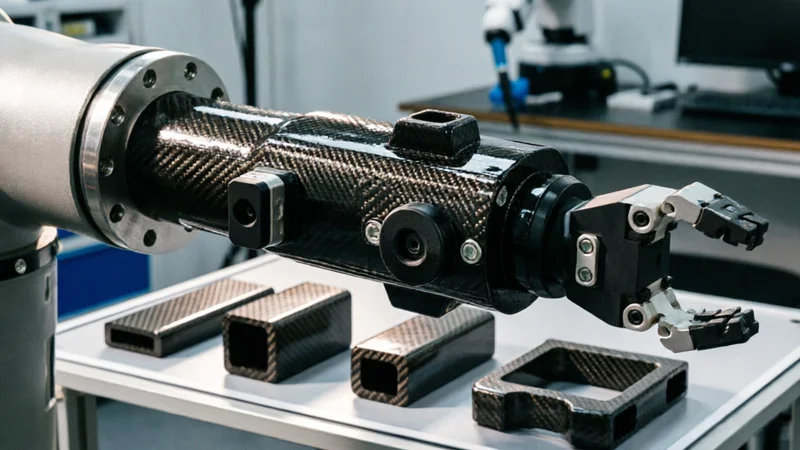
Custom-shaped carbon fiber end effector links for robotic arms. Designed for automation integrators and research labs requiring lightweight, rigid connections between the robot wrist and gripper/tool. Can incorporate sensor mounting bosses, cable routing channels, and quick-change interfaces.

Custom Carbon Fiber Musical Instrument Parts
Carbon fiber components for musical instrument manufacturing offering superior dimensional stability, low weight, and consistent acoustic properties. We produce carbon fiber bows, guitar necks, violin chin rests, drum shells, and wind instrument bodies. Carbon fiber instruments are immune to humidity changes and temperature fluctuations that affect wooden instruments.

Carbon Fiber Tablet Case — Ultra-Light Protective Shell
Lightweight carbon fiber protective case for tablets and iPads. Molded from T700 3K prepreg with reinforced corner protection. Adds minimal weight while providing superior rigidity and drop protection compared to polycarbonate or silicone cases. Ideal for field workers, enterprise deployments, and professionals requiring durable tablet protection.