
A custom carbon fiber shop provides end-to-end services for parts that cannot be sourced from standard catalog products. Whether the project is a racing component, an industrial cover, a medical device housing, or an automotive interior trim, a custom carbon fiber shop combines material expertise, t
Introduction
A custom carbon fiber shop provides end-to-end services for parts that cannot be sourced from standard catalog products. Whether the project is a racing component, an industrial cover, a medical device housing, or an automotive interior trim, a custom carbon fiber shop combines material expertise, tooling capability, and manufacturing processes to turn geometry into finished parts. The value of such a service lies in consolidating the entire workflow — design review, prototyping, tooling, molding, finishing, and quality control — under one accountable supplier.
For engineers and purchasing teams, the challenge is selecting a custom carbon fiber shop that can support both early-stage development and later volume ramp. A shop that only prototypes will leave the project stranded at low volumes, while a shop that only runs high-volume molding may be unwilling to handle the iteration required in development. This article outlines the service scope, the prototype-to-production workflow, the process options available, and the cost and quality considerations buyers should understand before engaging a custom composite shop.
What a Custom Carbon Fiber Shop Offers
The service portfolio of a typical custom carbon fiber shop spans six capability areas:
- Design support and DFM review: Engineers analyze part geometry, ply orientation, draft angles, and wall thickness to ensure the design is manufacturable in carbon fiber before tooling begins.
- Prototyping: Single-piece and small-batch parts produced by hand layup, vacuum bagging, or 3D-printed tooling to validate fit, function, and appearance.
- Tooling and mold making: Fabrication of composite, aluminum, or CNC-machined molds with controlled surface finish for repeatable part quality.
- Production molding: Compression molding, resin transfer molding, or bladder molding for serial volumes from tens to tens of thousands of parts per year.
- Post-processing and finishing: CNC trimming, edge sealing, clear coating, painting, and assembly of inserts or hardware.
- Testing and certification: Mechanical testing, material certification, and documentation for industries with compliance requirements.
Buyers should map their project stage to the services offered. Early-stage projects benefit most from a shop with strong prototyping and DFM capability, while established products need consistent serial production and quality systems. During DFM review, the shop should flag features that are difficult to mold — sharp internal corners, zero draft angles, or excessive thickness variation — and propose changes that reduce cost without compromising function.
Custom Carbon Fiber Shop Workflow: From Prototype to Production
A disciplined custom carbon fiber shop follows a structured workflow that de-risks the transition from prototype to mass production. The typical sequence is:
- Specification review: Define loads, environment, weight targets, surface finish, and volume. These inputs determine fiber grade, resin system, and process.
- DFM and simulation: Assess ply schedule, draft, and tooling strategy. Finite element analysis may be used for structural parts.
- Prototype build: Produce representative parts, usually 1-5 units, using flexible tooling. Iterate on fit and appearance with the customer.
- Production tooling: Commit to production molds once the design is frozen, amortizing tooling cost across the forecast volume.
- Process validation: Run first articles, verify dimensional tolerances and mechanical properties, and lock the process parameters.
- Serial production and QC: Produce to schedule with in-process inspection, final QA, and lot traceability.
Many shops also provide a formal gate review after prototype acceptance, where both parties approve the design, cost estimate, and production schedule before tooling capital is committed.
This sequence protects both parties: the customer validates the design at low cost, and the shop commits capital to tooling only after the design is confirmed. Shops that skip prototype validation and move straight to production tooling expose buyers to expensive rework.
Manufacturing Processes Used in a Custom Composite Shop
Process selection determines cost, cycle time, and part quality. The table below compares the processes most commonly offered by custom carbon fiber shops:
| Process | Best For | Typical Lead Time | Volume Range |
|---|---|---|---|
| Hand layup + vacuum bag | Prototypes, one-off parts, large panels | 1-2 weeks per iteration | 1-50 parts/year |
| Resin transfer molding (RTM) | Structural parts, good surfaces, moderate volume | 2-4 weeks for tooling | 50-5,000 parts/year |
| Compression molding | Automotive and consumer parts, fast cycles | 3-6 weeks for tooling | 1,000-50,000 parts/year |
| Filament winding | Tubes, shafts, pressure vessels | 1-3 weeks per run | 100-10,000 parts/year |
| Bladder molding | Hollow parts, bicycle frames, ducting | 3-5 weeks for tooling | 100-5,000 parts/year |
For custom CFRP fabrication, hand layup dominates prototyping because tooling cost is minimal, while compression molding and RTM become economical once volumes exceed several hundred parts per year. Buyers should ask the shop to recommend a process based on their volume forecast rather than accept the shop's most profitable default.
Quality Assurance for Custom CFRP Fabrication
Quality control in a custom carbon fiber shop covers both process and product. In-process controls include resin mixing verification, ply orientation checks, cure cycle monitoring with temperature and pressure logs, and visual inspection at defined stages. Finished-part verification typically includes dimensional inspection against the CAD model, surface finish assessment, and, for structural parts, mechanical testing of test coupons from the same production run.
Documentation matters for regulated industries. Shops serving automotive, aerospace, or medical customers should provide material certificates, cure records, and inspection reports per batch. Buyers should also verify that the shop's quality system covers traceability — the ability to trace any production part back to its material lots and process records supports both warranty claims and failure analysis. For cosmetic parts, appearance criteria such as visible-weave uniformity and pin-hole limits should be agreed in writing before serial production begins.
Pricing, Lead Times, and Bespoke Carbon Fiber Parts
Pricing for bespoke carbon fiber parts follows a predictable structure. Prototyping is charged at engineering rates with low tooling cost, typically $500-3,000 per iteration depending on part size and complexity. Production pricing depends on process, volume, and fiber grade: a compression-molded automotive part may cost $50-200 per unit at 5,000 parts per year, while a hand-laid aerospace prototype can cost ten times more per unit.
Lead times are driven by tooling. Simple molds take 1-2 weeks; production-quality molds with heated platens and matched surfaces take 3-6 weeks. Buyers planning for mass production should initiate tooling development early, because the tooling lead time often exceeds the prototype iteration time. A reliable shop provides a written schedule covering tooling, first articles, and production ramp, with clear milestones for approval.
Frequently Asked Questions
What is the typical lead time for a custom carbon fiber shop project?
Prototypes typically take 1-2 weeks per iteration with flexible tooling. Production tooling adds 3-6 weeks depending on mold complexity, and first articles follow tooling acceptance. A complete prototype-to-mass-production program usually spans 8-16 weeks from design freeze to the start of serial production.
How much does it cost to develop a custom carbon fiber part?
Development cost combines prototype iterations, tooling, and testing. Prototypes typically cost $500-3,000 per iteration. Production tooling ranges from a few thousand dollars for simple molds to tens of thousands for matched-metal tooling. Request an itemized quote separating engineering, tooling, prototypes, and unit pricing before committing.
Can a custom carbon fiber shop handle both prototypes and mass production?
Many shops offer both, but capability varies. Confirm that the shop has production-grade processes such as compression molding or RTM, not just hand layup, and that its quality system supports serial production with batch traceability. Ask for references from projects that successfully transitioned from prototype to volume production.
Conclusion
Engaging a custom carbon fiber shop with a structured prototype-to-production workflow reduces development risk, controls cost, and shortens time to market. Buyers should evaluate the shop's service scope, process capabilities, quality systems, and pricing transparency before committing, and should insist on a written roadmap covering tooling, first articles, and production ramp.
YongXian provides custom carbon fiber components and reinforcement materials, from prototype support to serial production. Explore our carbon fiber product range or contact our engineering team to discuss your custom composite project requirements.
Part of topic
Related Articles
- Custom Carbon Fiber Fabrication: One-Stop Service from Design to Delivery
- Carbon Fiber Near Me Suppliers: Global Local Supplier Directory for Quick Procurement
- Carbon Fiber High-Speed Train Brake Discs: Thermal Stability and Wear Resistance
- Carbon Fiber Composite Rebar for Corrosive Environments: Marine and Chemical Plant Applications
- Carbon Fiber Helicopter Rotor Blade Spar Design: Fatigue Life and Erosion Protection
- Carbon Fiber Automotive Side Panels: High-Gloss Class-A Surface Finish for Premium Vehicles
Interested in Our Products?
Contact our team for competitive pricing and technical specifications.
Get a QuoteRelated Products

Carbon Fiber Plate — 3K Twill T700 1.5mm
Thin 1.5mm carbon fiber plate with 3K twill weave surface. Lightweight and stiff, commonly used for covers, panels, drone bodies, and applications requiring a premium aesthetic appearance.

Carbon Fiber Plate — 3K Twill T700 3.0mm
Medium-thickness 3.0mm carbon fiber plate offering significantly higher load capacity while maintaining attractive 3K twill finish. Suitable for structural brackets, reinforcement plates, and load-bearing panels.

Square Carbon Fiber Tube — 3K Twill T700
Square cross-section carbon fiber tube manufactured with 3K twill weave for torsional strength. Preferred for structural frames, trusses, and support columns where rectangular geometry offers design flexibility.
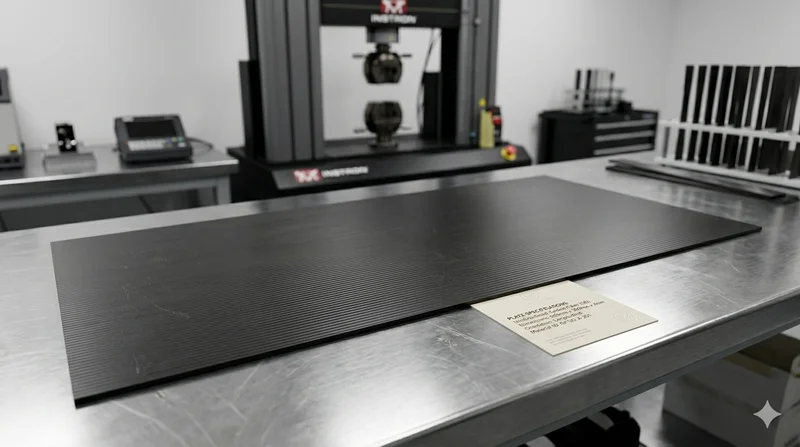
Carbon Fiber Plate — UD Unidirectional T700
Unidirectional carbon fiber plate with all fibers oriented in a single direction for maximum strength along the fiber axis. Essential for structural reinforcements, splints, and applications where load direction is predictable.
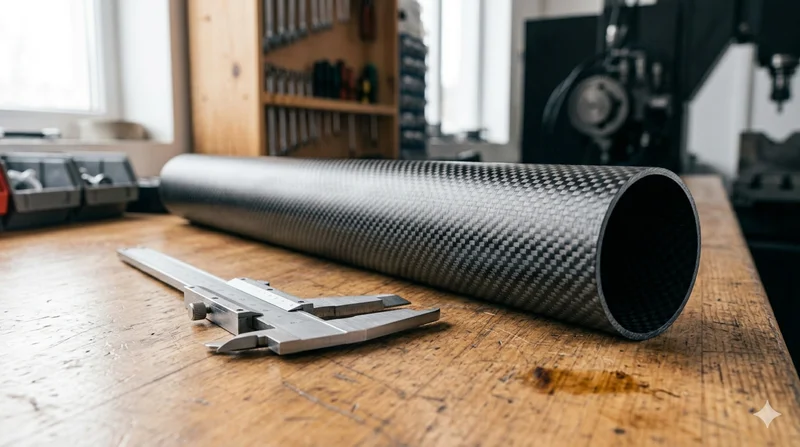
Round Carbon Fiber Tube — 3K Plain Weave T700
Standard round carbon fiber tube manufactured from Toray T700 grade fiber with 3K plain weave. Offers balanced strength and stiffness for general industrial applications including robotics, automation, sports equipment, and aerospace structures.