
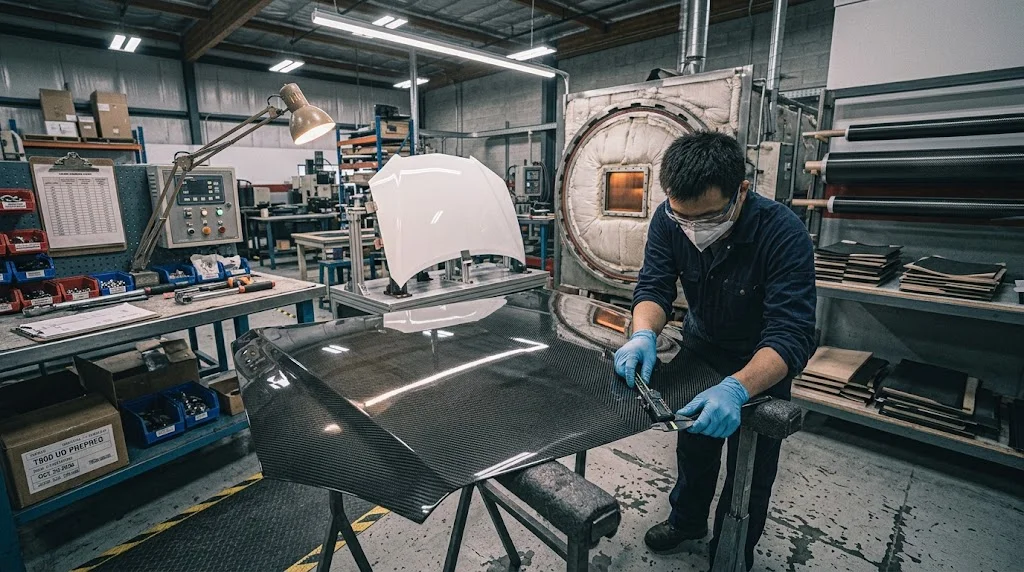
Custom carbon fiber parts for cars have split into two very different markets: cosmetic trim that anyone can bolt on, and panels that change how the car behaves. A full carbon hood replaces a 22-24 kg steel panel with an 8-9 kg laminate, a carbon roof drops 12-15 kg from the highest point of the car
Introduction
Custom carbon fiber parts for cars have split into two very different markets: cosmetic trim that anyone can bolt on, and panels that change how the car behaves. A full carbon hood replaces a 22-24 kg steel panel with an 8-9 kg laminate, a carbon roof drops 12-15 kg from the highest point of the car, and even a set of mirror caps removes half a kilogram where the eye notices it first. The figures in this guide come from small-batch production, not brochure claims.
This article walks the practical side of ordering custom carbon fiber parts for cars: which parts earn their price, how a one-off request becomes a cured part, what separates a decorative fabricator from a real custom carbon fiber parts manufacturer, and how to compare carbon fiber custom parts near me against a direct factory order.
Custom Carbon Fiber Parts for Cars: Where the Weight Goes
The strongest case for carbon is mass held high and far from the centerline. Every kilogram removed from the roof line lowers the roll center of gravity and reduces body roll in transient maneuvers, which is why roof and hood replacements outperform the same weight saved under the floor.
| Part | OEM weight | Carbon weight | Saved | Typical price (small batch) |
|---|---|---|---|---|
| Hood (steel to carbon) | 23 kg | 8.5 kg | 14.5 kg | $950-1800 |
| Roof panel | 19 kg | 6.8 kg | 12.2 kg | $1200-2400 |
| Boot lid | 14 kg | 5.6 kg | 8.4 kg | $780-1500 |
| Mirror caps (pair) | 0.9 kg | 0.4 kg | 0.5 kg | $120-260 |
| Front splitter | 2.4 kg | 0.9 kg | 1.5 kg | $320-650 |
| Interior trim set | 3.1 kg | 1.2 kg | 1.9 kg | $420-900 |
Panel stiffness matters as much as mass. A 1.6 mm twill laminate is roughly 20 times stiffer in bending than a 0.7 mm steel skin of equal weight, so a carbon hood stops oil-canning over bumps and a roof panel quiets wind flutter at motorway speed.
From Trim to Structural: What Is Worth Ordering
Not every part deserves carbon. The economics favor parts that are large, visually dominant or load-bearing in a simple way; everything else either saves too little or demands an engineering file you will not get from a cosmetic shop.
- Easy wins: mirror caps, vent surrounds, mirror housings and interior bezels — low load, high visibility, and small enough to ship. Tooling cost is minimal, so single pieces make sense.
- Panel replacements: hood, roof, boot lid and doors need a fit fixture and repeatable tooling, because a 3 mm growth in the mold shows as a panel gap you cannot shim out.
- Aero parts: splitters, diffusers and wings put load into the crash structure and bumper beam; specify the mounting hardware and load rating, not just the weave.
- Structural parts: suspension arms, roll cages and engine mounts need a laminate schedule, ply orientation and load calculations from a qualified engineer — treat any shop that offers them without paperwork as a red flag.
How a One-Off Request Becomes a Cured Part
Reputable manufacturers do not start with fabric; they start with your mounting faces. A predictable order flow looks like this:
- Reference capture: the OEM panel or the car itself is 3D scanned, so bolt holes and datum faces come from geometry rather than guesswork.
- Plug and mold: a master plug is machined, corrected for paint thickness, then laminated into a female mold — this tooling is what you pay for on the first part.
- Layup and cure: prepreg plies are oriented 0/90 with a ±45 skin pair, vacuum-bagged at 0.08-0.1 MPa and cured at 80-120 °C, then trimmed on a CNC router with a backing board.
- Finish and fit check: UV-clear topcoat over the weave, then a trial fit on the customer's car or a fit-check fixture before the batch ships.
Ask how the shop derives the mounting faces. If the answer is that they copy the old panel by hand, expect shims at assembly; if they scan and compensate for mold shrinkage, you are dealing with a process that repeats.
How to Choose a Custom Carbon Fiber Parts Manufacturer
A custom carbon fiber parts manufacturer for automotive work should answer four questions before you send money. First, do they publish a laminate schedule — ply count, orientation and resin system — for structural parts? Second, do they keep cure records with temperature and vacuum traces for each batch? Third, can they hold Class A surface quality with aligned weave across matching panels? Fourth, are they set up for automotive quality systems such as IATF 16949 or at least PPAP-style documentation for series parts? A shop that answers only with photos is selling appearance, not process.
Carbon Fiber Custom Parts Near Me or a Direct Factory Order?
Buying carbon fiber custom parts near me has real advantages: you can inspect samples in person, fit-check on the actual car, and get a replacement in days instead of weeks. Local fabricators, however, usually work by hand layup without an autoclave, which suits trim pieces but leaves void content higher on large panels. A direct factory order in China or Eastern Europe brings prepreg and autoclave curing, tooling amortized over batches, and unit prices 30-50 percent lower — but you pay mold cost on the first article, wait 4-6 weeks, and cannot check the part before it ships. A sensible split: prototype locally, produce the batch at the factory, and keep the fit fixture as your quality gate.
Frequently Asked Questions
How much do custom carbon fiber parts for cars cost per piece?
Mirror caps run $120-260 per pair, interior trim sets $420-900, splitters $320-650, and hoods or roofs $780-2400 depending on tooling. The first piece of any new part carries the mold cost, so unit price drops noticeably from the second piece onward.
Are carbon fiber hoods legal and safe for street use?
Yes when they keep the original latch, safety catch and crumple behavior; many regions require the hood to retain factory secondary catches. Ask the manufacturer for impact and hinge load data if you track the car, and never fit a hood that lacks a secondary safety catch.
How long does a custom order take?
Two to five weeks is typical: a few days for scanning, a week for plug and mold work, then layup, cure, finish and fit check. Peak season and weave-matching across panels add time, and a full four-piece set often ships in one lot so the weave direction matches.
Conclusion
Good custom carbon fiber parts for cars come from process, not from fabric choice: scanned mounting faces, controlled layup and cure, aligned weave, and a fit check on the real vehicle. Start with the parts that earn their keep — roof, hood, mirror caps — and let the manufacturer prove its tooling on one piece before committing to a full set.
YongXian manufactures carbon fiber sheet, tube, rod and cut-to-size blanks, and builds small-batch custom parts to customer drawings for automotive programs. Browse our carbon fiber range or contact our engineering team with your part drawings and annual volume.
Part of topic
Related Articles
- Custom Carbon Fiber Rod Grips: Fishing Rods, Tool Handles, and Ordering Specs
- Carbon Fiber Fishing Rods: Blank Types, Actions, and Buying Checks
- Custom Carbon Fiber Parts for Motorcycle Builds: Fit, Finish and Sourcing
- Carbon Fiber Robot Arms: Lightweight Design Tradeoffs
- Carbon Fiber License Plate Custom Guide: Frames That Fit and Last
- Building Carbon Fiber Drone Frames: Layout and Fastening
Interested in Our Products?
Contact our team for competitive pricing and technical specifications.
Get a QuoteRelated Products

Round Carbon Fiber Tube — 3K Plain Weave T700
Standard round carbon fiber tube manufactured from Toray T700 grade fiber with 3K plain weave. Offers balanced strength and stiffness for general industrial applications including robotics, automation, sports equipment, and aerospace structures.

Square Carbon Fiber Tube — 3K Twill T700
Square cross-section carbon fiber tube manufactured with 3K twill weave for torsional strength. Preferred for structural frames, trusses, and support columns where rectangular geometry offers design flexibility.

Round Carbon Fiber Tube — 3K Twill
Lightweight and ultra-stiff round tubes ideal for drone frames, robotics, and structural applications.

Round Carbon Fiber Tube — UD Unidirectional T700
Unidirectional (UD) round tube with all fibers aligned axially for maximum longitudinal stiffness. Ideal for applications requiring high bending rigidity with minimal weight, such as shafts, struts, and structural reinforcements.

Carbon Fiber Plate — 3K Twill T700 3.0mm
Medium-thickness 3.0mm carbon fiber plate offering significantly higher load capacity while maintaining attractive 3K twill finish. Suitable for structural brackets, reinforcement plates, and load-bearing panels.