
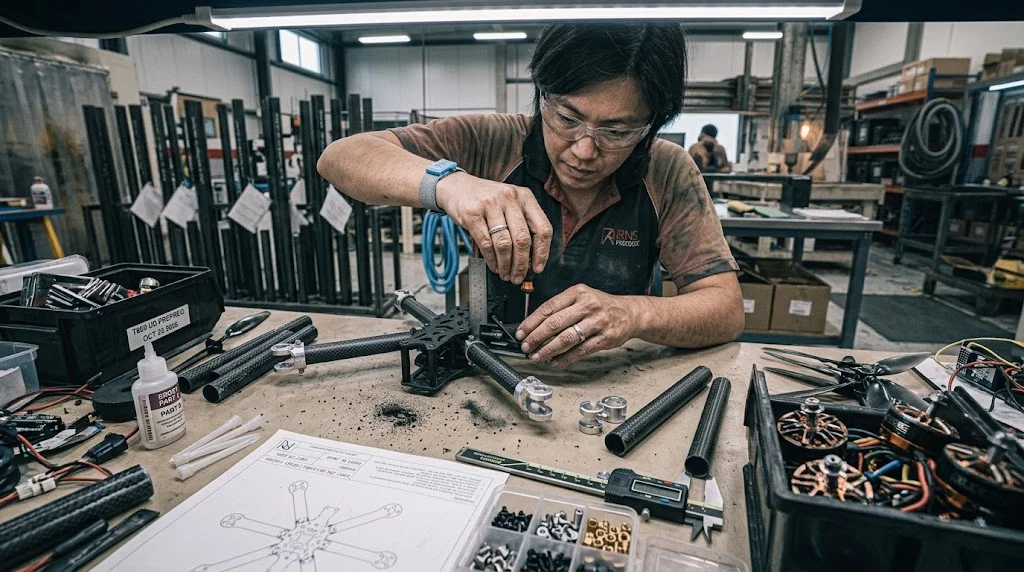
Carbon fiber drone frames are the structural backbone of every multirotor and fixed-wing UAV that must lift payload, survive hard landings, and keep flight controllers vibration-free. A well-built carbon fiber drone chassis does three jobs at once: it holds motors in precise alignment, it isolates t
Introduction
Carbon fiber drone frames are the structural backbone of every multirotor and fixed-wing UAV that must lift payload, survive hard landings, and keep flight controllers vibration-free. A well-built carbon fiber drone chassis does three jobs at once: it holds motors in precise alignment, it isolates the flight controller from frame resonance, and it absorbs crash energy without shattering. The difference between a frame that flies for hundreds of hours and one that cracks on the third flight usually comes down to layout geometry, tube-versus-plate choices, and how every joint is fastened.
This article walks through the real engineering of carbon fiber drone frames: which layout architectures suit which missions, how plate and tube sections combine into a stiff chassis, how to fasten carbon without destroying it, and how to evaluate the best carbon fiber drone frame on the market against your own payload and endurance targets.
Carbon Fiber Drone Frames: Layout Architectures Compared
The layout of a multirotor frame is not cosmetic — it sets the moment arms the arms must resist, the vibration modes the flight controller will see, and how crash loads spread through the structure. The three dominant architectures each suit a different mission profile:
- Flat plate X-frame: Two crossed plates form the center body, with arms bolted or bonded at 45°. Simple to cut from a single sheet, easy to repair, but stiffness depends heavily on plate thickness and joint quality — best for 250-450 mm class drones with modest payloads.
- Tube-arm frame: Round carbon fiber tube arms cantilever from a compact center plate or hub. Tube sections resist bending efficiently in every direction and save weight, making them the standard for 500-1,000 mm class drones and heavy-lift platforms. The joint between tube and center is the critical failure point.
- Sandwich truss frame: Carbon plates form the outer faces of a sandwich with aluminum or foam core, or tubular trusses connect plate nodes. Maximum stiffness per gram for large agricultural and survey drones, at the cost of more complex fabrication and inspection.
For the majority of builders, the tube-arm frame with a flat center plate gives the best stiffness-to-weight and the most forgiving crash behavior: a bent tube arm can be replaced for a few dollars, while a cracked center plate grounds the aircraft until it is remade.
Carbon Fiber Drone Chassis: Sizing Plate and Tube Sections
Sizing a carbon fiber drone chassis starts from motor thrust and arm length, not from a catalog. Motor static thrust sets the bending moment at the root of each arm; arm length sets the moment arm; the section must carry the moment with a safety factor of at least 1.5, plus vibration margin. The table below gives working bands for common classes:
| Drone class | Arm length | Arm section | Center plate | Notes |
|---|---|---|---|---|
| Racing / freestyle 5" | 120-150 mm | 5 mm plate arms or 6-8 mm tubes | 2-3 mm plate | Impact duty dominates; replaceable arms |
| Mapping / inspection 10-12" | 180-250 mm | 10-12 mm tubes, 1.0-1.2 mm wall | 3 mm plate | Vibration isolation for camera gimbal |
| Agricultural spray 15-16" | 280-400 mm | 16-20 mm tubes, 1.5-2.0 mm wall | 4-5 mm plate or sandwich | Lifting moment and tank slosh loads |
| Heavy-lift multirotor | 400-800 mm | 20-30 mm tubes, 2.0-3.0 mm wall | 6-8 mm plate with doubler | Torque from large props; redundancy |
Carbon fiber tube for drone arms is almost always round: a circular section resists bending equally in every plane, tolerates motor torque in any direction, and takes standard tube clamps. Square tube saves a little in flat stacking but concentrates stress at the corners — a crack initiator in crash loads. Wall thickness matters more than outer diameter for stiffness per gram: stepping diameter up and wall down stiffens the arm faster than adding wall at a small diameter, but never go below 0.8 mm on a flight-critical arm — handling damage and clamp crush set that floor.
Fastening Carbon Fiber Frames: Joints, Inserts, and Adhesives
Carbon fiber is strong in-plane and weak through-thickness, so every fastener, clamp, and bonded joint must spread load rather than concentrate it. The joint that fails is almost never the tube itself — it is the fastening detail. Four techniques cover most carbon fiber drone frame joints:
- Bonded clevis with load spread: Epoxy-bonded aluminum or carbon clevises with a long bond length (at least 2× diameter) spread clamp load over a large tube area. Sand the tube inside the bond zone and wipe with alcohol; fill the gap with thickened epoxy rather than relying on a slip fit.
- Threaded inserts: Aluminum or steel threaded inserts bonded into tube ends give removable mounting points without threading carbon directly. Carbon threads strip on the second removal; inserts carry the thread duty.
- Tube clamps with cushion: For replaceable arms, use clamps with a silicone or rubber cushion between clamp and tube; torque to spec and re-check after the first flight. Dry carbon clamps crush the wall and leave a permanent stress riser.
- Through-bolts with spreader plates: Where a bolt must pass through plate, back it with a spreader plate or large washer on the far side so bearing stress stays under the compressive strength of the laminate.
Whatever the joint, the rule is the same: never let a point load bear on bare carbon. Every gram of adhesive or insert weight adds stiffness the frame keeps for its whole service life.
Frequently Asked Questions
Are carbon fiber drone frames worth it over aluminum?
For most multirotor classes, yes — carbon fiber drone frames cut airframe weight 20-40% versus aluminum at equal stiffness, which converts directly into flight time or payload capacity. Aluminum frames do survive some crash modes better (they bend instead of shattering) and are easier to field-repair with rivets, but the weight penalty compounds on every flight. Hybrid frames that use carbon tubes with aluminum motor mounts often give the best of both.
What wall thickness should a carbon fiber tube for drone arms have?
Between 0.8 and 1.2 mm covers most mapping and inspection drones; agricultural and heavy-lift classes step up to 1.5-3.0 mm where clamp crush and bending moments both rise. The binding constraint is usually the mount, not the bending stress: a clamp that nearly breaches a thin wall will not hold torque after vibration cycles, and a screw that nearly exits the wall will not hold threads. Confirm the inside diameter against your inserts and hardware before ordering.
How do I choose the best carbon fiber drone frame for my payload?
Start from all-up weight including payload, then motor static thrust (aim for at least 2:1 thrust-to-weight), then arm length required for prop clearance. Check that the center plate thickness and arm tube wall in the sizing table above support the bending moment with margin, and that the frame offers replaceable arms if your mission includes high crash risk. Finally, verify vibration isolation: a frame that transmits motor harmonics to the flight controller will cost you more in degraded gyro noise than any weight you saved.
Conclusion
Carbon fiber drone frames win on stiffness, weight, and vibration control when layout, section sizing, and fastening are done deliberately: tube arms from a solid center plate for most missions, joints that spread load instead of concentrating it, and inserts wherever a screw will ever be removed twice. The best carbon fiber drone frame is the one engineered for your payload and crash exposure, not the lightest one on the spec sheet.
YongXian supplies carbon fiber tubes, plates and custom-cut components for UAV and drone chassis programs. Browse our carbon fiber tube range or send us your frame specifications and we will help match sections and wall thicknesses to your load cases.
Part of topic
Related Articles
- Carbon Fiber Robot Arms: Lightweight Design Tradeoffs
- Carbon Fiber License Plate Custom Guide: Frames That Fit and Last
- Carbon Fiber Tube for Drone Frames: Sizing and Wall Selection
- Carbon Fiber Plates for Running Shoes: How They Work
- Carbon Fiber Plate for Foot Orthotics: Design and Materials
- Carbon Fiber Drone: When Composite Airframes Make Sense
Interested in Our Products?
Contact our team for competitive pricing and technical specifications.
Get a QuoteRelated Products

Round Carbon Fiber Tube — 3K Plain Weave T700
Standard round carbon fiber tube manufactured from Toray T700 grade fiber with 3K plain weave. Offers balanced strength and stiffness for general industrial applications including robotics, automation, sports equipment, and aerospace structures.

Square Carbon Fiber Tube — 3K Twill T700
Square cross-section carbon fiber tube manufactured with 3K twill weave for torsional strength. Preferred for structural frames, trusses, and support columns where rectangular geometry offers design flexibility.

Round Carbon Fiber Tube — 3K Twill
Lightweight and ultra-stiff round tubes ideal for drone frames, robotics, and structural applications.

Round Carbon Fiber Tube — UD Unidirectional T700
Unidirectional (UD) round tube with all fibers aligned axially for maximum longitudinal stiffness. Ideal for applications requiring high bending rigidity with minimal weight, such as shafts, struts, and structural reinforcements.

Carbon Fiber Plate — 3K Twill T700 3.0mm
Medium-thickness 3.0mm carbon fiber plate offering significantly higher load capacity while maintaining attractive 3K twill finish. Suitable for structural brackets, reinforcement plates, and load-bearing panels.