
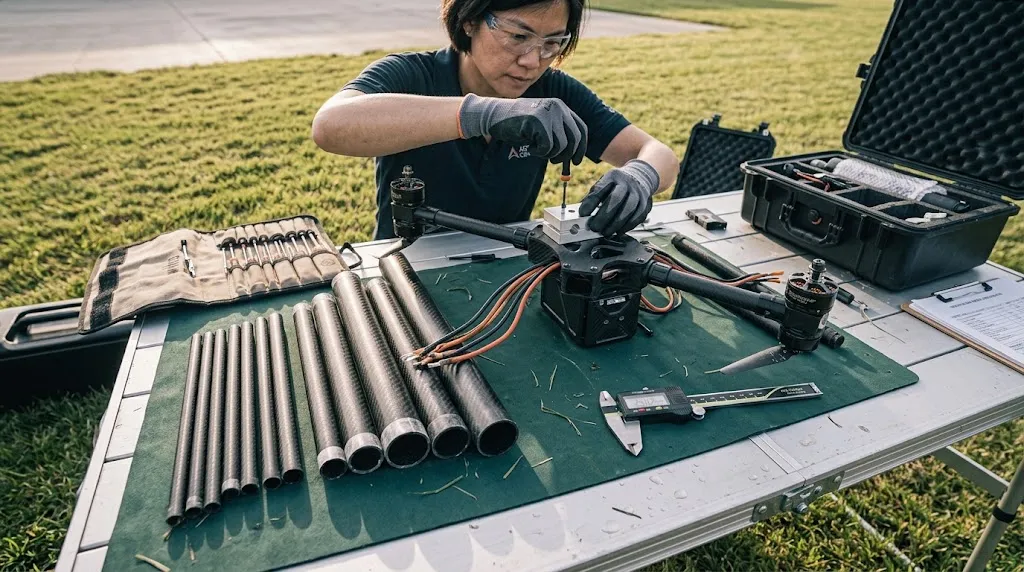
The carbon fiber tube for drone arms is the single most leverage-rich part on a multirotor: it sets arm stiffness, resonant frequency and a large share of frame weight, while also acting as the conduit for motor wiring and the fuse that fails in a crash — ideally in a replaceable, cheap way. Choosin
Introduction
The carbon fiber tube for drone arms is the single most leverage-rich part on a multirotor: it sets arm stiffness, resonant frequency and a large share of frame weight, while also acting as the conduit for motor wiring and the fuse that fails in a crash — ideally in a replaceable, cheap way. Choosing tubes by outer diameter alone is the most common build error; what matters is the section's second moment of area, which is driven by both diameter and wall thickness. This guide covers how to size a carbon fiber tube for drone frames and arms: diameter and wall tables with real stiffness numbers, roll-wrapped versus pultruded layups, surface finish for grip and glue, joining methods that survive vibration, and the same logic applied when the tube must also serve as a carbon fiber tube for RC plane structures.
Sizing a Carbon Fiber Tube for Drone Arms: Diameter and Length
Arm tubes on consumer and prosumer quadcopters cluster around a few diameters, and the diameter choice interacts directly with motor stator size and prop clearance:
- 16–19 mm tubes: 250–330 mm class frames with 22xx/23xx motors. Light and cheap; flex dominates on heavier payloads.
- 22–25 mm tubes: the workhorse band for 5-inch and 7-inch builds; a 4mm carbon fiber drone frame spec usually refers to plate thickness in the center hub, while arms stay tubular for mass efficiency.
- 25–30 mm tubes: heavy-lift and cinema platforms, 25–30 kg takeoff, where arm stiffness under asymmetric thrust matters more than a few grams.
- Length: measure motor-center to hub-edge, add 10–15 mm for the joint sleeve, and keep the tube end at least 25 mm inside any bonded socket — short bond lines crack first.
Check clearance before committing: prop radius plus motor bell must pass the tube at maximum tilt, and the tube should not sit in the prop wash more than necessary, since shrouded or high-mounted arms shed less thrust.
Wall Selection for a Carbon Fiber Tube for Drone Arms: Grams vs Stiffness
Stiffness of a thin-walled tube scales with the cube of diameter and roughly linearly with wall thickness, while mass scales linearly with wall area. That trade produces a clear table for a carbon fiber tube for drone use at a fixed 250 mm arm length:
| OD × Wall | Mass per 250 mm | Bending Stiffness (EI, approx.) | Typical Use |
|---|---|---|---|
| 16 × 1.0 mm | 18 g | 0.35 × 10⁶ N·mm² | Light 5" freestyle |
| 22 × 1.5 mm | 39 g | 1.3 × 10⁶ N·mm² | 5" race, 7" cruiser |
| 25 × 2.0 mm | 66 g | 2.5 × 10⁶ N·mm² | Heavy 7", light lift |
| 30 × 2.5 mm | 113 g | 5.0 × 10⁶ N·mm² | Cinema / heavy lift |
Layup choices matter as much as dimensions. Roll-wrapped tubes — prepreg rolled onto a mandrel and cured — give the best strength-to-weight and a smooth ID for press fits; pultruded tubes are cheaper but fiber runs only axially, so hoop strength and split resistance are poor, which is a real risk in a crash. For arms, specify roll-wrapped with a woven or twill outer finish: the weave adds hoop plies, resists point loads from zip-ties and clamps, and hides handling marks. Quasi-isotropic schedules (0/±45/90) are worth the small premium on arms that carry gimbaled cameras, where torsional stiffness under yaw torque is felt in the footage.
Joining and Mounting on Carbon Fiber Drone Frames
Tubes fail at joints before they fail in mid-span, so the interface deserves more attention than the tube itself:
- Adhesive sockets: aluminum or CF forks bonded with toughened epoxy, 0.1–0.15 mm bondline, abraded and wiped with solvent first. Overlap at least 1.5× OD.
- Clamp blocks: machine flat spots or use molded saddles; round-tube clamps on glossy finish slip under vibration unless the contact patch is knurled or taped with silicone tape.
- Sleeves at the hub: a short CF or aluminum sleeve at the root raises strain capacity where bending moment peaks; this is the cheapest crash-survivability upgrade on a carbon fiber drone frame.
- Wire routing: run motor wires inside the tube with foam end plugs to stop chafing; never drill through the bending zone — a hole in the tension face cuts fatigue life drastically.
After assembly, check arm resonance with a simple phone spectrum app at idle throttle; a first mode below roughly 45 Hz invites control-loop oscillation, and the fix is usually a stiffer wall or a root sleeve rather than heavier motors.
Versatility: From Drones to RC Planes
The same tubes cross over to fixed-wing projects: a carbon fiber tube for RC plane wing spars, pushrods and fuselage booms follows the identical selection logic — bending stiffness for the span, torsional stiffness for the spar, and wall thickness thin enough not to starve the airfoil. Common crossovers: 8–12 mm tubes as wing tubes on 1.5 m park flyers, 20–25 mm as tail booms on twin-boom UAVs, and thin-wall 6 mm tubes as pushrod guides. Buy practice advice: keep two spare arm tubes in the exact spec on the shelf, order tubes cut to length with ends faced square, and document your spec on the frame build sheet so a replacement order is a one-line email.
Frequently Asked Questions
What diameter carbon fiber tube should I use for drone arms?
Match the tube to motor class and all-up weight: 16–19 mm for 250–330 mm quads with 22xx motors, 22–25 mm for 5- and 7-inch builds, 25–30 mm for lift platforms over 10 kg. Then verify with stiffness rather than the catalog label — two tubes of the same OD with different walls behave very differently, and wall thickness is usually the cheaper lever than diameter.
Is a thicker wall always better?
No. Thicker wall adds stiffness linearly but also adds rotating mass at the arm end, which the motors must accelerate every throttle change, hurting response and efficiency. Size for the lowest mass that keeps the first arm mode comfortably above your control-loop demands; only go thicker if a resonance test or payload change shows you are short.
Roll-wrapped or pultruded tube for a drone frame?
Roll-wrapped, almost always. Pultruded tubes are axially strong and cheap but lack hoop fibers, so they split along the length under clamp pressure and in crashes. Reserve pultruded stock for non-critical parts like wire conduits or antenna booms where the load path is purely axial.
How do I attach arms to a carbon fiber drone frame without cracking the tube?
Avoid point loads and bending at the fastener. Use a bonded fork or a saddle clamp with a sleeve, tighten to a defined torque with a soft interface layer, and keep bolt holes out of the tube's tension zone — ideally the fasteners pass through the sleeve, not the tube wall. Inspect bond lines and clamp edges after every hard landing; hairline cracks at the root are a reason to retire the arm, not to re-torque.
Conclusion
Choosing a carbon fiber tube for drone arms is an exercise in second moments of area, layup quality and joint design — not in diameter shopping. Fix the arm length and motor class, pick a roll-wrapped tube whose EI lands where you need it, protect the root with a sleeve, and verify resonance on the assembled frame. Done this way, the tube delivers the stiffness that keeps the control loop clean at the lowest mass the crash budget allows.
YongXian manufactures roll-wrapped carbon fiber tubes in standard and custom diameters, cut to length for drone, UAV and RC builds. Browse our carbon fiber tube range or contact our engineering team with your diameter, wall and length for a quote.
Part of topic
Related Articles
- Carbon Fiber Plates for Running Shoes: How They Work
- Carbon Fiber Plate for Foot Orthotics: Design and Materials
- Carbon Fiber Drone: When Composite Airframes Make Sense
- Carbon Fiber Tubes for RC Planes: Spars, Booms and Frame Components
- Carbon Fiber Rod Fishing: Blank Grades and Action Curves Explained
- Carbon Fiber Tube Protector: Edge Guards and Damage Prevention
Interested in Our Products?
Contact our team for competitive pricing and technical specifications.
Get a QuoteRelated Products

Round Carbon Fiber Tube — 3K Plain Weave T700
Standard round carbon fiber tube manufactured from Toray T700 grade fiber with 3K plain weave. Offers balanced strength and stiffness for general industrial applications including robotics, automation, sports equipment, and aerospace structures.

Square Carbon Fiber Tube — 3K Twill T700
Square cross-section carbon fiber tube manufactured with 3K twill weave for torsional strength. Preferred for structural frames, trusses, and support columns where rectangular geometry offers design flexibility.

Round Carbon Fiber Tube — 3K Twill
Lightweight and ultra-stiff round tubes ideal for drone frames, robotics, and structural applications.

Round Carbon Fiber Tube — UD Unidirectional T700
Unidirectional (UD) round tube with all fibers aligned axially for maximum longitudinal stiffness. Ideal for applications requiring high bending rigidity with minimal weight, such as shafts, struts, and structural reinforcements.

Carbon Fiber Plate — 3K Twill T700 3.0mm
Medium-thickness 3.0mm carbon fiber plate offering significantly higher load capacity while maintaining attractive 3K twill finish. Suitable for structural brackets, reinforcement plates, and load-bearing panels.